Thursday, March 02, 2006

But They're Just Chocolate-Covered Peanuts


Geoff is in Barcelona this week, working on a story about racism and soccer. It comes on the heels of an incident at a Barça game in Zaragoza on Saturday, when the home fans started making ape noises at the Cameroon-born player Eto’o. Unfortunately, that kind of shit has become par for the course at Spanish soccer games. One of the most amazing things that Geoff told me is that one of his sources told him that making ape noises at black players “isn’t racist.” The fans, in his view, just want to insult their opponents. And monkey noises lobbed at black players are, apparently, like any other insult.

Ah, the famous, “It’s not racism” argument. I can’t tell you how many times I’ve heard Spaniards tell me that they’re not racist. When they dress in blackface for costume parties, it’s not racist, it’s “funny.” When Conguitos (translation, “little Congolese”) a type of chocolate-covered peanut, carry a cartoon of a naked African child with thick lips and a distended belly on its label, it’s not racism, it’s “marketing.” And now, when thousands of fans make ape noises at black players—and only black players—it’s not racism, it’s just the enthusiasm of fans.

, ,

Monday, February 27, 2006

The Woodcutters' Revenge

For a little over a week now, woodcutters have been clearing a piece of land near the molino. I can't say I like them: they make a lot of noise, they tear up the already muddy paths, and, oh yes, they're cutting down a bunch of innocent trees.

So when they ill-advisedly decided to drive their big trunk-hauler down the teeny overgrown path that empties into the clearing where we park, only to find the exit blocked by our parked car, I practiced a bit of eco-terrorism on them. First, I pretended like I wasn't home and therefore unavailable to move said car. After about thirty minutes of that, I opened the door and let the by now enraged Levon out, who terrified them for about 30 seconds until he became distracted by a toy. And then I yelled at them a bit, about erosion, and our crumbling fence, and how they path was ours and they didn't have permission to drive down it. (This last bit was something of a fib, but I figured they didn't know otherwise. I was right) They yelled right back, but I felt I had made my point.

I was no more forgiving the next day when I twice found them blocking the road out of the molino; the second time I even threated to file a denuncia, which as far as I can tell, is the ultimate threat in Spain. Soon after, they were keeping to the side of the road, and scowling unhappily at me every time I drove by.

At the end of that same week, the guy from Digital +, our satellite tv provider, showed up to fix our suddenly misbehaving reception. He fiddled for a while with the box, then fiddled some more with the dish, then called me outside. "You want to know your problem?" he asked. I nodded resignedly. He pointed up to a tall patch of eucalyptus trees growing behind the house. "You gotta cut'em down."

Friday, February 24, 2006

Well, At Least She's Consistent


You may remember that several weeks ago the president of the community of Madrid, Esperanza Aguirre, suggested that the new anti-smoking law might be a little too strict. Yesterday, she did indeed sign into effect a ‘revision’ of the national ban that lets workers smoke on the balconies and in the cafeterias of their workplaces, and everybody else during wedding and baptism receptions.

The day before that, however, she decided to go one better than the government on bird flu. Although the ministers of Health and Agriculture have decided that there is no need yet to enclose Spain’s chickens (Spain has yet to find a case of avian flu, though many predict that will come any day now), Aguirre disagreed, and now all farm-raised fowl, including several dozen ostriches on a ranch north of the capital, have to be kept where wild birds can’t reach them.

Madrid’s farmers aren’t happy about the decision, but luckily for the PP, they number far fewer than the comunidad’s smokers. And this way, no one gets to say that Esperanza Aguirre doesn’t care about her citizens’ health.

, ,

Wednesday, February 22, 2006

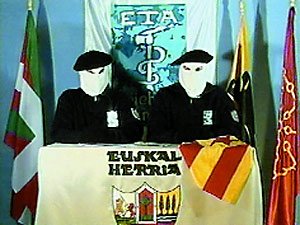
Whither ETA?


That was the slug for one of the first stories we did that wasn't about the Madrid bombings. And nearly two years later, it is still the question on everyone's mind. For the past month, rumors of an impending truce have been swirling, and Zapatero himself has said that he has information that "the beginning of the end" is near. The possibility has been driving the opposition Popular Party into a frenzy, and statements that the Socialists are "negotiating with terrorists" and conducting politics "on the backs of victims of terror" come in a daily stream.

On Saturday, ETA issued a statement in which it called for compromises, yet made no mention of the supposed truce. Many here take that as a hint that perhaps no cease fire is coming. But that hasn't stopped the hysterical rhetoric of the PP, members of which are now calling for Zapatero's resignation on the grounds that his ETA policies "have failed."

Criticizing Zapatero for a policy that supposedly has him willing to negotiate, and then criticizing him because that policy supposedly fails seems right up there with that old joke about the bad restaurant: "The food was terrible, and the portions were so small!" But calling for his resignation seems downright ridiculous. The PP were in power for 8 years during which dozens of Spaniards were killed, injured or kidnapped in ETA attacks. There has not been a single death or injury since the Socialists have been in power. For this, Zapatero should resign?

,

Monday, February 20, 2006

Another week, another utility


On Thursday we got an electric hot water heater. Actually, we got it on Wednesday, after Geoff insisted that perhaps the electrician and the plumber could stop blaming each other for his absence and actually meet at our house at the same time. They did, though when Fernando the plumber insulted Nacho the electrician´s electrical acumen, the latter left, leaving the former to install the thing.

Which of course couldn't be done in one day. Bright and early the next morning, there was garrulous Fernando and his taciturn assistant Pedro, hard at work. Several hours later, we had copper pipes where our creaky butane heater used to be, and a shiny white tank in the basement. Only problem was that it didn't work.

Seems maybe Fernando didn't know quite as much about electric water heaters as he professed. That may explain why he cornered me in the kitchen for about an hour to hold forth on how we really should have put in a gas (or gasoil, as it's called here) heater. But I thought I detected a smirk when I called Nacho back to ask for his help.

Next, the internet. Any suggestions, anybody?

Friday, February 17, 2006

Fear of flying


A new terminal opened at Madrid's Barajas airport on February 5. Architecturally, it's supposed to be quite spectacular--it was designed by Richard Rogers, the same guy who did the Pompidou Center in Paris. But I've been avoiding it--flying through it, that is--because I already find airports and check ins and security searches trying enough, and I fear this new terminal will make them more so. In the first week after it opened, the nightly news ran a regular segment on the delays, the lost baggage, the construction remains still in plain view, but those, I imagine, are just opening jitters. The real problem is accessibility--to get to the terminal on public transportation you have to get off the metro and onto a bus (from our apartment this comes after 2 changes and an hour long underground ride), and then on to another bus if your flight happens to leave from terminal TS4 rather than T4. Someday, there will be a metro stop directly at the new wing, but last I heard, the municipal and national governments were arguing about who should pay for it.

And speaking of airports, on a flight from Barcelona today, I was reminded of the rule of Spanish flying: the later in the day you fly, the more delayed your flight will be. Instead of getting some flights off on time, both Iberia and Spanair seem to let the little delays of the day pile up for all their flights. So by the time you get to a 5pm departure, like mine today, you can pretty much count on a half hour retraso. And if you happen to take the last flight of the day, as Geoff did last night, you can count on having the airport to yourself by the time you arrive.

, ,

Monday, February 13, 2006

Appearances


I spent the better part of two days last week in plastic surgeons’ offices for a story: Spain, it seems, is home to more plastic surgeons who conduct more plastic surgery, than anywhere else in Europe. It was a very strange experience: the expensive modern art on the walls; the pretty assistants who all wear chic matching suits, like salesgirls at Zara; the patients who retreat to the waiting room clutching slightly bloodied ice packs to their face as they wait for the swelling to go down from their Botox shots. But the strangest of all was how normal everything came to seem, the groups of women sitting in chatty, happy groups making it seem like the decision to have a little taken off here, a little tightened there, is no more weighty a decision than what color polish to choose at the manicurist.

Friday, February 10, 2006

The Smoking Wars


Every since Spain's smoking ban went into effect on January 1, every bar small enough to legally escape the crackdown—and they are many—has posted a handmade sign on its door advertising the fact. Which means that instead of actually preventing smoking in public, the law is simply shuffling the geography of where smoking takes place.

Meanwhile Esperanza Aguirre, the president of the comunidad--or region--of Madrid, is about to shuffle even more. Her government has drafted a plan to "enact" the anti-tobacco law that in fact disactivates it, allowing smoking in bars as long as the ventilation is good and in offices as long as there is a balcony . After all, she doesn't want smokers "to feel discrimated against." The Minister of Health has responded by calling Aguirre's plan illegal, and suggesting that the presidenta is perhaps willing to jeopardize the health of madrileños in order to win votes. Members of Aguirre's cabinet, in fact her very own councillor for health, has responded by calling for the Minister's resignation. Nothing new there--calling for resignations is what the PP seems to do best these days. The crispación continues.

,

Monday, February 06, 2006

The cake that ate our electricity

Sure, we were getting a little cocky. Two space heaters, two dehumidifiers, the occasional vacuum cleaner, and all the table lamps you could want. For six glorious days we were environmentally unsound, scarfing down all the electricity we could get our hands on. But it wasn't enough. I had to go and try to bake.

Baking: one of the things, right up there with blow-drying my hair, that would make me feel most at home. And it wasn't anything fancy, just a bizcocho, which is the Spanish version of something between a sponge cake and a pound cake. I had to improvise the recipe since the Spanish recipes I have all called for metric measures, and I only have American ones, conscientiously imported. I had to melt the butter instead of creaming it, since we don't yet have a mixer, but the batter tasted fine.

After the bizcocho had spent three minutes in the oven, however, the power blew--all of it, right as dark was falling. To be honest, I knew that back when we were running off of water power, the oven, which is gas but has an electric broiler, routinely overloaded the circuits. But I had hoped that now that we have some 17,000 watts at our disposal, I'd be able to bake a simple cake. I would be wrong.

So, we turned off the oven, lit all the candles in the house, and finished making dinner. After, as we huddled next to the fire for warmth, Geoff pointed out that since the electricity was already gone we might as well re-light the gas and finish baking the cake. So we did, and spent our Sunday night eating steaming bizcocho in the dark.

The recipe:

2 sticks of unsalted butter, melted
2 cups sugar
2 cups flour
1 tsp. baking powder
1 Tbsp. lemon juice
1 tsp. vanilla extract
125 g (sorry. that's the size they come in) plain yogurt.

Mix everything together. Pour into greased baking pan. Bake at 350 degrees for about 40 minutes. Serve warm.

Friday, February 03, 2006

Eating: Juana la Loca


One of the chief pleasures of urban life is that you can have a neighborhood restaurant, a place where out of the whole sprawling metropolis, you know the food will be good, you know the waiter will greet you by name, you know the bartender will remember how you like your coffee. Technically, I suppose you don’t need to live in a city to have a neighborhood restaurant, but somehow the whole enterprise seems less meaningful if 1) everyone knows you at the post office too and 2) you have no other restaurants to choose from. If one lives, say, in Oberlin, Ohio, the fact that the waiters at Black River Café all know you like your eggs scrambled is not comforting. It is suffocatingly boring.

But in Madrid, it’s a different story. There, my neighborhood restaurant is Juana la Loca. Tucked onto a corner of La Latina, its violet-blue walls are at once soothing and every so slightly chic. The waiters, despite their all-black uniforms, are friendly. There are at least 6 wines available by the glass. The owner, who looks like an older Pedro Almodovar, also owns what may be my favoritely-named restaurant ever, Maldeamores.

The food, needless to say, is great. It’s almost all tapas and pintxos, but innovative ones, like roasted artichokes with shaved parmesan and whole cloves of blanched garlic, or a tuna carpaccio that gets silkiness from a drizzle of almond oil and crunch from saffron-flavored puffed rice. Even the regular suspects come dressed up: humus comes with strips of crisp-fried pita and a sprinkle of pimentón; the onions in the tortilla de patatas are deliciously caramelized.

So truly do I love Juana la Loca that I hesitated to mention it here, afraid it might be overrun. But then I remembered what this blog’s traffic levels are. So, all tens of you, go forth and try Juana la Loca. Tell Gustavo I sent you.

Juana la Loca: Carrera San Francisco 4. Tel: 913640525

Thursday, February 02, 2006

Levon Across the Water

There's a lot to tell about our dog Levon's journey across the water, but I'll leave that for Geoff, who suffered the worst of it. I don't, however, think I'll ever forget the image of him inside his crate,coming toward us on the prongs of a forklift.

He seems to be adapting well, if tentatively, to Spanish life. The mornings with tennis ball on the deserted beach near our house, and the chunks of Asturian beef we guiltily slip him, only help.

Sunday, January 29, 2006

Let there be light

It's true. As of 5:15pm on Friday, January 27, we have electricity. Photos to follow.

Forgive me if I sound surprised. It's true that we were told, back in early November when we handed over a check for an absurd amount of money to cover the cost of cement poles and wire-hanging, that the process would take "10 days--two weeks max." It's true that as recently as 10 days ago, our own electrician told me that "things would have to get very complicated" for us not to have electricity by Friday. By now, I expect things to get "very complicated." When it comes to things involving installation of any sort in Spain, I am inured to hope.

Of course it didn't help that when I called on Wednesday to ask if they had finished hanging the wires, José told me that, well, they hadn't started until Tuesday, and they should be done Thursday. When I asked why they hadn't started on Monday, as he, and three other people at Viesgo had promised repeatedly, he changed the subject to how I hadn't gotten the right permissions. When I said that first, I had gotten the permissions they said we needed and that in any case the posts had been up since the first week of January, just waiting for the wires, he mumbled something about the weather. And then he changed the subject to how he still needed an order from his office to come do the final inspection and that another company would be in charge of putting in the meter, and who knew how long that would take. When I reported this to Nacho the electrician, he said, "Yes, I told you it was going to be very close to get it done by Friday." I said, "You told me things would have to get very complicated for them not to have it done by Friday." He shrugged.

Around 11, José himself showed up to do the inspection. Around noon, I called Laura at the customer service desk at Viesgo to ask when the guys would come out to do the hookup. Laura told me that she thought the team would be there that afternoon. By this point, I had already decided to head back to Madrid—forecasters were predicting a huge snowstorm overnight that would have the whole northern half of Spain blanketed, and I had to have the car in the capital to pick Geoff and Levon up on Monday. But I didn't want to miss the hook-up guys if they were indeed coming. I asked if she was sure. She said she "thought so." I decided to stay the night, kicking myself the whole time for ignoring instinct and experience.

But at 4:30, there he was: a handsome man in a blue Viesgo suit telling me I would have electricity within half an hour. I toyed with taking some of the space heaters I had bought out of their boxes, then decided to wait, still suspecting that something would go wrong. As the lights came on, Mr. Guapo said, "You never appreciate something so simple as flipping a switch until you don't have it, do you?" Well no, sir, you don't.

Thursday, January 26, 2006

How not to plan your next vacation


FITUR opened in Madrid on Wednesday out at the IFEMA convention center. You could tell it was coming because suddenly, a ring of yellow sand materialized in the middle of the Plaza Mayor, the newborn site —as it is every year—for a performance by the famous dancing horses of Jerez.

Out at the convention center, things are much less predictable. FITUR is the world's second largest travel trade fair, and in the quest to stand out amid the hundreds of other booths that are all grappling for the attention of hordes of travel agents and convention planners, each country or hotel chain or regional tourist board tries to outdo the other. Some wrap recent theater-school graduates in billows of turquoise tulle and have them ripple like a river you might want to row down. Some convince middle-aged Spanish men to dress like the Centurions who one roamed their city's streets. Some force poor natives from foreign countries to do folkloric things in an overheated convention center for hours on end.

Imperative to the task of drawing a tour planner from Lérida or Liverpool to your booth is a small legion of pretty azafatas--some dressed like hot businesswomen, others like hookers at Mardi Gras-- to hand out brochures. But hostesses aside, in the end, it all comes down to swag. Free food, drink, and tchotckes apparently keep the travel industry afloat. In the few hours I was there, I scored half a dozen pens, two pencils, one glass each of sherry, cava, and a very fine Rioja, a poster of Picasso, three lapel buttons, fresh conch, a fan, a bottle of olive oil, and a fez. And I wasn't even trying.

FITUR, which runs through Sunday, is open to the public during the weekend.

,

Wednesday, January 25, 2006

Ode to an Immersion Blender


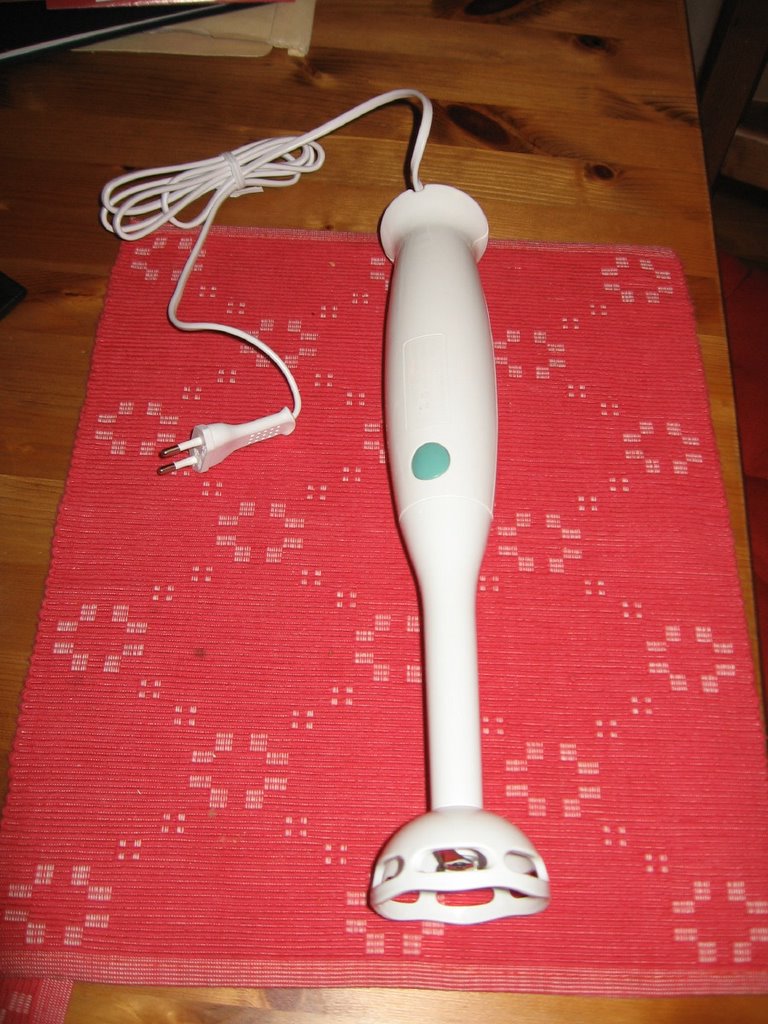
I know that technology is supposed to be America's strong suit (after, oh yes, civil liberties and democratic transparency). But there are some things that Europeans just make better. Simple things, like dustpans with broomstick-long handles and oversink cabinets with built in dish drainers.

And immersion blenders. So neat and trim, so practical: no need to transfer anything, no chance of spraying asparagus soup all over your kitchen just as your guests arrive because you filled the blender too high. The very embodiment of European values, in fact: no gaudy doo-dads, just enough power to get things done without being ostentatious about it. I know that, technically, immersion blenders are available in the US, but honestly, how many people there do you know who have them?

It was a happy day yesterday when I took advantage of the nation-wide rebajas to first finally buy one, and then to make a deliciously smooth and creamy carrot soup with it. Couldn't have been easier. Here's the recipe:


Carrot and Dill Soup (serves 4)

2 Tbsp. butter
1 large onion, sliced thinly
6 carrots, peeled and sliced thinly
1 tsp dried dill
5 cups chicken broth
Chopped fresh dill for garnish

Sauté onion and carrots in the butter with the dried dill until the onions are translucent. Add the broth and bring to a boil. Lower heat, and simmer until carrots are soft, about 40 minutes. Use immersion blender (or if you must, a regular one) to puree until smooth. Serve topped with a good amount of chopped fresh dill.

,

Tuesday, January 24, 2006

Thank you, Benedict Anderson


By the time I got out of graduate school, I was a little tired of the ubiquity of the "imagined communities" rhetoric. Good idea, but damn if it didn't make its way into every dissertation and job talk of the 1990s. Still, I found myself thinking about it again as we near an apparent agreement on the Catalan statute.

Taxes, it should be said, have been a major sticking point--who gets how much of the revenue. But the major hold up throughout the process has been about the word "nation." All along, the Catalans have insisted that Statute define Catalonia as a nation, while the government has insisted that Statute define Catalonia as a place with a national identity. That may not seem like a difference worth holding up a pact that will utterly remake the nature of Spanish government, but trust me. And things got even more punctilious after that. Just days ago the government ceded a bit, and offered the concessionary "Some Catalan citizens feel that Catalonia is a nation"; when that was deemed too patronizing by the outraged Catalan parties, the government took off the "some."

Then, in the face of continued resistence, they revised it again. Now it says that "The Parliament of Catalonia...has defined Catalonia as a nation." Classic trick: say what somebody says it is, rather than what it is. But it seems to be working. The last hold out among the Catalan parties meets with Zapatero today, and I'll lay money that there's an agreement by the end of the day.

,

Sunday, January 22, 2006

The Electrician's Family

I showed up at the molino this weekend to find Nacho the Electrician hard at work, along with the better part of his family. Actually, with the exception of his mother (who has the body of your average señora but the dyed-red shag of an 80s rocker), the rest of them—sister, grandfather, unknown man who could have been a brother or a guy they met in the bar on the way over—seemed a bit sheepish. Which seemed unnecessary until I realized that rather than working they were there to look around our house. But Nacho's mother was working hard, and we now have 1) a cable that juts out from a hole in the wall, cuts up to the roof, and stretches across the patio; 2) one and a half floor's worth of new outlets (one and a half still to come); and 3) a pretty little stone house, complete with red tile roof, to house the counter, whenever that gets put in. Progress.

Thursday, January 19, 2006

Seeing: Madrid


The city of Madrid spends a lot of its culture budget promoting the Festival de Otoño in October, but for some reason, I always find the end of January a lot more interesting. This year, Spain´s most famous ballerina, Tamara Rojo, is dancing El Quijote with the Argentine Julio Bocca at the Teatro Albeniz, while Victor Ullate´s work El Sur--a ballet about domestic abuse with music by possibly the best-known flamenco performers in the world, Enrique and Estrella Morente--premieres at the Teatro Gran Via. Caja Madrid´s five-star flamenco festival begins next week. MadridFusion, which ends today, has all the avant-garde chefs of the world showing off their latest creations (Adrià issued a 23-point manifesto and demonstrated a battery-powered screwdriver that shoots out strands of carmelized sugar). And all the big US Christmas movies--Munich, Brokeback Mountain, Luther (what? You haven't heard of that one? Joseph Fiennes playing the tonsure-headed founder of Protestantism? I can't imagine why)are finally making their way over.

,

Wednesday, January 18, 2006

The Scent of Return

Not too long ago I mentioned how Córdoba's scent hit me as soon as I got off the train. It used to be that way with Madrid as well: I would get off the bus from the airport at Plaza Colón and lightly swoon as I inhaled the smell I hadn't realized I had forgotton, the smell of Madrid. It wasn't olive oil in this case, more like a mix of coffee and exhaust and fried calamari and that peculiar cleaning fluid that Spaniards use, but it instantly reminded me where I was, and I loved it.

When I got in to town earlier this week after a month away, it wasn't there. Or rather, it probably was but I didn't notice it. I think it must mean that Madrid is becoming home.

Wednesday, January 11, 2006

Essentialism

Two pieces of interesting news from the weekend:

A general in the Spanish army was placed under house arrest after he warned that if proponents of autonomy went too far with the Catalan Statute, the army would be forced to intervene. And a man in his 60s was killed when his car accidentally hit a gitana girl as she crossed the street, injuring her lightly. Her family, upon witnessing the accident, ran into the street and shot the driver eleven times.

There, in one news cycle, two constant themes of Spanish history and myth: the rebellious military, the violent Gypsies. The last time the army threatened revolt was in 1981, when a band of generals shot up the Congress of Deputies in an attempted coup. At the time, it was terribly frightening: Franco had been in the ground for fewer than 6 years and the prospect of a return to dictatorship or civil war seemed very real. But these days, "ridiculous" seems to be the general opinion of Lieutenant General Mena's threats regarding the Statute.

Not so the public outcry regarding the murder of Gaspar García in Sevilla. The Union Romani and other Gypsy organizations have been inundated with slur-filled emails and threatening phone calls. Some perceptions, it seems, are more resilient, like weeds.

Sunday, January 08, 2006

What the Three Kings Brought


Not electricity, exactly, but the poles on which our electrical wires are strung. It's a start.

Friday, January 06, 2006

The Kid, The Fat Guy, and the Objectification of Women


As consolation to all those who lost the El Gordo Christmas lottery, today brings the smaller but still sustantial El Niño. This one's winners are also announced by children in Catholic school uniforms, a fact that is probably not amusing to anyone but me.

But amused I am. Not least because the regular daily lottery is announced on TV every night by five willowly women in high heels and form-fitting clothes whose sole job it is to pick up a ping pong ball, slide it into place, and—with big, suggestive (now you'll have a chance at me) smiles— intone the number written on it. So I can just imagine the girls in the photo above thinking today is the start of a great career.

,

Wednesday, January 04, 2006

Eating in Cordoba: Meson Juan Pena

I traveled to Córdoba the day before I came back to the States, and realized that a lot of things have changed since I lived there a decade ago. They have these nifty bikes, free to use, parked outside the train station, for example (a woman in the tourist office told me that Córdoba has more bike lanes than any European city outside of Holland). El Churrasco has opened a small inn--lovely, if a bit rococo for my tastes. Muslim chic is all the rage, with tea rooms and Arab baths popping up around the Mezquita.

But Juan Peña is blissfully the same. Same bullfighting pictures along one wall, same farm implements along the other. Same braseros underneath the tables, with thick blanket-like cloths to pull over your legs and warm your feet. And the same fantastic food.

I had lived for months in Córdoba before I ever tried Juan Peña, even though it was right across the street from the bar where I had breakfast every day (every day, that is, until the waiter--whom I thought was my friend but who clearly disapproved of my unladylike habit of eating a whole, not half, toast—told me I was "getting a little fat"). In fact, it was my visiting friends David and Elizabeth who convinced me to try the place. They ate there one night and came back raving. "You have to get the fried eggplant and spinach with garbanzos," they told me.

So I did. And in the dozens of times that I've been to Juan Peña since, I've never not had those two things. The spinach is lightly cooked, and spiced with cumin and other vaguely Moroccan flavors. And the eggplant is just plain remarkable. Cut like french fries, it is crisp and salty on the outside, melting and not at all eggplanty on the inside.

That's what I ordered two weeks ago, plus a gambas al ajillo for good measure, in the spirit of all-time favorite tapas eating. "Is that a lot?" I asked the waiter after ordering, remembering his critical brethren across the street. "Yes," he admitted. Then I ordered it all anyway.

Meson Juan Peña
Doctor Fleming, 1.
Tel. 957 20 07 02

,

Sunday, January 01, 2006

Laws Sure To Be Broken

Spain's smoking ban goes into effect today, and already one guy has found a way around it. More, no doubt, to follow.

Saturday, December 31, 2005

A Modest Proposal


The big political debate in Spain right now (if we leave aside the smoking ban, and the LOE protest, and whether Zapatero is or is not, as his opponent Mariano Rajoy calls him, a "solemn idiot"), is over the Catalan Statute. If passed, the statute will grant significantly more autonomy to the already fairly autonomous region of Catalunya. There are many points of contestation—financing, the judiciary, whether Zapatero or Maragall comes first in official protocol—but the great sticking point seems to be over the word "nation." The Catalans consider themselves to be one; many other Spaniards aren't so sure.

Zapatero has successfully persuaded parliament to agree to discuss the proposal, but it's anyone's guess what will happen next. The Catalan parties are unanimous in their support for the "nation" clause, ZP has insisted that it cannot stand, and the PP is making loud pronouncements about how both the Catalans and the Socialists are trying to destroy Spain.

In the meantime, some opponents of the Statute have mounted a boycott of all Catalan products, which include mineral water, and the white sausage called butifarra, and a bunch of delicious cheeses, but more than anything else, means the sparkling wine called cava . Cava producers are already lamenting the drop in sales.

So choose tonight's champagne wisely. Have I mentioned that Freixenet, a fine, inexpensive cava, is readily available in the United States?

, , ,

Wednesday, December 28, 2005

Holy Innocents


Back here in the US, the holiday festivities are winding down as we slouch toward New Years. But back in Spain, things are barely getting started. New Years, after all, is merely the halfway point in a fortnight's worth of celebrations. And today—a Wednesday unremarkable in most parts of the world—is reason for its own brand of rowdiness.


For an outsider, the Spanish Christmas is full of mysteries. That's moss on the cardboard next to the Christmas trees, and it took me many years to figure out why anyone would want moss at Christmas. But of course: the landscapes in the elaborate nativity scenes—called beléns, or Bethlehems, in a charming piece of Spanish shorthand—that go up seemingly everywhere are lined with moss. The really upscale ones have waterwheels too. I know this because all the stands at the Christmas market that sell nativity scene figures have hand-painted signs tacked to the front proclaiming, "We have waterwheels that work."

And I only just learned why next to all those stalls selling miniature shepherds and Baby Jesuses are others—sometimes the same ones--that sell whoopee cushions, and fake bugs, and plastic piles of shit, and strange wooden instruments that look like butter churns but make loud farting noises when played. It's because December 28th—today—is the Feast of the Holy Innocents, which for the Spanish is a kind of April Fool's Day when everyone plays pranks on each other. Of course.


Have yet to figure out why everyone goes around in electric-colored fright wigs and cartoon masks, however.

,

Wednesday, December 21, 2005

And They Polish Their Windows With Balsamic Vinegar

One of the things that Spanish cities do well is clean their streets. Every night whole brigades of men and women dressed in neat green uniforms comb the streets with brooms and hoses. There are also these little washing mobiles that spray water out the sides as they inch down the street. It's quite effective, as one would hope in a country where littering (to say nothing of spitting, dropping burning cigarettes, or sitting on the street drinking) carries no negative value whatsoever.

When I lived in Cordoba many years ago I used to joke that they hosed the streets down with olive oil. No one but me found it funny, admittedly, but I thought it was a fine explanation for why the whole city reeks--in the best possible way--of extra virgin cold pressed. Which is why I found myself chuckling on Monday when I got off the train in Cordoba and was immediately hit with the same green scent.

Sunday, December 18, 2005

Eating: La Turuleta


Ever since it opened several months ago, I have avoided La Turuleta. I have done so despite that fact that it is right downstairs, because, well, it is right downstairs. On a street that is positively awash in bars and restaurants—so awash that the tides can be hard to part on certain warm summer nights—the last thing we needed was another one. In fact, there was a minor building-wide rebellion when it became clear that another bar was going in. The president of our comunidad went so far as to file a complaint with city hall, on the reasonable grounds that the space is not zoned for hostelry. Reasonable, but unpersuasive. The bar went in, no doubt illegally, and is now doing a thriving business in tapas.

So in protest, I resisted going there. Until the other day, when it came time for lunch and none of the other neighborhood menus del día seemed very appealing. So much for political commitment (though in my defense I will say that they did a remarkably fine job of soundproofing).

I'm glad I caved, and then caved again. In the two lunches I've had there in as many weeks, I've had a beautiful shellfish soup— bright yellow, slightly viscous, and stocked with squid, shrimp, and mussels; a tasty-if-a-bit-too-soupy rice with fresh artichokes; a classic potaje made with cod and chickpeas; and a very delicious, Asian-y chicken and vegetable stirfry. And a cream cheese brownie for dessert (twice).

LA TURULETA: Almendro, 25. Tel.: 91 364 26 66.

Friday, December 16, 2005

El Caganer


I've come a little late to the whole "War on Christmas" debate, but Bill O'Reilly has reminded me why I choose to live in Spain, even if they can't make a decent doughnut to save their lives. Or bagel, as the case may be.

Let's lay aside the obvious, distressing fact that O'Reilly et al are marshalling the great democratic forces of the boycott not to Christianly protest against, say, the atrocities in Darfur or the high cost of AIDS drugs in Africa, or even, and let's be clear here, consumerism itself. Let's leave aside the whole bullying insistence that "the majority celebrate Christmas so the feelings of a few secular humanists and other heathens don't count." Leave aside as well the attack on freedom of speech. Is it not absurd that the judgement of whether a society is secular or religious comes down to what their mega-stores paint on their windows in December?

Here in Spain, they say "feliz navidad" and "felices fiestas" with equal, well, felicity. In fact, the "fiestas"--that would be "holidays"--is perhaps more popular simply because it is more grammatically correct: what we have here is a series of holidays: not just Christmas, but New Year's and Epiphany as well.

Which is not to say that they do away the religious completely. One of the most popular holiday pastimes in Spain is to visit the nativity scenes that are mounted in most every public square and, yes, shop window. These can be very elaborate affairs, not just Jesus and his folks and the kings and a couple of barnyard animals, but whole armies of peasants drawing water from wells, and children playing, and soldiers advancing, all of them dressed in robes and headscarves.

In Catalunya, there is one figure, however, who does not share the vaguely biblical dress: El Caganer. Also known as: The Shitter. Tucked into a corner of the creche, the Caganer squats with his pants around his ankles, a freshly-laid pile of excrement beneath his bare butt. Theories on the meaning of the Caganer abound: he represents primitive nature in the face of the divine; he’s the embodiment of the value Catalans put on the down-to-earth; he is another example of the important place of shit in Catalan folk culture.

And although most caganers wear traditional Catalan dress, in the past few years, it has become popular to shape them so that they resemble the most significant people of the year—part homage, part mockery. So while last year’s big stars in the caganer line-up were Felipe and Letizia (they married in May 2004), this year it is their newborn, Leonor, who will be taking a crap in crèches throughout Catalonia. Leonor, and George W. Bush. Perhaps the best-known group of caganer artisans use their website to ask clients to nominate the year’s new figures, and this year, President Bush was their choice. I wonder what Bill O'Reilly would have to say about that.

, ,

Wednesday, December 14, 2005

Via Publica

It would be nice to think that during all that time in which we heard nothing from Viesgo they were steadily putting up posts and stringing electrical wire. Nice, but utterly unfounded. So when another week had gone by and we still hadn't heard anything, I gave José another call. "Oh yeah," he said, as if my voice was recalled to him from some place deep in his memory. "You need some more permissions."

It seems that the part of the route that we were told was public--and hence incorporated in the one permission we had from the ayuntamiento--is not. Or rather, it is, but there is not very much of it; the public path is only a few feet wide. As José said, "If we put the posts right down the via publica, there won't be a via publica any more." So we need permissions from the neighbors who own the land that runs alongside. All six of them.

But José said he and his partner were working on it. They already had four, and had sent letters to the other two, asking them to sign the form. One might be tempted to ask why Viesgo couldn't have done that from the beginning; why they couldn't have simply sent out forms instead of forcing us to figure out who owned what land and traipse from door to door, pen in hand. One might be tempted to ask, but one wouldn't.

Friday, December 09, 2005

Seeing: Modern Realism


On a walk the other night I stumbled across the Caja Madrid gallery in the Plaza San Martin, with Edward Hopper on the banner. Inside, an exhibition right up my alley: 1920s and 30s realism, with heavy emphasis on carnivals and dancehalls, and a charming farm scene, complete with donkey, by a pre-abstract Joan Miró. I was a bit confused, however, by the absence of the very painting on the banner, the melancholic Hotel Room. Had they taken down the star attraction of their show? Had I missed a room somewhere?

No, they had not and I had not. The exhibit is divided in two, with the really big gun paintings over at the Thyssen-Bornemisza. So Thursday being a holiday and all that, I decided to take in part two. Hotel Room was indeed there, and quite entrancing a painting it is. The longer I looked at it--the harsh light, the two suitcases, the carefulness with which the woman unfolds the paper--the more certain I became that something tragic was going to happen. But what I loved was that no matter how long I looked, I couldn't tell if the tragedy had occurred yet, or if it were still to come.


Away from the Hoppers, I had one of those experiences where I kept finding paintings I liked, and everytime I checked for the artist's name, it was the same one: Felice Casorati. He painted a lot of women, but it was the eggs on a battered black desk that I liked best.

Realismos Modernos is at the Fundacíon Caja Madrid (Plaza San Martin, 1) and the Museo Thyssen-Bornemisza (Paseo del Prado, 8) until January 8.

Wednesday, December 07, 2005

The Bridge


No sooner had we written about one obscure holiday, than another is upon us. Make that two: yesterday was Día de la Constitución and tomorrow, in a perfect marriage of Church and State, is Día de la Inmaculada (the Inmaculada in this case refers to Mary--Dec 8 is the day that Pope Pio IX declared that she too was conceived without sin).

The coupling of these two particular holidays might be a bit strange were it not for the puente. A puente (or "bridge") is what happens in Spain when a holiday falls a day away from the weekend--you just elide right over that irksome workday in the middle, and turn a simple day off into a four-day extravaganza. When it came time to schedule a day, 27 years ago, to sign the Spanish constitution, I have no doubt that country's politicos purposefully chose Dec. 6 because it fell two days before Dia de la Inmaculada. Not one: that would have gotten them, at best, one measly extra day off. But by putting the new holiday two days before the old one, they guaranteed themselves at least one puente. And in the best case scenario, two. Indeed, right now we are in the middle of the perfect storm of Spanish puentes: two official holidays that fall, respectively, on a Tuesday and a Thursday, necessarily wiping out Monday and Friday, and, why not, taking Wednesday with them for good measure. In short, a 10-day vacation.

Monday, December 05, 2005

Eating: Le Dragon


Lest anyone think that there are only Asian restaurants in Madrid, let me explain. For awhile now, I've been intrigued by the food blogging extravaganzas that go on over at sites like Is My Blog Burning, so when I read about the latest Dine and Dish I decided to give it a try. This month's theme: Asian Persuasion.

And then, this weekend, a friend reminded me of the mini-Chinatown that lurks, of all places, beneath the Plaza de España (northeast of the Don Quijote statue, down the stairs that lead to the underground parking lot). There's a lot to be written about this phenomenon, but for now, suffice it to say that I've wanted to visit for a while. And this confluence--my desire to try my hand at a food blogging event, my desire to visit Madrid's own Chinatown--took me to the Plaza de España today at lunchtime. Or underneath it, to be exact.

Well, I'm sorry to report that Chinatown might be something of an exaggeration. Chinavillage comes closer. China-convenience-store-on-the-side-of-an-otherwise-abandoned-highway is even more accurate. One travel agency, one grocery store, one place selling Buddhas and mah johng sets, and a single restaurant. A very authentic looking restaurant, but one with only 10 tables. All of which were very, very full.

But I still had my Dine and Dish assignment to fulfill. So I got on the metro, and headed to Le Dragon, which lies physically in the Salamanca neighborhood, and metaphysically at the other end of the Chinese restaurant spectrum from a joint in the Plaza de España parking lot. Very chic decor, like the inside of a laquer box, beautiful hostesses running around in bright red cheonsams, a style of Asian restaurant that the Spanish papers insist on calling "London-esque."

Which as far as I can tell, translates as "expensive." I, however, stuck to the 12-euro menu del dia, which included a plate of quite delicious sauteed vegetables, a credible version of curry shrimp with cilantro, and rice. I could have had dessert too--all around me the well-dressed Spaniards were consuming huge bowls of whipped cream with nuts the way Americans might reach for the fortune cookies; that is, as if whipped cream with nuts was the natural thing to have at the end of a Chinese meal. But I stuck to that other typically Chinese ending: espresso.

Le Dragon, Gil de Santibáñez, 6. Tel. 91 435 66 69/ 88

Saturday, December 03, 2005

Drinking: Via Lactea


I'm somewhat ashamed to admit that I had never been to Vía Láctea until last weekend. After all, it is one of the most famous bars in the city—the epicenter of the movida madrileña, that explosion of music and art and exuberant freedom that took hold of the city's youth following the death of Franco. If you've seen Pedro Almodovar's Bad Education, you've got some idea of what the movida was like. And Vía Láctea was at the heart of it, a cavernous bar with not much in the way of style except 80s rock posters and colored lights.

That, some decent music, and a good feel. Twenty-six years after it opened, Vía Láctea is still going strong. At 1am last Saturday night, the place was packed, with a steady stream coming through the door, and a line outside curling down the block. Most everyone was in their 20s or 30s, but I saw more than a few 40-somethings and, I swear, one small group wo were well into their 50s. Which makes a certain amount of sense, given the age of the place. As one 18-year-old I spoke with put it, "My parents used to come here." Now how many thriving bars can say that?

Vía Láctea: Velarde, 18. Teléfono: 91 446 75 81

Thursday, December 01, 2005

Tomorrow's Forecast: Rain

Months ago, Viesgo assured us that as soon as we deposited an obscene amount of money in their account, they would start work, and that we would have electricity a short 10 to 14 days later. They said the same thing 15 days ago, when we made the deposit. Of course we did not believe them. But still, that tiny flame of hope flickered.

Today I called José, the "capataz"--or guy in charge of this whole project. We had talked to him last week as well, and he had promised to start no later than Monday. But on Thursday, he and his team still hadn't begun. "It's the weather's fault," he said, in that charming-irritating way that Spaniards have of refusing all blame. This is very bad news. "The weather" to which José referred is rain. And let's be clear: Asturias is the Seattle of Spain, the London of Spain. It always rains. "Don't worry, we won't forget you," said José. I was not reassured.

Wednesday, November 30, 2005

The Box

When I was in high school, a couple of friends and I would play a game: we would go to the mall, identify a promising victim, and follow him or her throughout the mall. The fun in this (in case it is not clear) derived in part from the sheer unpredictability of the unknown person: would she be a stalwart, middle-America type, nothing but Sears and Cinnabon, or were we in the presence of a more unexpected character, someone who might, say, top off her visit to the lingerie department at Neiman Marcus with a cheese log at Hickory Farms? The other part of the fun came from the stealth: you were supposed to follow your target without being detected. If through poor technique or plain bad luck, however, your mark turned around and looked at you, you had to fall down dead on the spot.

I was thinking about this game today because when I stepped out onto the street this afternoon, I again crossed paths with an elderly, full-dress nun (Carmelite, I think), carrying the same mysterious card board box with holes punched in it as yesterday. When I saw her the day before, she seemed to be coming from the market, so I imagined that, in the best case scenario, the box contained chicks who would lead long happy lives supplying fresh eggs for the sisters, and in the worst, that it held the rabbit that would soon be dinner.

But today, there she was again, tottering her way down the street with her air-conditioned box. What could it contain? I had no choice but to follow her. We passed the newsstand. She did not, mercifully, go to the market. We turned left, past the paper store with the Christmases, past the new Gallegan restaurant, past the lighting supply store. She was moving very slowly, so it was hard to keep my distance. And when she stopped, it was so sudden that I almost ran into her. Where was she going? Of course: the vet's. She went in, and I decided it best not to follow since 1) the office was very small and 2) I might be forced to fall down dead. As a result, I never got to see what was in the box, what pet it is that nuns get to keep.

Tuesday, November 29, 2005

Shopping: Casa Postal


I first discovered Casa Postal several years ago when I was working in the Biblioteca nacional. In those days I used to walk home in the afternoon, a little physicial exertion after long hours of reading or avoiding reading. I would try to take a different route each day, just to keep things interesting.

Which is how, on a stretch of Libertad I had never traveled before, I found myself entranced by the display windows of this tiny shop, crammed with old posters, calendars, post cards, wrappers, cut-out dolls. Perhaps it is a bit strange that after having just spent the day with old, dusty papers I would want more, but historical research does that to you: it convinces you that a great and unusual find is yours for the handling.

So I went in. Two of the walls were papered with more of the same—calendars from the 40's, advertisements from the 20's, movie posters from the 50's. But most of the space was given over to large stacks of flat file cases, each one labeled with a theme or geographical name that identified its contents. And in the center, two long wooden tables, where mostly old men would sit, having asked to see all the postcards on, say, Seville, or fly-fishing.

I was there again this weekend and it hadn't changed. Same crowded space, same old men thumbing carefully through stacks of postcards, same sense that a great discovery was contained there, if you just knew to ask for it.

Casa Postal, c/Libertad 37; tel 91 53 27 037

Sunday, November 27, 2005

Overheard, Sunday morning

Well-dressed middle-aged señora to her Chihuahua as he lifts his leg and pees on the corner of the San Andres church: "¡Así me gusta!" ("That's the way I like it!")

Friday, November 25, 2005

Merry merry


There is no Santa Claus. They do not decorate Christmas trees, nor do they give presents on Christmas day. They do not hang stockings or blast popped-up versions of Christmas carols through their department stores. They do not eat candy canes.

At least not naturally: none of these traditions is remotely Spanish. But all of them have been making inroads into cultural life here, one more example, for good or ill, of the globalization of American culture. Happily, the infiltration of American-style holidays does not mean that Spanish traditions disappear. They just get added on: more ways to have a good party.

The process, however, is not always seamless. Hence my amusement this morning at the paper store, when I saw the sign above, which translates roughly as "We've got the Christmas of Christmas." An utterly confusing phrase--are they saying that their Christmas is the best of all possible Christmases?--until I realized that "Christmas" is the word for "Christmas cards." How "Christmas" came to mean "cards" and not trees or stockings or candy canes or any other holiday-related import remains a mystery.

Thursday, November 24, 2005

Six degrees

One thing of which I was reminded on this last trip to the molino was that everyone in Oviñana has a stake in it. We first encountered the phenomenon on our second night there, when, in a fit of naive confidence that we could somehow get the electrical system to work if only we understood it better, we called up the electrician that the previous owners recommended, and invited him over. Manolito was a very chatty guy, who, in between discourses on amps and watts, mentioned that he had help raise the millstone that functions (or used to function. An errant bottle of sidra broke the glass top, but that's another story) as a kitchen table. Later we found out from our albañil, José María, that the millstone was right where it had always been and Manolito had nothing to do with raising it or anything else. But the pattern was set.

Now, everytime I'm up there I seem to run in to someone who has some connection to the place. There was the town drunk who showed up with our furniture delivery, saying that he was "strong as a toro bravo" and that he helped lay out the stone patio. There are random guys in the café, who periodically remember that they helped re-do the walls or put on the roof. There is Alberto the Carpenter's wife (Alberto being the one who built all the cabinetry we'd like to tear out), who told me that before David and Mari Paz owned the place, a homeless man and his burro lived there. And before that, it belonged to her mother, who was born in the molino.

Then, last week, in the process of collecting permissions, we met Nelli, who turns out to be the mother of Eduardo, who runs the construction supply store where we got the tiles for our new bathrooms. Nelli says HER mother was born in the molino. Which either makes Nelli and Alberto's wife sisters, or makes for a very strange coincidence.

Sunday, November 20, 2005

Like Sheep


It is the thirtieth anniversary of the death of Francicso Franco, Spain's former dictator.

It is also the annual Día de la Transhumancia, when the country's agricultural sector asserts its rights by herding livestock (mostly sheep) through the center of Madrid--along the Calle Mayor, through the Puerta del Sol, to the Puerta de Alcalá, and then back again.

Last night, a Mass was held at the Valle de los Caidos, or Valley of the Fallen, the massive basilica/shrine built through enforced labor by the losers of the Spanish Civil War, during nearly two decades, to honor Franco. The dictator is buried inside the church, as is José Antonio Primo de Rivera, founder of the Spanish Falange, a right-wing political group that supported Franco's Nationalists during the civil war. Notable attendees of the gathering included Franco's daughter, Carmen, and Antonio Tejero Molina, the Guardia Civil officer who led the 1981 military "golpe" or coup that attempted to topple Spain's then-nascent democracy. Today's news replayed the chants of "Franco! Franco!", and the Fascist salutes.

This morning during my weekly Sunday run, as I crossed the mouth of the Calle Mayor, I had to jostle for position with teams of oxen, impatient to execute their marching orders.

Later this morning, we had breakfast at the Cafe del Oriente.

Outside, in the Plaza del Oriente, which spreads out in front of the Royal Palace, several hundred Spaniards--mostly well-off elderly citizens or angry young people--congregated to pay homage to Franco by singing patriotic songs, chanting nationalistic slogans, stabbing the air with fascist salutes, waving (and often actually wearing) Spanish flags, and selling Francoist and Falange literature and memorabilia.

After we finished breakfast, we made our way through the chants and flags and walked the short distance to the Puerta del Sol, so that we could observe the animals on their home stretch. Before us passed men carrying flags on thick wooden poles several times their height; oxes pulling carts; groups of men, women, boys, and girls dressed in traditional attire, stopping intermittently to perform folk dances; large, swaggering, forlorn sheepdogs; and finally, the guests of honor--hundreds of confused sheep, herded through the passageway narrowly permitted by the hovering crowd.

The sheep's appearance, though glorious, was brief, and soon the Puerta del Sol had emptied, leaving only an army of sanitation trucks and workers (all dressed in bright, flourescent green uniforms), hosing the cobblestone streets and dispensing with the formidable splattering of sheep dip.

Saturday, November 19, 2005

Love the One You're With

Late Saturday afternoon, back in Madrid after four days at the Molino.

I never tire of the contrast between urban Madrid and rural Asturias. Madrid: heat and noise rising; Asturias: dampness and quiet descending. Madrid: large gatherings of people, swift mobility, heels on sidewalks, a whirl of lights at night, hard edges; Asturias: pairs and solitary figures walking tree-shadowed roads, leisurely paces, the soft earth below muffling all movement, endless darkness at night--introducing a billion trillion brightly precise stars when the sky is clear, easy curves.

This trip was relatively uneventful, in the sense that no catastrophes befell us. We rounded up the final permissions forms from neighbouring landowners and transfered the money to Viesgo, the electric company, with its assurance that work would begin within the week (or perhaps the week after...), so we should actually have electricity at the Molino the next time we head north. We've lined up an electrician to make peace between the new powerlines and the ancient and idiosyncratic wiring inside the Molino. And we learned just this morning, as we were preparing to leave, how to clean the pipe filters so that our connection to Oviñana's water supply flows with enough force to get the showers and sinks upstairs working.

The mold and mildew was legion, as always, and my guess is that we'll never defeat it. But can we somehow embrace it?

Except for the concern about how the place will look when family and friends start visiting in the spring, we enjoyed ourselves more fully this visit because our expectations seemed better matched to what we experienced.

No matter how bad things have been, or how forcefully Lisa has insisted we have to sell the place, I fall in love with the Molino every time I go. Whatever's wrong with the place, it's not the Molino's fault, I tell myself. Just because previous owners have made bad decisions about it doesn't mean I should hate it. If I got a pound dog who'd been abused by his former masters, it wouldn't occur to me to blame the dog. So with the Molino. In fact, I feel very protective of this strange, mysterious beast--moreso each time I go.

For good or ill, I think I'm a friend for life.

Tuesday, November 15, 2005

Eating: Anarkoli

I have a long history with Indian restaurants in Madrid, mostly unsatisfying. On my very first trip to Spain, they were something of a refuge, one of the few kinds of places where a 19-year-old American girl might feel comfortable eating by herself (Chinese restaurants filled the same function; other foreigners, I figured would be less likely than Spaniards to wonder at the social worth of a person clearly so unpopular as to be unable to find someone to eat with her). But the food was never very good.

That changed when Geoff introduced me to Annapurna, a very upscale restaurant near Alonso Martínez. Annapurna is credited with being the first place to introduce upscale madrileños to upscale Indian cuisine. It's easy to see why they would like it: very heavy on the cream, nothing very spicy, lots of hushed, subservient waiters. But servings are small, prices high, and there were far too many people in business suits smoking cigars. Plus, both times I've been there, the hostess was rude.

For awhile we used to go out to Mombai Masala on Recoletos after yoga. Decor: Raj fantasy, food: decent, prices: high. Isn't the whole point of Indian that it's good and cheap?

So I'm happy to say that last week we found our perfect Indian restaurant: Anarkoli. Just opened, on a street that already has a string of Indian places. Warm, not terribly Indian-looking decor, nice waitresses, reasonable prices. And the food is excellent. The samosas are light, flaky, and dusted with chile-salt mix. Saag aloo still has its distinct components; the spinach bright green, with a few tomatoes thrown in for color, the sauce rich but not greasy. And the butter chicken--all white meat, nothing to leave you worrying about what parts you're eating-- was just plain delicious.

Anarkoli: c/Lavapies, 46
91467 6000

Sunday, November 13, 2005

We Gather Together


Spaniards like to gather. Usually there’s no more serious purpose to it than simply being with other people—eating, drinking, talking, and talking some more. This makes public demonstrations in Spain both more and less interesting than in the United States. An American political protest is usually something you notice. In Spain, you’d probably notice it, but it may take you a few minutes to be sure that you’re not confusing it with one of the other myriad gatherings you regularly encounter.

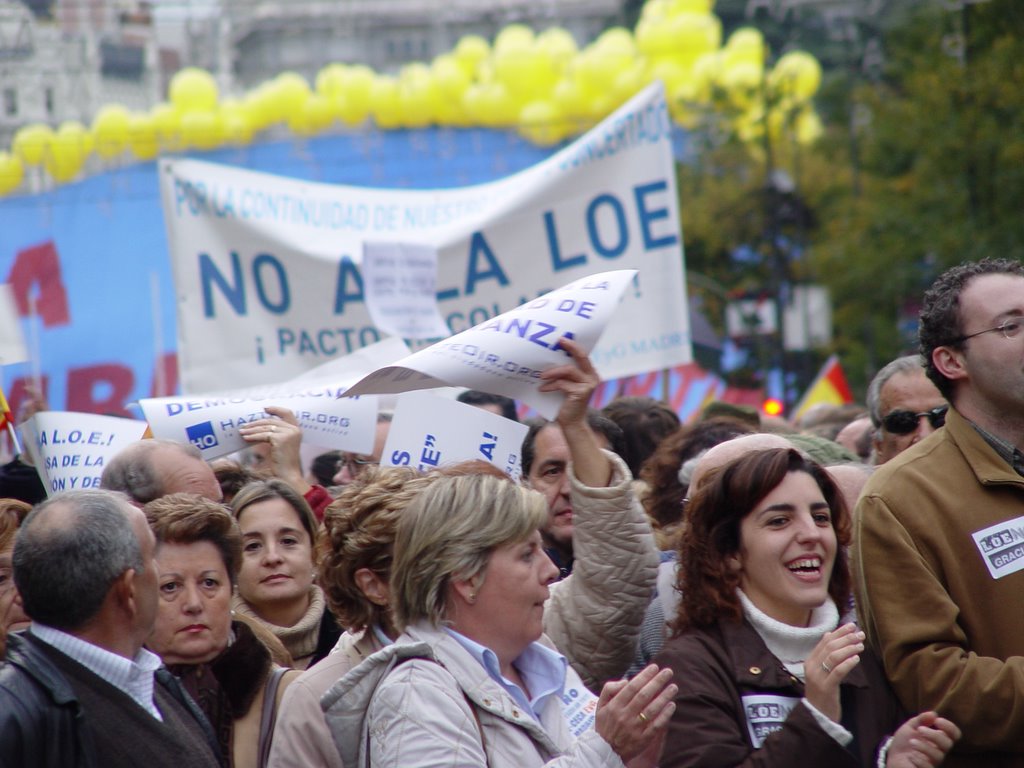
Yesterday, at the urging of the Catholic Church (THE Church here for centuries—and still hanging on) and the conservative Popular Party, between five hundred thousand and one and a half million people (depending on who did the counting) gathered at five o’clock in downtown Madrid, near Neptune’s Fountain, to march in protest, up the Paseo del Prado, to the Plaza de Independencia.

We knew this was more than a casual social gathering, if only because of the countless placards. What were all of these Spaniards protesting? The Ley Orgánica de Educación (LOE), the government’s new education law. Why were they protesting this law? We were actually covering this event for an assigned news story, so it should have been clear to us. But from the dozens of times we asked protestors why they were opposed to the LOE, we never got a coherent explanation.

The Spanish government has supported the Catholic Church forever, including paying tens of thousands of clerics to teach required religion classes in the public schools, and only after the government changed hands—from the Popular Party to the Socialists, has this cozy dependence come under public scrutiny.

So this law must be the Socialists’ way of getting religion out of the schools, right? One would think. But this legislation—a close version of which the PP itself put in place before it left office—ensures that every child who attends a public school will be guaranteed the choice to either take a religion class or not. And it stipulates that both the teachers and content of the religion classes will be determined by the Catholic Church. Best of all, the government will foot the bill.

So what’s to protest, you might ask. (If this law were on the table in the U.S., wouldn’t the religious right praising the heavens for its divine mission accomplished?) Well, it seems that in Spain, there is something about meddling with religion in public schools that just won’t do.

Or that yesterday’s event was really less protest than posture, less inspired crusade than plain old gathering. The language of politics certainly seemed to fill the air…in platitudes blared from a monstrous sound system along the route, and on signs carried by thousands upon thousands of marchers. But after attending the rallies after the terrorist attacks, this march seemed like a poorly run carnival, without enough food or stuffed animals to compensate for a lack of deeply shared public feeling.

After making its short way from the beginning to the end of its designated route, the crowd had nowhere to go, and for the better part of an hour, we were stuck together like a huge ball of rice. And although the popular music playing over the loudspeakers made things a little better, the song list seemed remarkably odd: Pink Floyd’s “Brick in the Wall” (“We don’t’ need no education…”)? R.E.M.’s “Losing My Religion”?

Trying to make the best of the situation, I kept shooting photos for the story we’d eventually have to file. But it wasn’t long before I felt like I a photographer hired for some rich child’s Saturday afternoon birthday party. The kids, talking in groups with friends and a lot of balloons, spent most of their time dancing and singing to the music, and only during the occasional moment when I, or another press photographer, would point the camera in their direction, did they begin suddenly to blow their party horns, raise their protest signs, and scream memorized chants about the horrors of the LOE. It had the drama of a puppet show (the children’s parents pulling the strings).

Participation in the democratic process is good, one of the things I’ve most admired in Spain in recent times (democracy has certainly been more genuinely operative here than it has in the U.S., for example). But this episode—an example of something the U.S. does in fact seem to have figured out (in this case, the separation of church and state)—left me a little depressed.

After a while, as the afternoon became night, the crowds melted away, heading towards the bars, cafes, and restaurants of the surrounding neighborhoods. And except for the notable fleet of water-spewing trucks and green-suited sanitation workers that materialized to clean up the mess, it seemed like any other Saturday night in Madrid. Everywhere you looked, people were eating, drinking, and talking. Everywhere you looked, Spaniards were gathering.

Thursday, November 10, 2005

Dia de la Almudena


The first clue should have been the cathedral bells that started clanging just before 10am. I went out to the street, thought to myself, "hmm, the museum isn't open yet," but figured that the guard had overslept. Went to the bakery, noticed that the shelves were full of a roscon-like pastry with little cream crosses drawn on it, and thought, "there must be a holiday coming up." But it wasn't until I got to the market and saw the big metal gates drawn across the entryway that I realized that the streets were suspiciously quiet for a Wednesday morning. Aha. The holiday was today. But what holiday was it?

Saint Isidro. Virgin of La Paloma. Constitution Day. Armed Forces Day. Assumption Day--although we're used to the regular eruption of esoteric holidays here, they still amuse us. I thought we knew them all. But no. Yesterday was Dia de la Almudena--the patron Virgin of Madrid. Of course.

So we went: Dia de la Almudena is celebrated with a huge Mass in the Plaza Mayor. Cardenal, bishops, priests, noviates, all lined up in neat rows, with nuns guarding the host back stage. The non-clerics get to dress up too: women in their tight castizo dresses, with that goofy carnation on top of their head; men in their far more elegant capes. They go to Mass, they take the Virgin out in a procession, everyone goes out for vermouth. Another successful holiday, with all the critical elements: costumes, a little religious devotion, plenty of alcohol.

Tuesday, November 08, 2005

Neighbors, Part II


Spent the weekend once again trying to track down the neighbors who own the land where our electrical posts will go. And, through gossip and actual encounters, I learned a lot in the process: that the head of the water mafia in town, whom everyone seems to hate, is not terribly well-educated: he spells "Nieves" with a "B"; that the monstrosity going up near Cesar's house was supposed to be a new home but has since been turned into an insurance office; that the father of Eduardo, the construction-company's owner, is a lawyer; that Emilio, who owns the tiny grocery in town, might be something of a political counterweight to Alfonso, owner of the tobacco shop.

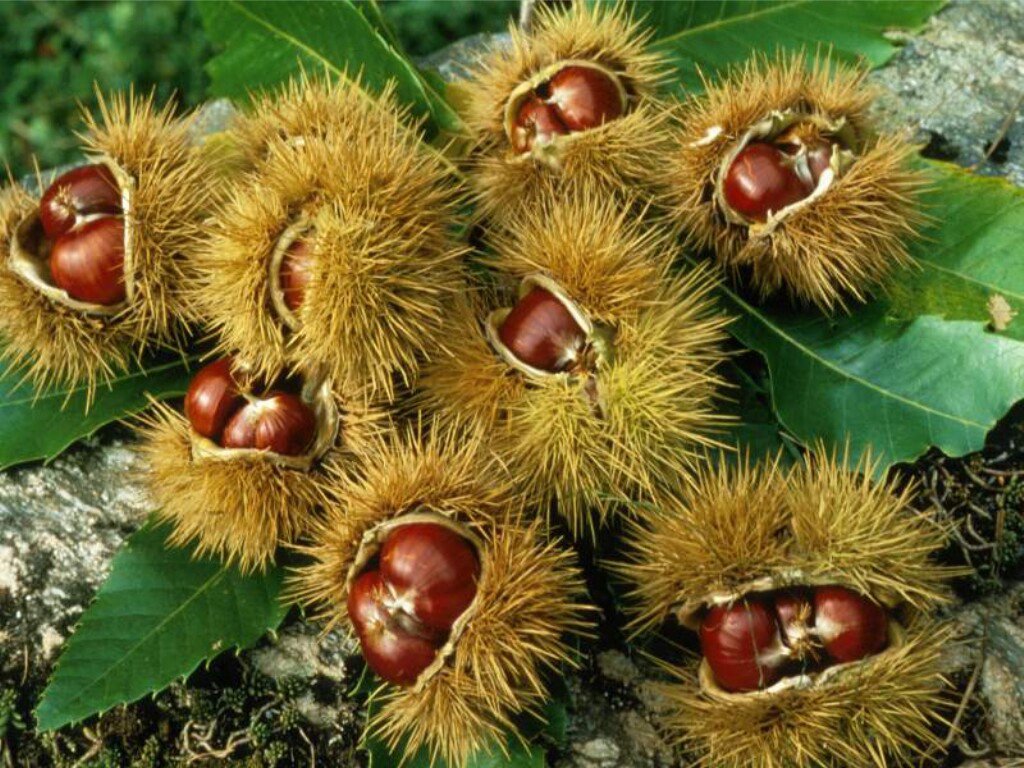
It's chestnut season in Asturias, and everywhere old men and women stand hunched on the side of the road, with sacks and baskets for collecting. And at the neighbors' houses too: wooden boxes filled with shiny chestnuts left to dry a bit in the sun. Back at the molino I collected a bowlful myself, pulling back the burrs that look like prickly golf balls to reveal the trio of nuts inside.

Friday, November 04, 2005

Staying: Asturias Airport


So I get to the airport at 4:45 for my 5:25 Iberia flight, thinking I'll just swipe my card through the automatic check in and be on my way (to Asturias). But no, the machine swallows the card, then spits it out, swallows, spits, swallows, spits, before telling me it can't read it. I try entering my passport number. "No Reservation Found". So I try another machine, to no avail. The lines at the counter are monstruous, too long for me to wait in and still make my flight. I go to an agent who is supposed to help passengers use the automatic check-in machines. I explain my plight; her response is to try the machine again. When she is satisfied that I am neither lying nor an idiot, she tells me to go stand in one of the monstrous lines. I explain that if I do that, I won't make my flight. She tells me she can't do anything else: her job is to help people with automatic check in.

I see that the lines for Business Class are much shorter, so, with about 20 minutes until my flight leaves, I choose one to stand in. When I get up to the counter, the man taps on his computer until he discovers that my ticket is coach. "This is a coach ticket," he says. I reply that I am aware of that fact, but that my flight leaves in 15 minutes, and the machine doesn't work and the lines..." He tells me he can't check me in: his job is to check in people in Business Class.

He then points me to two counters at the end of the terminal for "Last Minute" flights. There are two lines, each 3 deep with very antsy people, but there is only one agent, working very, very slowly. When I finally get up to him, he chides me for getting to the airport so late, but hands me my boarding pass. I speed off through security, pissing off a security guard and lots of other Spaniards by jumping the line. I get to the gate with about 4 minutes to spare. The agent there is talking at length to another passenger. I try to interrupt (politely, of course). She snaps at me and tells me to wait until she is done. When she finally turns to me, she has adopted the tone of voice that one would use with a very naughty, if tragically slow, child. "The plane," she says, "has already left."

She sends me to the Transit counter, where the line is, if anything, even longer than the original check-in lines. I stand there, along with a seething mass of Germans, Swedes, French, and the odd Spanish--who know better and keep trying, with more or less success, to jump the line, for about an hour. Finally, an agent takes my now-useless boarding pass and says, "let me get you a boarding pass for the next flight." I am joyous. For about 10 minutes, until it becomes clear that she is not, in fact, doing anything of the sort. After another 20 minutes or so of just standing there, another agent, newly arrived, waves me over. I hand her the same now really useless boarding pass. She types away for a bit, then tells me she can't give me a new boarding pass: her job is to give boarding passes to people who are connecting from other flights.

I go to the sales desk. The woman there, the only sympathetic person I've met in this whole ordeal, tells me she can only sell me another ticket for an additional 170 euros. But she does suggest I talk to a supervisor.

I go find the supervisor who is busily typing at a computer. I stand there for 15 minutes until she is done. I tell her the whole saga. She issues me a boarding pass for the next flight. It is, of course, delayed, meaning I get to Asturias far too late to pick up the car (which is still at the shop where I left it, shattered of window, back at the beginning of October). Which is how I came to spend the night at the Hotel Cristal, conveniently located in what is basically the Asturias Airport parking lot.

It's funny: the Spanish are so famously independent, so "viva yo," and all that. But give them meaningless bureaucracy and they'll enforce it for all they're worth. On the positive side, my Spanish really came together during my tirades.

Thursday, November 03, 2005

Staying: Barcelona


I found myself having unexpectedly to spend the night in Barcelona last week on what was apparently Catalan 99.5% Hotel Occupancy Day. After calling around to many, many places, including my favorite hotel in the city, I finally managed to secure the very last room in Barcelona at the Hotel Abba Sants. Not the sort of place I would normally go: big, ugly exterior; lots of businessmen. But it turned out to be relatively nice, modern but not too cold, with a very kind receptionist who patiently tried to come up with a phone charger for me, even though in my bleary state I kept erroneously insisting that the make of my mobile was Movistar ("Not the service, señora, the telephone").

It's located right near the Sants train station, which makes it a good place for getting in and out of town. And it's a short uphill walk away from the L'Illa Diagonal mall, which has a wonderful--I can't believe I'm saying this--food court, half inviting, gourmet-y restaurants, half food stands and cookware stalls. Fresh fish and produce, beautifully displayed, in a mall. Plus a FNAC, which, should anyone besides me be interested, sells phone chargers.

Monday, October 31, 2005

It's A Girl


Spain awoke to the news that it had (another) heir: early this morning Letizia gave birth to Leonor, who, according to her grandmother the queen, is healthy, chubby, and a "llorona," --a wailer. Leonor's birth will eventually occasion a reform of the constitution so that women have equal rights to the throne, but that is some time off in the future. For now, a few interesting facts about royal births:

All Spaniards have identification numbers that they use as a combination social security/driver's license number. The "DNI," as it is called, is necessary for everything from paying taxes to setting up a phone account to booking a plane ticket. For most, the number is 8 digits long, but the royal family has the market on the easily-remembered numbers 1-50. The king is 1, the queen is two, and so on through their children and grandchildren. Which makes Leonor #12.

And a little history: Victoria Eugenia, the English-born wife of Alfonso XIII, was the last Spanish queen to give birth in the comfort of her own palace. Apparently, her 12-hour labor was especially arduous, but every time she cried out, her mother-in-law, the Queen Mother, would scold her, "We Spaniards do not scream when we bring a king into the world."

Sunday, October 30, 2005

He Seemed Like Such a Nice Boy


On Thursday in Calella de Palafrugell, all the talk was of Tano, the local bar-owner/artist who was apparently in cahoots with the second-most wanted Nazi in the world. In June, Tano received a wire-transfer for some 170,000 euros from the son of Aribert Heim (also known as "Dr. Death") that, according to the artist, was payment for some paintings. At a sandwich shop just off the beach, Pilar and Lola talked at length about what a great guy Tano is: friendly and kind and a regular in their Tai Chi class. Pilar thought he was in a photo she had, but wasn't sure. And then she said that she had heard he and his wife had bought a huge house in Palafrugell. "So you never know," she sighed.

Saturday, October 29, 2005

Eating: El Cisne Azul


After being turned away from an Indian restaurant at 3:35 because the kitchen was "closed" (closed? at 3:35? in Madrid?), my friend Sam and I ended up eating bad-but-expensive sushi for lunch on Wednesday. And not enough of it either, because on the way home we ended up stopping for a dessert of sauteed mushrooms.

Sam had seen the place before, and although he knew it specialized in mushrooms, he had never eaten there. We went in, and it looked for all the world like your typical ca. 1976 Spanish bar, with bad lighting and blaring tv, formica floors covered in used napkins, and turquoise tiles (we later learned the bar is called The Blue Swan, at which point I understood the tiles to be an illustrative touch, though I still have no idea where the swan comes in) covering the walls. The only decoration, such as it was, were the laminated charts depicting wild mushrooms stuck randomly on the door, behind the bar, in the window.

The tapa display case held plates of trompettes de la mort, shitake, hen of the woods, and some irregularly-shaped mushrooms that the Spanish call cow's tongues. We argued about whether boletus in Spanish are porcini in Italian, then ordered them anyway. Sauteed with garlic until they were brown around the edges, a fried egg sitting on top, they were utterly delicious.

Meanwhile, in a corner of the bar, a group of ten men were finishing lunch. Cigars were out, talk was raucous, and there were two open bottles of Ballantines on the table as digestif. As one of the men got ready to leave, he pulled the waiter over and whispered instructions. Seconds later, the waiter came back with a large crate of boletus (which are indeed porcini, and cepes, for that matter), a thick layer of dirt still clinging to their fat stems. He pulled out a couple--they were huge--weighed them, and dropped them into a plastic bag for the man to take home.

The Cisne Azul, c/Gravina, 19; tel. 915213799

Wednesday, October 26, 2005

War Counsel

I spent a few hours yesterday with the folks at the Fundación Francisco Franco. Their offices were much as you'd expect: dark and a bit musty, walls hung with faded tapestries and flags; a paneled board room with a floor-to-ceiling portrait of the Caudillo dressed in full regalia. And the Foundation officers also what you'd expect: elderly, gracious, rather tenaciously nostalgic.

One of the most interesting things to come out of the meeting was the correspondence they showed me between Franco and Lyndon Johnson. It seems that the US president had asked the Generalísimo to send Spanish troops to support the American ones in Vietnam. And Franco's reply was, well, insightful:

"My military and political experience allows me to appreciate the great difficulty of the enterprise in which you are engaged: guerrilla warfare favors the indigenous insurgents, who with very few men can keep contingents of better-armed troops in check. ...War in the jungle is an affair without end.

"I don't know Ho Chi Minh personally, but from his history and his efforts to throw out the Japanese, the Chinese, and the French, we must credit him with being a patriot....Without a doubt, he could be the man that, at this time, Vietnam needs."

Someone should have shown that letter to Aznar.

Sunday, October 23, 2005

Winter

When I left Spain at the beginning of October, it was hot and everyone was still wearing sandals. Two weeks later it is still pretty damn warm, but clearly, the collective consciousness-- if not the actual season--has turned, and we are in winter. You can tell because even though I was almost sweating in a suede jacket this morning, everyone around me had on sweaters and scarves and was crossing the Plaza de Oriente like it was frozen tundra. And yesterday, the tables at San Gines were once again full of people drinking hot chocolate.


Another sign of winter: huesos del santo, little sugar-coated marzipan cookies that they make for All Saints Day. The holiday isn't until November 1, but in a bit of American-style commercialism, my bakery has begun selling them. The name translates as "saints' bones"; hence the shape. At La Tahona, they come scored like rotini, and with candied chestnuts, apple, or sweet potato where the marrow would be. My favorite, though, are filled with yema--sweetened egg yolk, which should be disgusting, but isn't.

Saturday, October 22, 2005

Feria de los Sentimientos


Walking through the Plaza Mayor this afternoon after two weeks' absence, I was reminded of how dearly the Spanish love a fair. And not just the big ones, that have them dressing up in costumes and drinking til all hours of the morning. Small ones--Feria of the Book, Feria of Used Tchotkes, Feria of Solidarity--all it takes is a few white tents and large speakers. Once, Geoff and I, crossing the Plaza Mayor early on a Saturday morning, were surprised by workers setting up what, for all intents and purposes, appeared to be a Feria of Disease. (In truth, they may have called it a health fair). Flocks of white tents filled the square, each one dedicated to a single, horrifying condition. There was a pancreatic cancer booth, a heart disease booth, even a leprosy booth. Not much action outside that one.

So it was with some curiosity that I entered the roped-off area of today's Feria of Feelings. I pictured graphic goings-on in the tents: wailing, hysterical laughter, screams of pain. But instead it was a children's fair, complete with inflatable Moonwalk (strangely called an "American court") and guys making balloon animals. There were some banners that listed various feelings, and among them "tolerance" and "phobias" were especially prominent, leading me to believe that this fair, like so many Spanish ones, had some subtle political statement to make. I just couldn't figure out what it was.

Friday, October 07, 2005

Eating in Salamanca: Zazu

I was in Salamanca yesterday, with time left over for lunch. My plan had been to take a cab directly to Chez Victor, which I had loved--especially a dessert whose only feature I remember is its luscious caramel sauce--when I ate there many years ago with my mom. But when I got there yesterday, it suddenly occurred to me that Chez Victor was probably expensive, and there was no menu outside to persuade me otherwise. So I opted instead for what looked to be a very charming, and far more economical, restaurant around the corner, called Zazu.

And it was charming, in its way, with deep blue walls and windows open on the Plaza de la Libertad. The restaurant called itself "Mediterranean", which translated mostly as Italian, with a few Spanish touches thrown in. I ordered the menu del dia (salad, pasta, dessert, wine, 12 euros) and asked for a glass of water, which in Spain always mean tap water. The waiter--long, dark hair, a little less than fastidious--said, "Of course," and then proceeded not to bring it. When I asked him again, some 20 minutes later, he said, "Sure, but we only have bottles." And then he brought the loud British lady next to me a glass of tap water for her medicine.

Salad was one of those weird concoctions with random vegetables (steamed carrots, raw celery) thrown in with the too-sweet dressing. But the gnocchi with chicken, bacon, arugula and sun-dried tomatoes came together well. Still, I found myself wishing I had stayed with my first impulse.

Zazu is at Plaza de la Libertad, 8, in Salamanca.

Wednesday, October 05, 2005

Things Done and Undone

Here is the list of things I hoped to accomplish on this last trip to Asturias:

  • Get the car inspected

  • Get the car registered

  • Get permission from all concerned to put electrical posts on their property

  • Get permission from the local government to put electrical posts along the road to the molino

  • Deposit the money so that Viesgo will connect us to the electrical system

  • Get the hot water heater fixed

  • Maybe do a little painting


Here is the list of things I actually accomplished on this last trip to Asturias:

  • Left the car (still unrepaired) at the shop so that when I return, the rear window will have been replaced

  • Got a map showing us who all the neighbors are along our prospective electrical route

  • Got permission from one of them

  • Made official request to local government for permission to put up electrical posts

  • Deposit the money so that Viesgo will connect us to the electrical system

  • Got hot water heater fixed, but now it shoots huge flames whenever lit; probably needs to be re-fixed


Part of the problem is that everyone has opinions that, when you hear them, seem perfectly rational, but that actually end up leading you down another horrifically torturous alley of bureaucracy and mystification. You know it's going to happen, of course, but it sucks you in nonetheless. "Why don't you connect from the factory?" asks Alfonso. "Why don't you have them lay the line underground?" says the unknown (and unasked) man at the bar. "Why don't you go to the industrial office in Oviedo and tell them to get all the permissions?" says Fernando, owner of Casa Fernando restaurant. Even I knew enough not to follow that trail, but six days later, it's a pretty short list of accomplishments with which to content myself.

Saturday, October 01, 2005

Mañana


Yesterday I brought the car (that's what it looks like, there on the left, only ours is charcoal gray and missing a rear window) back to Pedro, because he told me the new window would be in by then. When I got to the shop, he checked, assured me it was there, and sent me off to the cafe next door while they put it on.

It was one of those old-fashioned kinds of bars that used to be everywhere but are becoming harder to find as Spain turns more European: men coming in for beer at 9:30 in the morning, floor covered in napkins and empty sugar packets, a broken foozball table in the corner, hams hanging everywhere. And of course, both the tv and radio were blaring, as were two slot machines. I kind of liked it.

After spending an hour there reading Portrait of a Lady and drinking coffee, I went back to the shop. Pedro told me he had made a mistake: that the window that had come in was not mine. Would I like him to tape up the back with plastic?

On the good side, I picked some of our figs and apples yesterday. They are sidra apples, and hence, according to local wisdom, not good for eating. But I tried one, and thought it delicious. I would have made a pie, if only our oven worked.