Showing posts with label Shopping. Show all posts

Thursday, November 16, 2006

TeymiGordy


Madrid’s Mercado de la Cebada is not a pretty place. I’ve seen photos that show it was once was one of those turn-of-the-century beauties decked out in wrought iron, but somewhere along the way, the graceful old building was torn down to make way for today’s brick and cement bunker. As Spanish markets go, it fulfills its function—good produce, good fish, good meat—but unless you count the nudie calendar hung on the wall across from the chicken and egg guy, it’s not the most aesthetically pleasing of places. And many of the original stalls stand empty, which, coupled with occasional noises from the mayor’s office about “revitalization,” sometimes leads me to suspect that the Cebada is not long for this world.

Which is why I was so pleased to walk in there a few weeks ago and see one of those previously abandoned stands suddenly occupied. TeymiGordy (more on the unfortunate name below) is lined with bright blue canisters, each one—there are over 300—containing a different variety of tea. All the basics are there, though even a simple chamomile comes in several versions—Egyptian, for example. But the most enticing are the blends, like green tea with strawberries and white orange blossoms, or the romantically named “Arab Sighs,” with rose petals, raspberry, hibiscus, cardamom, and cinnamon. There are also flavored sugars (lemon, caramel, three kinds of brown)and a middling collection of tea cookies. Two pots on sternos contain the day’s free samples.

TeymiGordy is run by Laura Miso, whose hair is dyed to match her tea canisters. The shop’s name came from the two things, she says, that comfort her: Tea (that would be the “Té”) and “my dog Gordy,” (that would be the Westie pictured on the sign). She got the idea to open a tea shop because, she says, “I don’t like coffee.” Those are heretical words in this espresso-fueled city, but she figured there had to be others like her. Here’s hoping she’s right.

TéymiGordy is located to the right of the stairs as you enter the Mercado de la Cebada. Tel: 91 344 2038.

, ,

Wednesday, September 27, 2006

Eating in San Sebastián: Galparsoro


There must be a hundred sayings in Spanish that have the word bread in them. My favorite is "Eres mas bueno que el pan," which translates literally as "You are better than bread," and is usually said while cupping the face of an adorable child in your hands and squeezing. Or alternatively, "Eres mas inocente que el pan"--"You're more innocent than bread."

But the dirty secret for a country that puts such a premium on bread as to compare it to goodness itself is that most Spanish bread is not very good. Your standard barra is cottony and bland and even the rustic-looking gallego is disappointingly flavorless and unchewy. It's true that La Tahona, near us on c/Humilladero, has me convinced it's the best bakery in Madrid because of its delicious chapata, but even it turns out standards--barras and baguettes--that just don't do it for me. I can only conclude that Spaniards like bad bread.

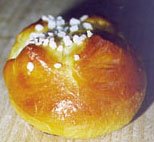
But Galparsoro, in San Sebastian, changed my mind this past week. They appear to supply barras to half the city; in the morning their deliverymen pull huge woven baskets stuffed with loaves on handcarts through the Parte Vieja. But it is their specialty breads that really stand out. Gorgeous chapatas and rusticas and vienesas. A dense, slightly sour mushroom-shaped thing called a Plus Minus. And what are certainly the best brioche I've eaten outside Paris. But the star, the shocking star, of their offerings is the humble suizo, a normally uninteresting sweet roll topped with sugar. At Galparsoro, the dough is chewy and yeasty and not too sweet; the sugar on top comes in big crunchy crystals. Early Tuesday morning I ate one warm from the oven as I walked along the seawall. It was, indeed, mas bueno que el pan.

Galparsoro: Nagusia 6, San Sebastian.

Monday, July 17, 2006

Eating in Barcelona: Bubo


Earlier this year I noticed that the candle shop that used to be on the corner next to our first apartment in Barcelona had changed into a bakery. It was just as well; I never saw too many customers in the candle store, or, for that matter, too many candles (that's Barcelona minimalism for you).

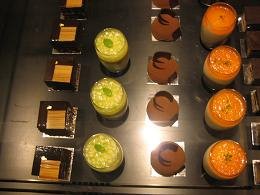
In truth, 'bakery' doesn't seem like the right word for Bubo: there is no smell of yeast, no warm air coming off the ovens. What it does have, however, are gorgeous cakes--some of them individually sized, some of them not--all of them decorated and displayed like some kind of postmodern jewel. Sacher torte, vanilla cream wrapped in white chocolate, tiny lemon sablee tarts. Also: swirls of chocolate and pistachio turned into lollipops, and homemade sugared marshmallows, that to my mind (if not my mother's) taste like really good, papaya-flavored Peeps.

In the course of doing research on Bubo for this piece, I learned that the name comes either from 1)a children's word for "yummy" or 2)the abbeviation of bueno and bonito. I almost volunteered the information that in English, at least, bubo also refers to the boil-like extrusions caused by the plague, but thought better of it.

Bubo, 10 Carrer Caputxes; tel 93 268 7224

Monday, May 22, 2006

Spadrille Eseason


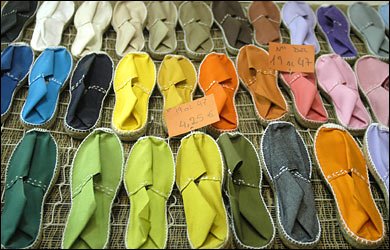
It's espadrille season again (or as a sign I passed today, clearing shooting—if perhaps not very effectively—for the English-speaking market says: "Time for Spadrilles from Spain." Not far from our apartment, the crowds are again gathering around what I think must be Madrid's most popular footwear store, Casa Hernanz. I wrote about the shop about a year ago, but what were in my opinion the best parts got cut out. So I thought I'd print the original here:

Around the first of May last year, long lines began forming outside a little shop just off Madrid’s Plaza Mayor. I had walked past it for months but never really noticed the place before: a non-descript awning reading “Casa Hernanz” and a pair of smudged display windows were the only signs of commerce. But now, suddenly, an ever-present trail of people led out from the door. Morning and night, every day but Sunday, lines snaked around the corner. What were they after? Was this a secret outlet for U2 tickets? Was someone handing out free hams?

Casa Hernanz, it turns out, makes espadrilles. A thousand stores in the city sell these homely, rope-soled shoes, but there is only one Casa Hernanz, where the long wooden counter dates to the nineteenth century and the shoes are made by hand. Come summer—a season which, according to local fashion norms, calls for rope-soled footwear—it is the place for madrileños to buy their authentic espadrilles.

The Hernanz family has been in business for five generations. Today, brothers Jesus and Antonio still make the basic kind of espadrille—two pieces of sturdy cotton sewn to a flat hemp sole—by hand, although they have improved on the original model by gluing a piece of rubber to the sole in order to make the shoe more durable. They also make truly traditional pairs—Jesus calls them “artisanal” –whose soles are unadorned and which are sewn with hemp instead of cotton.

Lightweight and inexpensive (at Casa Hernanz, a basic pair costs about $5.70, and the artisanal $19.50), espadrilles used to be footwear for peasants and laborers, but these days, they are more likely to be worn at home as a kind of warm-weather slipper. They’re not confined to indoors, however. “They’re very popular among young people who wear them to nightclubs,” says Jesus. “And you see them more and more on the street. They’re much better than those horrible plastic things.”

Even the humble espadrille, then, is subject to the whims of fashion. These days the Hernanzes also sell factory-made espadrilles in a variety of styles: some, called “valencianas,” tie around the ankle, others have wedge heels and pointed toes. “When I was young,” says Jesus, “there were only three models and maybe five colors available. But today they come in suede, silk, leather and you can get them to look like any other shoe.” The Hernanzes will even custom-make espadrilles in a fabric of the client’s choice.

But it is the basic espadrille for which those lines of people wait. Once inside the store, they line up at a counter squeezed between bolts of cloth. They state a size and a color, and Jesus or Antonio searches the floor to ceiling cases behind, where the sizes are handwritten directly on the shelves, for the proper pair. Only first-timers—foreigners, mostly—retreat to the small bench tucked near the entryway to try on the shoes. For everyone else, there is no need: this is an annual purchase, like suntan lotion or (heaven forbid) flip-flops.

Casa Hernanz, located at Calle Toledo, 18, is open Monday-Friday from 9am-1:30 pm and 4:30-7:30pm, Saturdays from 9am-1:30pm. Tel: 91 366 5450

Tuesday, November 29, 2005

Shopping: Casa Postal


I first discovered Casa Postal several years ago when I was working in the Biblioteca nacional. In those days I used to walk home in the afternoon, a little physicial exertion after long hours of reading or avoiding reading. I would try to take a different route each day, just to keep things interesting.

Which is how, on a stretch of Libertad I had never traveled before, I found myself entranced by the display windows of this tiny shop, crammed with old posters, calendars, post cards, wrappers, cut-out dolls. Perhaps it is a bit strange that after having just spent the day with old, dusty papers I would want more, but historical research does that to you: it convinces you that a great and unusual find is yours for the handling.

So I went in. Two of the walls were papered with more of the same—calendars from the 40's, advertisements from the 20's, movie posters from the 50's. But most of the space was given over to large stacks of flat file cases, each one labeled with a theme or geographical name that identified its contents. And in the center, two long wooden tables, where mostly old men would sit, having asked to see all the postcards on, say, Seville, or fly-fishing.

I was there again this weekend and it hadn't changed. Same crowded space, same old men thumbing carefully through stacks of postcards, same sense that a great discovery was contained there, if you just knew to ask for it.

Casa Postal, c/Libertad 37; tel 91 53 27 037

Monday, September 19, 2005

Shopping: La Antoja


Found a new gourmet foodstuffs store yesterday afternoon, while I was walking through Lavapies. The tagline for La Antojá translates as "caprices of the palate," and that's pretty much what you get: all those things that the Spanish consider delicacies. Walnuts in honey; artisanal jams; smoked red peppers; and—of course—white asparagus.

(Speaking of which, I once got slammed on a foodie website for an article I wrote in which I referred to white asparagus as "repellently flaccid." To each his own.)

But back to those caprices of the palate: with the exception of Italian pastas and French foie gras, most everything at La Antojá comes from Spain, and most everything comes packaged in pretty little jars and tins. The red-haired owner Belinda was fretting about the unpredictable weather (she couldn't decide if it was time to take down the ice cream freezer), but was helpful nonetheless, steering me away from a bottle of Somontano ("too expensive," she said) and toward a very-attractively labeled Azul y Garanza, from Navarra.

La Antojá is located on c/Argumosa, 26, in Madrid.

Categories: