Showing posts with label Food. Show all posts

Tuesday, May 15, 2007

Eating seasonally


I pulled up to the cemetery on my way back to the molino the other day, and ran into José María, our contractor, with one of his Romanian assistants. At first I thought he had come to collect the bill for the tiling, but then I saw the bulging plastic bags he and Vlad were carrying. This being spring, I had of course noticed that the cemetery walls were, well, crawling with snails. But I hadn't realized that anybody else had noticed. Nor, to be honest, did I realize that these things I tried not to crunch underfoot on my daily walk with Levon were somebody else's lunch.

José María opened his bag somewhat sheepishly to show me his haul, as if he had been caught with his hand in someone else's cookie jar. What could I say, but buen provecho?

Friday, January 19, 2007

Outtakes


I've written about Madrid Fusion, that 3.5-day extravaganza of culinary innovation and ego here. But there are still a few impressions that didn't make it into print, like Ferran Adrià admitting to me that, all technological doodads aside, "what's better than a fried egg?" Or the liquid nitrogenized dollops of olive oil served as hor d'oevres at dinner that, once put in their mouths, had all the stern ladies at the Real Casino blowing smoke out their noses like dragons. Or the woman who pushed her way toward a plate of ham during the massive tapas lunch served in the exhibition hall saying, "It's the only decent thing to eat in this place." In fact, although the hall was fairly teeming with truffles and chocolates and cheese and a never-ending array of small plates born from a back-stage kitchen by trails of waiters, it was the ham stand that drew the ravenous crowds. Ham and the wine to wash it down with. Viva la España.
Wednesday, September 27, 2006

Eating in San Sebastián: Galparsoro


There must be a hundred sayings in Spanish that have the word bread in them. My favorite is "Eres mas bueno que el pan," which translates literally as "You are better than bread," and is usually said while cupping the face of an adorable child in your hands and squeezing. Or alternatively, "Eres mas inocente que el pan"--"You're more innocent than bread."

But the dirty secret for a country that puts such a premium on bread as to compare it to goodness itself is that most Spanish bread is not very good. Your standard barra is cottony and bland and even the rustic-looking gallego is disappointingly flavorless and unchewy. It's true that La Tahona, near us on c/Humilladero, has me convinced it's the best bakery in Madrid because of its delicious chapata, but even it turns out standards--barras and baguettes--that just don't do it for me. I can only conclude that Spaniards like bad bread.

But Galparsoro, in San Sebastian, changed my mind this past week. They appear to supply barras to half the city; in the morning their deliverymen pull huge woven baskets stuffed with loaves on handcarts through the Parte Vieja. But it is their specialty breads that really stand out. Gorgeous chapatas and rusticas and vienesas. A dense, slightly sour mushroom-shaped thing called a Plus Minus. And what are certainly the best brioche I've eaten outside Paris. But the star, the shocking star, of their offerings is the humble suizo, a normally uninteresting sweet roll topped with sugar. At Galparsoro, the dough is chewy and yeasty and not too sweet; the sugar on top comes in big crunchy crystals. Early Tuesday morning I ate one warm from the oven as I walked along the seawall. It was, indeed, mas bueno que el pan.

Galparsoro: Nagusia 6, San Sebastian.

Monday, September 11, 2006

Another Culinary Diatribe


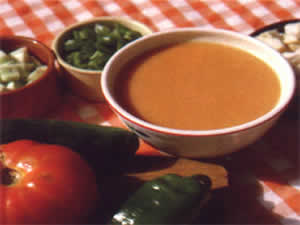
Temperatures in Madrid have dropped in the past few days, which means I've probably made my last gazpacho of the season.

In truth, it took me a long time to learn to love gazpacho. Not only because, well into my twenties, I refused to eat tomatoes (until the fateful day when I passed a market in Caligari, Sardinia--how well I remember it!--and the red globes looked too delicious to pass up). But mostly because, even after I had learned to love the tomato, I only tried gazpacho in the US, where it tends suffer from a serious texture problem.

Namely, it makes me gag. Admittedly, I am overly sensitive to foods--oatmeal and rice pudding come to mind--that try to be soupy yet still have tiny solids floating around in them. The problem with American-style 'gazpacho' is that somewhere along the line, someone got the idea that all you do to make it is put a bunch of vegetables in the blender and push the on button.

Gazpacho, it's true, is easy to make. But it is not that easy. Any Spaniard will tell you that in order to get the emulsified creaminess that defines good gazpacho, it is not enough to blend. You have to strain as well. If you're too lazy to strain, well, you're too lazy to make gazpacho.

My recipe:

1 kilo ripe tomatoes, cored, seeded, and cut into large chunks
1 Italian green pepper, cored, seeded, and cut into large chunks
1/2 a large cucumber, peeled and cut into large chunks
1 clove garlic
4 inches of day-old baguette, crusts removed
2 TBS of sherry vinegar
1/2 cup (or more--Spaniards tend to use more) extra virgin olive oil
Salt to taste

Throw everything except the last two ingredients in a blender and puree. With the motor on, gradually add the oil until the gazpacho attains the desired consistency (if you want it thinner, you can also add a little water). Add salt to taste.

With a wooden spoon, force the gazpacho through a fine-mesh strainer into a bowl, pressing on the solids to extract their full flavor. Discard solids. Refrigerate gazpacho until cold.

If you wish, you can garnish gazpacho once it's served, with chopped tomatoes, onions, cukes, and/or croutons. That is acceptable texture.

Monday, July 17, 2006

Eating in Barcelona: Bubo


Earlier this year I noticed that the candle shop that used to be on the corner next to our first apartment in Barcelona had changed into a bakery. It was just as well; I never saw too many customers in the candle store, or, for that matter, too many candles (that's Barcelona minimalism for you).

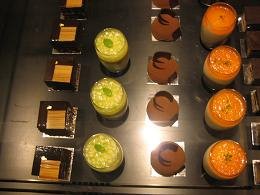
In truth, 'bakery' doesn't seem like the right word for Bubo: there is no smell of yeast, no warm air coming off the ovens. What it does have, however, are gorgeous cakes--some of them individually sized, some of them not--all of them decorated and displayed like some kind of postmodern jewel. Sacher torte, vanilla cream wrapped in white chocolate, tiny lemon sablee tarts. Also: swirls of chocolate and pistachio turned into lollipops, and homemade sugared marshmallows, that to my mind (if not my mother's) taste like really good, papaya-flavored Peeps.

In the course of doing research on Bubo for this piece, I learned that the name comes either from 1)a children's word for "yummy" or 2)the abbeviation of bueno and bonito. I almost volunteered the information that in English, at least, bubo also refers to the boil-like extrusions caused by the plague, but thought better of it.

Bubo, 10 Carrer Caputxes; tel 93 268 7224

Saturday, July 15, 2006

In the Kitchen


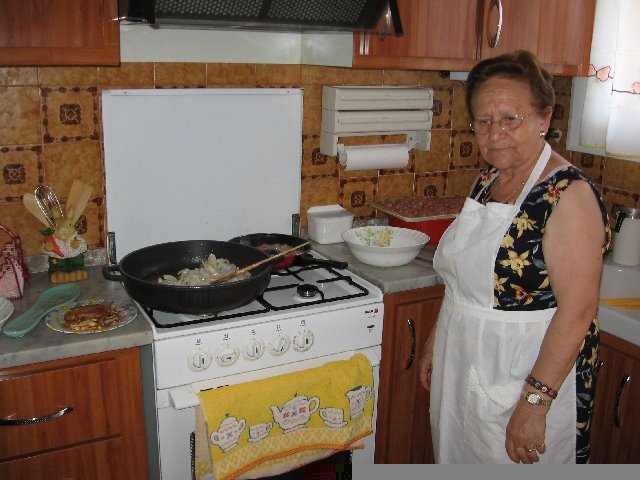
About this time a week ago, I was standing over a hot stove in a stifling kitchen, watching Carmen Barrios (above) prepare her trademark meatballs with squid. Carmen is one of the Cocineras de Sils (they used to be called The Grandmothers of Sils, but that was before a couple of 38-year-olds joined the group), a collective of about 100 women dedicated to preserving the traditional cooking of Catalonia. She is also the sort of woman who brings to mind the word "pistol."

When I met Carmen, she was cooking for The Cocineras' annual dinner. The Cocineras have published cookbooks, demonstrated how to prepare pollastre amb salsafins at the Hotel Ritz in Barcelona, received awards in Madrid, and appeared on television and radio with Arzak and Adria. But the dinner is what they most look forward to: the spiffed-up gym as dining hall, the adulatory speeches, the band with two female singers in matching dresses who complement their repertoire of pasodobles and foxtrots with synchronized dance moves. And of course, there's the food: 94 tortillas, 94 casseroles, and a whole lot of cake, all made by the Cocineras.

Carmen didn't waste any time. As soon as she saw me at the dinner, she marched up--recently coiffed hair bobbing, high heels clicking--and demanded in that machine-gun voice of hers, "Don't I look great?" Then she went off to ask the table that got her casserole if they didn't love her meatballs.

Monday, April 17, 2006

Eating in Madrid: Cañas y Barro


There are a few basic rules for finding a decent paella that, if you are a foreigner, you learn only through harsh experience (I suspect that for many Spaniards, these rules are innate, like their ability to keep all the soccer leagues straight).

Rule #1: No matter what its bearer may call it, nothing that anyone ever brought to a potluck in Boston, or Ann Arbor, or, say, Oberlin, Ohio, is remotely close to real paella.

Rule #2: Never eat paella on a menu del dia--it's been made ahead. Same goes for those massive paellas on display at tourist restaurants along Echegaray and most every paseo maritimo on the Costa del Sol. You only want paellas that are made to order. And for that, you usually need to eat in an arroceria

Rule #3: Purists will tell you that paella should only have rabbit, snails, and those massive beans called garrofa in it. But in truth, most combinations are pretty tasty. Chicken and chorizo; shellfish and chicken; vegetables and squid--they're all good. The only exception to this rule are those vegetarian restaurants where they start getting funky on you with the verduras. Carrots do not belong in a paella. Ditto for broccoli, yellow squash, and tofu.

Rule #4: The best paellas, the ones that will stick with you longest in memory, are cooked over an open fire on a dia de campo with friends.

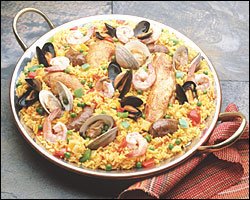
I'm frequently asked where to get a good paella in Madrid. And, since I assume the asker is willing to ignore rule #4 for the moment, my answer is usually Cañas y Barro. It's a small place, decorated in a romantic style whose excesses border on the ridiculous, but the rices, including the authentic (rabbit, snails, garrafo) paella, are expertly made and thoroughly delicious.

I found it the first time when I was working in the municipal archives at Conde Duque. That day, I was on my own for lunch, and since I am a bigger fan of paella than Geoff is, I decided to take advantage of my solitude for a little rice. It was a risk, since some restaurants require a minimum of 2 people per arroz. And I was the only person in there, which made me a little nervous. But the menu assured me they made rices for one, the waiter was solicitous, and the bright yellow dish of aioli he brought to start things off was reassuringly valenciano. And indeed, the shellfish paella that finally emerged from the kitchen was the best I'd ever tasted. Admittedly, I've never been to Valencia. But trust me, it was good.

For the longest time I thought that Cañas y Barro was my personal discovery, mostly because the place was always empty or near-empty when I was there. I've since been proven wrong by the CNN bureau chief. But he also turned me on to the restaurant's zucchini and bacon appetizer, so I can't hold it against him.

Cañas y Barro, Amaniel 23, Tel. 915 424798

Monday, September 19, 2005

Shopping: La Antoja


Found a new gourmet foodstuffs store yesterday afternoon, while I was walking through Lavapies. The tagline for La Antojá translates as "caprices of the palate," and that's pretty much what you get: all those things that the Spanish consider delicacies. Walnuts in honey; artisanal jams; smoked red peppers; and—of course—white asparagus.

(Speaking of which, I once got slammed on a foodie website for an article I wrote in which I referred to white asparagus as "repellently flaccid." To each his own.)

But back to those caprices of the palate: with the exception of Italian pastas and French foie gras, most everything at La Antojá comes from Spain, and most everything comes packaged in pretty little jars and tins. The red-haired owner Belinda was fretting about the unpredictable weather (she couldn't decide if it was time to take down the ice cream freezer), but was helpful nonetheless, steering me away from a bottle of Somontano ("too expensive," she said) and toward a very-attractively labeled Azul y Garanza, from Navarra.

La Antojá is located on c/Argumosa, 26, in Madrid.

Categories: