Friday, March 31, 2006

Vanguardias rusas


I haven't quite figured out the relationship between the Thyssen Museum and the Fundación Caja Madrid, but whatever it is, I like it. They've been co-sponsoring shows for awhile now, spreading the goods between the new Thyssen space and the Fundacíon's small gallery in front of the Convento de las Descalzas. Right now, they've got an impressive show on Russian vanguard going on. I haven't made it to the Thyssen, but last night, in between finally seeing 'Capote" and buying 2 pounds of good coffee at El Mexicano and 2 boxes of vacuum bags at our hardward store (both items hard to come by in Asturias), I rushed through the show at the Fundacion.

And left it, as always, quite taken with the place. It's small--just two rooms—but I like the intimacy, and the fact that you're not beating back hordes from the walls. It's free. And the Thyssen doesn't hog all the good stuff for itself; there was a Malevich series, and some Rodchenko, and a reproduction of that great monument to the III International. Go see--it's there until May 16th.

Wednesday, March 29, 2006

Terms of Endearment II

I'm not the first person to delight in her counter's ability to deduce which search terms bring readers to her blog. But I've noticed that the most common referral lately is from people googling "spanish" and "terms of endearment", and that most of those doing the looking come from countries where Spanish is not the first language. Which has me imagining hundreds (okay, dozens) of people throughout the world searching for the sweet words to whisper in their Hispanic beloved's ear.

So, in the interest of public service, a few to help you along the way: media naranja (literally, "half-orange", or other half); rey/reina de mi alma ("king/queen of my soul">, and my all-time favorite, the simple but effective mi vida("my life"), which can also be adorably abbreviated to mivi.

Monday, March 27, 2006

The Hedonist's Approach to Labor Unrest


Given the Spanish propensity for coming together in large groups (to drink and chat, to protest educational reform, to run with the bulls), you'd think that labor actions would be more dramatic here. They happen alright--I barely made it to my GREs years ago because a rail strike kept all trains from leaving Córdoba for Madrid until midnight, and I nearly lost my hearing in one recent action by airport workers (the strike consisted largely of marching through Barajas blowing police whistles). But in general they don't have the massive impact you see in, say, France.

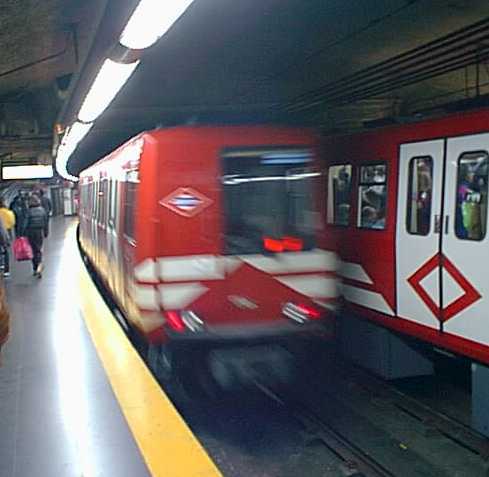
Aside from the fact that any strike in Spain is bound to feel festive simply because, well, there are people standing around together, the strikers themselves often tend not to seem particularly fired up. How else to explain the fact that upon returning to Madrid tonight I found polite signs in the metro warning me of an upcoming labor action? It seems that the subway train drivers of the city are very unhappy about a "deterioration of working conditions" and a "lack of training"--though on who's training is lacking, they don't say. But the degree of their annoyance is obscured by the decidedly milquetoast approach they're taking. The strike won't run for a full day --just from 7 to 9am and from 7-9pm, and even then, only 50% of the trains will be stopped. And the slowdown won't happen every day either--Tuesday and Thursday of this week, and the first three days of the following week. Which means it will stop just in time for everyone, subway workers included, to leave for their Semana Santa vacations.

Thursday, March 23, 2006

Events great and small


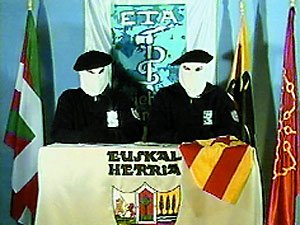
Yes, ETA declared a "permanent ceasefire" yesterday. It was—and is—the only thing anyone is talking about here, and you can tell that behind all the skepticism and calls for prudence, a creeping sense of elation lurks, just waiting until it's safe to come out.

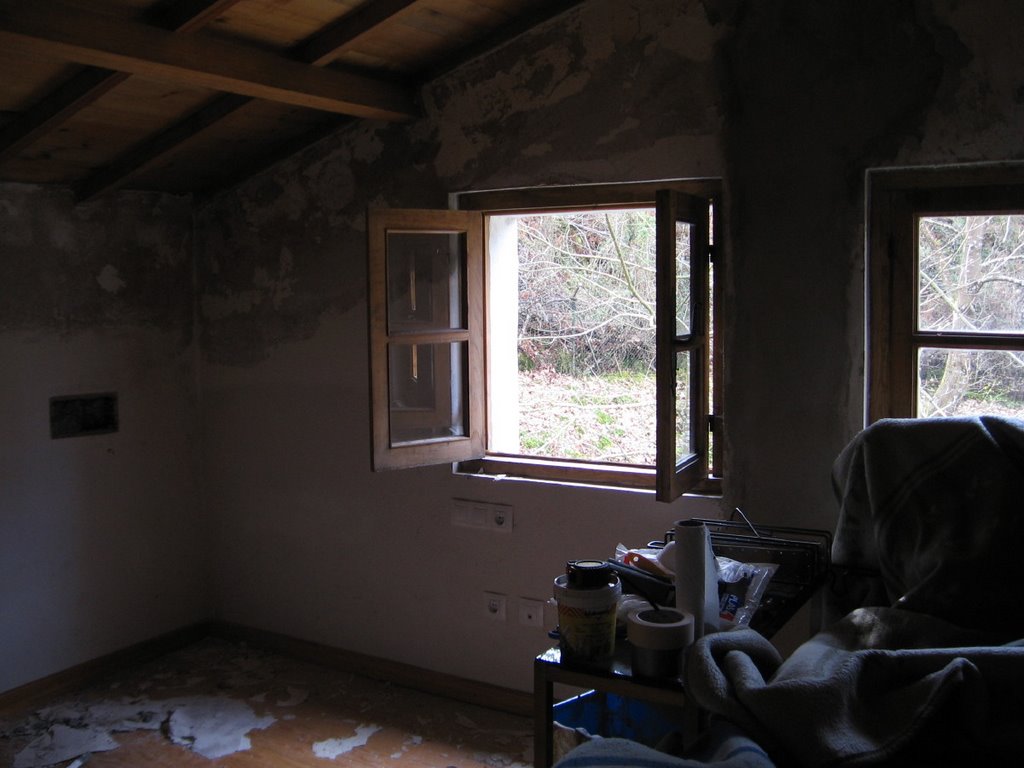
I've been involved with more mundane things, like trying to get the upstairs bedrooms into some kind of shape. It's a daunting task (see above). Not 40-years-worth of terrorism daunting, but hard enough for me.

,

Monday, March 20, 2006

He eats jamon too


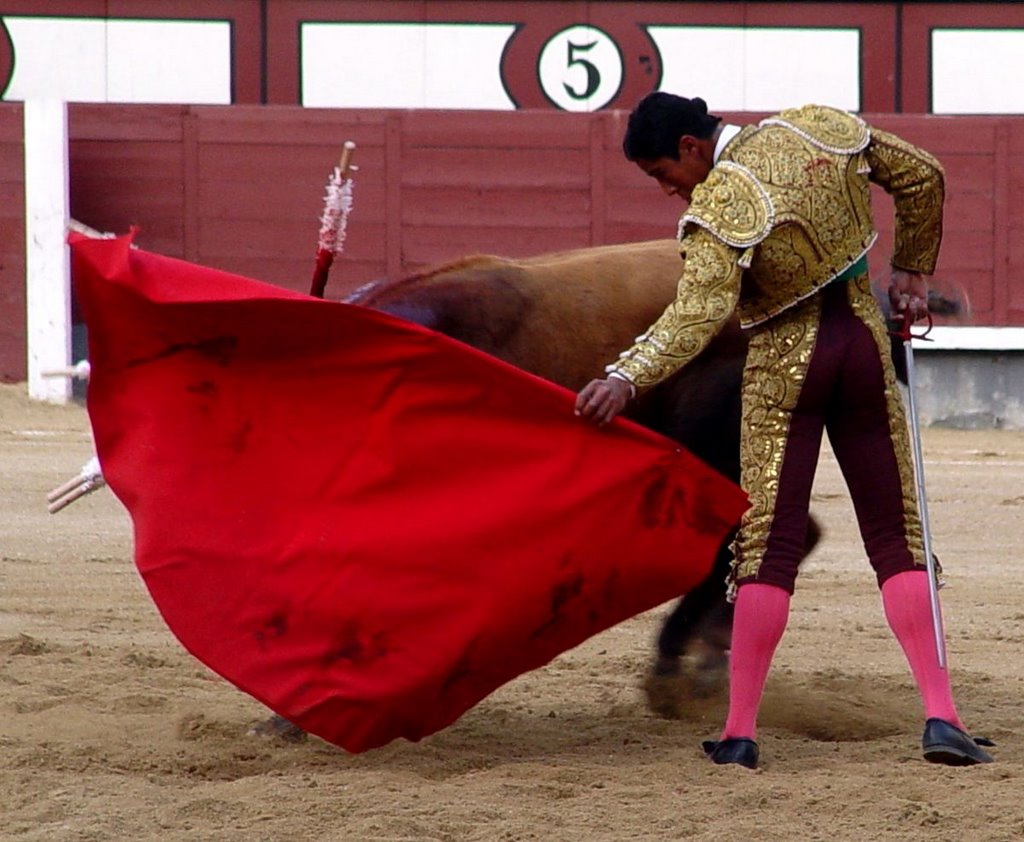
There's a lot to say about Mehdi Savalli, the so-called "Muslim matador," and we say some of it here.

Saturday, March 18, 2006

Ah, youth


Spanish jovenes have long gotten around drinking laws, parental supervision, and the high cost of clubs with the “botellon,” an open air gathering where participants bring their own booze and mixers, and just, well, hang out. (The word translates literally as “big bottle,” in reference to the liter-sized containers of beer often consumed.) But the “macrobotellon” is a new invention, one that was supposed to bring the better part of Spain’s youth into the street last night to party.

It started last month, when students in Sevilla used text messaging to spread the word about an outdoor party held to celebrate the end of exams. About 5000 kids showed up, and the celebration made the national news. Unwilling to be outdone, students in rival city Granada, declared their own “macrobotellon” for this weekend, promised 30,000 attendees, and again spread word of it via text messaging (The same medium was put to more serious ends two years ago when, the night before national elections, it called thousands out into the street to protest the Aznar government’s handling of the March 11th investigation).

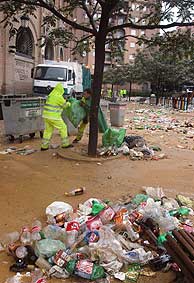
Word of Granada’s challenge quickly leaked out to kids elsewhere in Spain, however, and 22 cities ended up hosting their own “macrobotellones” Friday night. A couple got out of hand: 24 people were arrested in Barcelona, and there were barricades and riots in Salamanca when the police tried to kick the kids out of one square. But on the whole, there wasn't much of a political message, unless "let's get wasted" can be considered a political message. (In fact, the mayor of Granada went on TV saying that the city had to respect young people's right to enjoy themselves, so there you go. Only in Spain). But in Madrid, the whole thing was something of a bust--rain and a heavy police presence made sure of that. Instead, the city's drunken youth all hung out where they normally do: right outside our apartment.

,

Wednesday, March 15, 2006

Terms of Endearment


Twice in the past week I have been called 'cuca.' I figured it was an Asturian word, and I wasn't too worried, since its users sounded friendly, much as if they were calling me 'guapa' or 'maja.' Still, I wasn't sure, and since "cucaracha" is the Spanish word for "cockroach," I wanted to make sure I wasn't being compared to an insect. So I looked it up in an Asturianu-Castellano dictionary and learned that 'cuca' means "a pile of corn husks, or a small mountain of grass." Of course. What every woman wants to be called.

Tuesday, March 14, 2006

Writing in Airports

Now that we have heat and electricity and plenty of hot water, only Internet remains as our most-desired utility. It is, however proving to be remarkably difficult to obtain. The phone we had--which operates via radio waves--couldn't provide it. There is no broadband or cable service to our part of Asturias. And our mobiles get only spotty coverage. Which means that we make daily treks to check our email.

And by trek, I mean trek. The closest spot is the bar in Soto de Luiña. It's only 5 minutes away, but internet comes through a device that looks like an electronic slot machine. You sit on a stool at the screen and try to wrestle the cursor: used mostly by jovenes playing video games, the mouse gets quickly bogged down in gook. On the plus side, there's coffee at hand, and they occasionally give you free food.

There is a real-life internet café in Luarca, some 20 minutes away, but it's closed at midday and at other times, is often overrun by jovenes shouting at their video games, or middle-aged men looking at porn. There is a free, city-sponsored "ciber center" in Cudillero, but it is only open weekdays from 4-8pm, and is often taken up with "How to Navigate the Web" classes. It is also more or less the personal fiefdom of the one man who works there, so whenever he has something else to do, it closes. Yesterday I turned up only to learn he would be out until Thursday: "He just became a papa" was the reason why no one else could unlock the door and turn on the lights.

We thought we were rectifying this situation when, last week, Telefonica came to give us a new satellite phone that would, they promised, allow us to get online as well. Even when we told them we had Macs, multiple people at Telefonica assured us the satellite would work. But, now that the satellite is installed, of course it doesn't. When I called yesterday to see if they could just give us the IP addresses for Macintosh, I was told "We at Telefonica don't know anything about Macintoshes."

So, while we 1) either find someone who does or 2) give in and buy a PC, we are back at our most-favored Internet option: the airport. It's expensive, and it's 30 minutes away, but it has WiFi and we can use our own laptaps. Levon is not so crazy about it, however. He spends a lot of time in the parking lot.


Saturday, March 11, 2006

A Simple Life


In Asturias, I like my life, because this is what’s in it: solitude, Levon, the ocean, the beach, a burning fireplace, daily bread, thick clean air.

Two years seems like forever, or a day...

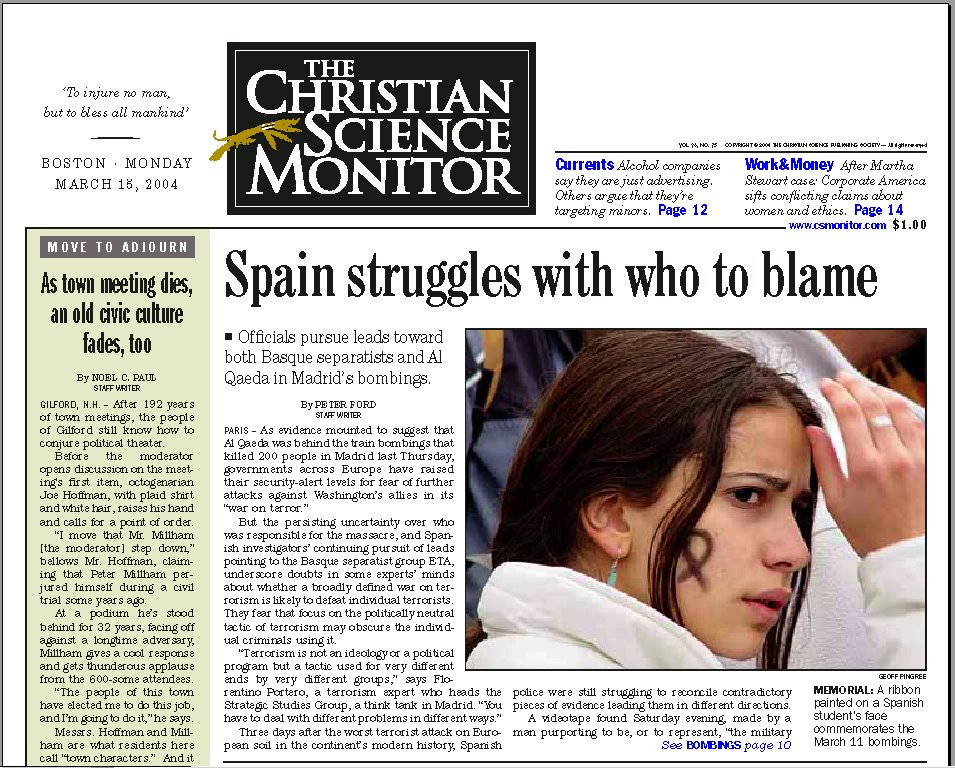
Two years ago today we became, you might say, real journalists. I shot the photo below in the Puerta del Sol where thousands of young people had gathered after the bombings to mourn collectively, and our first big news story was "Terrorist Attacks Jolt Spain." Far different from the story we had filed the evening of March 10th, a piece on the upcoming Spanish elections. Last year the commemoration here was notable; this year, it's more muted, more pensive. With all the political fighting within Spain, and the great uncertainty outside in the rest of the world, we all wonder, I suppose, what the future holds for people of different faiths, convictions, hopes, grievances.

Otro 11-M


Another March 11. Like last year, I spent this one with a television crew, with all the stress and frenzy television crews seem to generate. But Madrid itself is calmer than a year ago, the media less rapacious, the commemorations smaller. Memory fades.

My Madrid has changed, though, perhaps permanently. Calle Genova, which used to mean the Turner English Language Bookstore to me, is now the place where that dramatic nighttime protest took place outside PP headquarters, thousands calling for Aznar to take responsibility. Cibeles, which was once where I went to pick up mail sent "General Delivery" to the central Post Office, is another demonstration, this one filled with millions of people streaming through the pouring rain on March 12th. And Atocha, of course, is something else altogether. Two years ago and one: the candles and flowers and handwritten notes stacked one on top of each other, lining the vestibule and circling the entire exterior.

On Thursday we did an interview at the video monument set up at Atocha when they finally took away the candles and flowers. Gonzalo was a captain in the army, 46 years old, when the bomb went off in the car. He lost most of his hearing, had a lung collapse, suffered burns over half his body. A year later he ran 10 kilometers in a race. But he hadn’t yet been able to make himself view the monument.

He agreed to do it for the interview, saying that he “had to confront” the monument. He walked up to it, his lifelong military training evident in his rigid posture and jutting jaw. He looked at the screens for about two minutes, and broke into tears. It broke my heart.

Monday, March 06, 2006

Staying: Madrid


I spent my first night in Madrid, back in the early 1980s, in a small pension still thoroughly stuck in the Franco era. The rooms were dark, the owners severe, and the “private bath” turned out to be a raised platform with a drain, located right in the middle of the room. I took one shower, flooded the place, and was forced to flee in shame. From there, I moved to another pension, this one located right off the Plaza Mayor. The beds were concave and slightly damp, the shared bathroom just this side of filthy, but the twin dwarf brothers who owned the place were friendly, and they offered me a small, greasy glass of wine each evening when I returned.

Mostly I stayed there because the place cost about 4 bucks a night, which pretty much won me the accommodations category in those latenight bullshit sessions with fellow backpackers. But even when I became a bit more upwardly mobile, I learned that Madrid’s more expensive hotels weren’t all that much better. Of course, the very top end—the Ritz, the Palace—were lovely, ornate places. But most mid-range accommodations throughout the 80s and 90s were dreary at best and subject to unfamiliar standards of cleanliness at worst.

It’s all different now. I’ve written about some of the city’s great new hotels here and here and here, but I’m beginning to lose track of them all. In the last couple of weeks alone, three of the more stylish chains-- Petit Palace, AC, and Vincci—have opened delightful new hotels that combine sleek accommodations with classic Madrid architecture. And more are on the way.

,

Thursday, March 02, 2006

But They're Just Chocolate-Covered Peanuts


Geoff is in Barcelona this week, working on a story about racism and soccer. It comes on the heels of an incident at a Barça game in Zaragoza on Saturday, when the home fans started making ape noises at the Cameroon-born player Eto’o. Unfortunately, that kind of shit has become par for the course at Spanish soccer games. One of the most amazing things that Geoff told me is that one of his sources told him that making ape noises at black players “isn’t racist.” The fans, in his view, just want to insult their opponents. And monkey noises lobbed at black players are, apparently, like any other insult.

Ah, the famous, “It’s not racism” argument. I can’t tell you how many times I’ve heard Spaniards tell me that they’re not racist. When they dress in blackface for costume parties, it’s not racist, it’s “funny.” When Conguitos (translation, “little Congolese”) a type of chocolate-covered peanut, carry a cartoon of a naked African child with thick lips and a distended belly on its label, it’s not racism, it’s “marketing.” And now, when thousands of fans make ape noises at black players—and only black players—it’s not racism, it’s just the enthusiasm of fans.

, ,

Monday, February 27, 2006

The Woodcutters' Revenge

For a little over a week now, woodcutters have been clearing a piece of land near the molino. I can't say I like them: they make a lot of noise, they tear up the already muddy paths, and, oh yes, they're cutting down a bunch of innocent trees.

So when they ill-advisedly decided to drive their big trunk-hauler down the teeny overgrown path that empties into the clearing where we park, only to find the exit blocked by our parked car, I practiced a bit of eco-terrorism on them. First, I pretended like I wasn't home and therefore unavailable to move said car. After about thirty minutes of that, I opened the door and let the by now enraged Levon out, who terrified them for about 30 seconds until he became distracted by a toy. And then I yelled at them a bit, about erosion, and our crumbling fence, and how they path was ours and they didn't have permission to drive down it. (This last bit was something of a fib, but I figured they didn't know otherwise. I was right) They yelled right back, but I felt I had made my point.

I was no more forgiving the next day when I twice found them blocking the road out of the molino; the second time I even threated to file a denuncia, which as far as I can tell, is the ultimate threat in Spain. Soon after, they were keeping to the side of the road, and scowling unhappily at me every time I drove by.

At the end of that same week, the guy from Digital +, our satellite tv provider, showed up to fix our suddenly misbehaving reception. He fiddled for a while with the box, then fiddled some more with the dish, then called me outside. "You want to know your problem?" he asked. I nodded resignedly. He pointed up to a tall patch of eucalyptus trees growing behind the house. "You gotta cut'em down."

Friday, February 24, 2006

Well, At Least She's Consistent


You may remember that several weeks ago the president of the community of Madrid, Esperanza Aguirre, suggested that the new anti-smoking law might be a little too strict. Yesterday, she did indeed sign into effect a ‘revision’ of the national ban that lets workers smoke on the balconies and in the cafeterias of their workplaces, and everybody else during wedding and baptism receptions.

The day before that, however, she decided to go one better than the government on bird flu. Although the ministers of Health and Agriculture have decided that there is no need yet to enclose Spain’s chickens (Spain has yet to find a case of avian flu, though many predict that will come any day now), Aguirre disagreed, and now all farm-raised fowl, including several dozen ostriches on a ranch north of the capital, have to be kept where wild birds can’t reach them.

Madrid’s farmers aren’t happy about the decision, but luckily for the PP, they number far fewer than the comunidad’s smokers. And this way, no one gets to say that Esperanza Aguirre doesn’t care about her citizens’ health.

, ,

Wednesday, February 22, 2006

Whither ETA?


That was the slug for one of the first stories we did that wasn't about the Madrid bombings. And nearly two years later, it is still the question on everyone's mind. For the past month, rumors of an impending truce have been swirling, and Zapatero himself has said that he has information that "the beginning of the end" is near. The possibility has been driving the opposition Popular Party into a frenzy, and statements that the Socialists are "negotiating with terrorists" and conducting politics "on the backs of victims of terror" come in a daily stream.

On Saturday, ETA issued a statement in which it called for compromises, yet made no mention of the supposed truce. Many here take that as a hint that perhaps no cease fire is coming. But that hasn't stopped the hysterical rhetoric of the PP, members of which are now calling for Zapatero's resignation on the grounds that his ETA policies "have failed."

Criticizing Zapatero for a policy that supposedly has him willing to negotiate, and then criticizing him because that policy supposedly fails seems right up there with that old joke about the bad restaurant: "The food was terrible, and the portions were so small!" But calling for his resignation seems downright ridiculous. The PP were in power for 8 years during which dozens of Spaniards were killed, injured or kidnapped in ETA attacks. There has not been a single death or injury since the Socialists have been in power. For this, Zapatero should resign?

,

Monday, February 20, 2006

Another week, another utility


On Thursday we got an electric hot water heater. Actually, we got it on Wednesday, after Geoff insisted that perhaps the electrician and the plumber could stop blaming each other for his absence and actually meet at our house at the same time. They did, though when Fernando the plumber insulted Nacho the electrician´s electrical acumen, the latter left, leaving the former to install the thing.

Which of course couldn't be done in one day. Bright and early the next morning, there was garrulous Fernando and his taciturn assistant Pedro, hard at work. Several hours later, we had copper pipes where our creaky butane heater used to be, and a shiny white tank in the basement. Only problem was that it didn't work.

Seems maybe Fernando didn't know quite as much about electric water heaters as he professed. That may explain why he cornered me in the kitchen for about an hour to hold forth on how we really should have put in a gas (or gasoil, as it's called here) heater. But I thought I detected a smirk when I called Nacho back to ask for his help.

Next, the internet. Any suggestions, anybody?

Friday, February 17, 2006

Fear of flying


A new terminal opened at Madrid's Barajas airport on February 5. Architecturally, it's supposed to be quite spectacular--it was designed by Richard Rogers, the same guy who did the Pompidou Center in Paris. But I've been avoiding it--flying through it, that is--because I already find airports and check ins and security searches trying enough, and I fear this new terminal will make them more so. In the first week after it opened, the nightly news ran a regular segment on the delays, the lost baggage, the construction remains still in plain view, but those, I imagine, are just opening jitters. The real problem is accessibility--to get to the terminal on public transportation you have to get off the metro and onto a bus (from our apartment this comes after 2 changes and an hour long underground ride), and then on to another bus if your flight happens to leave from terminal TS4 rather than T4. Someday, there will be a metro stop directly at the new wing, but last I heard, the municipal and national governments were arguing about who should pay for it.

And speaking of airports, on a flight from Barcelona today, I was reminded of the rule of Spanish flying: the later in the day you fly, the more delayed your flight will be. Instead of getting some flights off on time, both Iberia and Spanair seem to let the little delays of the day pile up for all their flights. So by the time you get to a 5pm departure, like mine today, you can pretty much count on a half hour retraso. And if you happen to take the last flight of the day, as Geoff did last night, you can count on having the airport to yourself by the time you arrive.

, ,

Monday, February 13, 2006

Appearances


I spent the better part of two days last week in plastic surgeons’ offices for a story: Spain, it seems, is home to more plastic surgeons who conduct more plastic surgery, than anywhere else in Europe. It was a very strange experience: the expensive modern art on the walls; the pretty assistants who all wear chic matching suits, like salesgirls at Zara; the patients who retreat to the waiting room clutching slightly bloodied ice packs to their face as they wait for the swelling to go down from their Botox shots. But the strangest of all was how normal everything came to seem, the groups of women sitting in chatty, happy groups making it seem like the decision to have a little taken off here, a little tightened there, is no more weighty a decision than what color polish to choose at the manicurist.

Friday, February 10, 2006

The Smoking Wars


Every since Spain's smoking ban went into effect on January 1, every bar small enough to legally escape the crackdown—and they are many—has posted a handmade sign on its door advertising the fact. Which means that instead of actually preventing smoking in public, the law is simply shuffling the geography of where smoking takes place.

Meanwhile Esperanza Aguirre, the president of the comunidad--or region--of Madrid, is about to shuffle even more. Her government has drafted a plan to "enact" the anti-tobacco law that in fact disactivates it, allowing smoking in bars as long as the ventilation is good and in offices as long as there is a balcony . After all, she doesn't want smokers "to feel discrimated against." The Minister of Health has responded by calling Aguirre's plan illegal, and suggesting that the presidenta is perhaps willing to jeopardize the health of madrileños in order to win votes. Members of Aguirre's cabinet, in fact her very own councillor for health, has responded by calling for the Minister's resignation. Nothing new there--calling for resignations is what the PP seems to do best these days. The crispación continues.

,