Wednesday, April 11, 2007

Eating in Madrid: Sudestada


Even though I had read good things about Sudestada, I was skeptical. For one, because it is the second incarnation of a restaurant in Buenos Aires, and chains—no matter how small or international—make me nervous. For another, because the menu is all over the place, relatively speaking: Malaysian curry puffs, Singaporean dumplings. Kirin beer. But mostly because when it comes to Asian food (or Mexican, but that’s for another day), I wouldn’t trust a Spanish restaurant critic to know a good pad thai if it stood up and started shooting nam pla-flavored endorphins. Harsh, I know, but born of experience.

Though maybe it’s time to review my prejudices. Because Sudestada is great. It’s a small place, which meant we ended up eating at the bar because all of its eight or so tables were booked. And there’s zero décor. But the food is excellent: the Singapore dumplings light and flavorful; the Malaysian curry puff more samosa than anything else, but still delicious; the beef with peanuts glazed with a tangy sauce that had me licking my chopsticks. And for dessert, a dense coconut something—part cake, part pudding—that was achingly sweet, but irresistible. I can’t wait to go back.

Sudestada, Modesto Lafuente, 64; Tel. 915 334 154

Saturday, April 07, 2007

Holy Arrivals, Holy Returns


Even now, Spain is a holy country. Today is Sábado Santo, Saturday of Holy Week. Yesterday was Holy Friday. Tomorrow is Easter, the holiest of the holy days in this holy week.

Last Sunday, many Spaniards walked the streets of their cities and towns carrying palms to initiate a week of welcomes for the country’s many saints, penitents, virgins, saviors.

Thirty years ago today, Spain gave a different, ambivalent welcome to a long-banished prodigal. On Sábado Santo in 1977, the Communist Party returned to the Spanish fold, legally recognized after four decades of enforced absence under Franco.

Communism’s official return to Spain heralded nothing so grand as eternal salvation, of course, and it surely distressed many Roman Catholics—then, still, the country’s national religion.

But this is a place where politics and faith have always had an intimate, if sometimes dangerous, relationship. And so it is perhaps fitting that the day marking the return of the “godless” was quickly christened Sábado Santo Rojo—Red Holy Saturday. Rhetorically, at least, Spain has never been much good at turning away a true believer.

Friday, April 06, 2007


As I was saying: Last night the news was filled with pictures of grown men sobbing helplessly, their capirotes clutched to their chest. Because of the rain, their processions couldn't go out.

In happier Semana Santa-related news, the town of Corleone (yes, that Corleone) has just allowed its nazarenos to once again wear their capirotes during their processions. It seems that not too long ago, all that face-covering enabled certain, shall we say, rivals, to get close to one another, with the expected violent results. But now, Corleone is ready to show that it has transcended the past. At least its recent past. Because those processions date, after all, to the time when Sicily was part of Spain.

Wednesday, April 04, 2007

Elegy


Is it my imagination, or do comings and goings happen faster in Madrid than elsewhere? I was walking around Chueca yesterday, and was moderately surprised to find that The Wok, which I'd swear I had eaten at just a couple of months ago, had metamorphasized into Original. No loss there, but still it was a bit of a surprise: white and beige instead of red and black, birch trunks growing from the floor instead of chopsticks on the table, and a menu whose main ingredients come sourced (partridge from Toledo, cheese from Extremadura) instead of invented by some poor Spaniard pretending to understand Asian food.

But the biggest shock was to see Taberna Carmencita, the old-fashioned bistro beloved by Lorca (and by me), transformed into an Italian restaurant. And not even Italian: Italo-Argentine. The tiles are still there in their astonishing voluptuousness, but what used to be squid in its ink and braised beef cheeks is now arugula pesto and empanadas. Worse, the exterior is as blue as it was once red. Look closely and you can still see the logo--Taberna Carmencita surrounded by a flowery border--etched in the door's glass.

Tuesday, April 03, 2007

Another Reason I Know I'm Not Spanish


It's Semana Santa, and you know what that means: posters of agonizing Virgins and Christs plastered to every shop window. There are a lot of things I've come to appreciate about Semana Santa: the dark, soul-stirring music, the devotion that the men (and women!) who carry the pasos through the crowded night, the solemnity of it all, the 10-day vacation. But the delight and adoration that images of these suffering...can I say it?...statues excites, well, let's just say it's another thing I still don't get.

Wednesday, March 28, 2007

Doh!


Not as bad as "Let them eat cake," but right up there. When Zapatero went on tv last night to answer questions live from ordinary Spaniards (a first for Spanish prime ministers), he made only one gaff. It was just an especially bad one. Asked what a cup of coffee costs by an otherwise not-very-coherent man intent on proving that the government was at fault for rising euro prices (note the cultural difference: in the US he would have been asked the price of a quart of milk), ZP made the mistake first of answering, and then of answering wrong: 80 cents. As someone who just yesterday paid 1.30 for a tiny shot of espresso, I knew he had just got himself into a mess of trouble. And sure enough, all the headlines today are gloating over the Socialist prime minister's clear estrangement from the people.

Still, thanks to a helpful survey provided by today's edition of El Mundo, it turns out that a cup of coffee does cost 80 cents--in the Congress of Deputies cafeteria.

Wednesday, March 21, 2007

From Inside


The view from my room in the beautiful new, Frank Gehry-designed Marques de Riscal hotel. Obscured only occasionally by the sheets of snow that slide down the undulating titanium roof and crash to the ground below.

Monday, March 19, 2007

Happy Father's Day


It's Father's Day in Spain. Pretty much every other place in the world celebrates Father's Day in June (though not all. Estonia: November; Australia: September). But in Spain, the holiday falls on March 19 because, of course, March 19 is St. Joseph's day. As in Joseph, husband of Mary, adoptive father to Jesus. "It used to be a holiday," said our dry cleaner, meaning it used to be a day off. "But now that the politicians have gotten rid of it, you don't even know that it's here."

Well, some of us do. Feliz dia del Padre to ours.

Sunday, March 18, 2007

Spring Awakening


The view outside our window. It's Sunday, it's warm, it's the Plaza San Andrés. What else to do but join the swarm?

Friday, March 09, 2007

Next up: Saltwater Taffy Stands and Jet Ski Rentals


Going in along the road to our little San Pedro beach: a sidewalk. Admittedly, the road is a little precarious for those señoras who can't dart away from moving traffic in the time it takes to round a blind curve at 80 kms an hour. But what's next, umbrella rentals?

Thursday, March 01, 2007

More Adventures in the Heart of Darkness

So I return from a month away to find that both our landlines--Madrid and Asturias--have been turned off. It seems that back when I blocked Movistar from continuing to extort from our bank account exhorbitant amounts for Blackberry connections never made, Telefonica got blocked as well. This is because, of course, they are separate companies.

In any case, because our January bill hadn't been paid, our phone lines were cut off. I called Telefonica yesterday, and asked that the Asturias line be temporarily restored so that I could least call the bank and ask them to authorize payment. The "customer service" representative agreed, and told me that the line would be restored for within 45 minutes. I was happy. About 20 minutes later, I got an automated call from Telefonica telling me that my service had been reactivated. I was really happy. That is, until I tried to dial out.

I called Telefonica back, got a man this time, who told me to be patient, that the automatic call telling me service had been restored didn't necessarily mean service had been restored, and that I should wait another few minutes. Two hours later, our phone still unable to dial anything beyond the Telefonica number, I called again. "Be patient," I was told. Two hours later, I called again. "This can take up to six hours," I was told. "They told me 45 minutes," I said, piteously. "And I got a call telling me it had been restored." "Wait a little while longer," the man said.

When I woke up this morning, the phone still wasn't working. I called again. "Oh, well, there must be a problem," said the "customer service" representative--this one female--who answered. "Let me transfer you to our technicians." I explained the whole story for the, I don't know, 28th time to the technician. "Well, it says here you haven't paid your January bill," she said. I said, "Perhaps you haven't been listening to me. The bank made a mistake and blocked payment erroneously. I would like to tell them to go ahead and pay you guys, but I can't because, even though you told me you would temporarily restore my phone service, and I got an automatic call telling my that said service had been restored, I CAN'T DIAL OUT.

That's when she started shouting. "WE HAVE NO OBLIGATION TO RESTORE SERVICE," she said, loudly. "AND EVEN IF WE DID, IT COULD TAKE TWO DAYS." "So, why," I asked, "did they tell me it would take 45 minutes, and why did I get an automated call telling me it had been restored? Isn't it possible that there's a problem? And if re-activation of the line takes 2 days, and you only give me 2 days to repay the bill before cutting off the line again, isn't it possible that the phone would never be restored in the time you alloted for payment? "FINE," she yelled at me. "YOU'LL HAVE PHONE SERVICE WITHIN TWO HOURS."

Neither of us believed her. And rightly so: 12 hours later, I still can't dial out.

Wednesday, February 07, 2007

Eating in Asturias: Koldo Miranda


Considering that to my mind, Koldo Miranda sits just off the road to the Hipercor, you wouldn't describe it as a beautifully located restaurant. But once inside, you feel like you're out in the country, in an old casona, far from Spanish-versions of Walmarts that sell tires not far from the canned tuna. It's a lovely place, with stone walls done up with glass insets and dark wood.

After many postponements, we finally ate there a couple of weeks ago. And it turns out it was too bad we hadn't made it earlier. Two amuse-bouche: one of squash soup with chorizo mousse, the other bread cut and fried to look like french fries, served with sauces that looked, but didn't taste, like ketchup, mayonnaise, and melted cheese. Then fat clams in green sauce, the best roast vegetables I've ever tasted, and a roast monkfish in saffron saboyan. Then a lot of delicious desserts, most of which we hadn't asked for (the best kind).

And if you had any doubts about the restaurant's ambitions, check out the wine list. Somewhere toward the middle is a Pingus 2001, priced at 1,125. Euros. Pretty good for a joint up the road from Walmart.

Friday, February 02, 2007

More News from Deep Spain


About three weeks ago, the mayor of the tiny mountain village of Fago was murdered. He was driving home at night when his car was apparently ambushed at a turn on the dark road from Jaca. His body was found not far from the site.

The media immediately descended on Fago, and it soon became clear that the mayor was despised by roughly half he population for his refusals to empadronar (or municipally register) people who didn't live in Fago year round and his decisions to restrict construction in the town. It was also suggested that the casa rural he and his wife had spent some 400,000 euros to renovate wasn't doing so well. His decisions, in fact, had divided the town into factions so bitter that if you were on one side, you didn't want to get caught talking to someone on the other. There are only 37 people empadronado in Fago, with maybe 200 more living there, but they sure didn't like each other.

Yesterday, the Guardia Civil finally arrested someone in the case. Turns out he is the former candidate who ran--and lost--to the now-dead mayor, and that the two had long-time disputes over boundaries and livestock. What's more, the arrested ran the only other casa rural in town. Viva la España negra.

Thursday, January 25, 2007

Nightmare on Gran Via


I think every expat in Spain has a Telefonica story to tell. The futile attempts to get phone service installed, the internet routers that mysteriously stop working, the head-bangingly frustrating efforts to get phone service, once installed, turned off. It's practically a rite of passage.

I've been through that passage--many times. So I knew that my visit to Telefonica headquarters was going to be trying. But I had no idea that it would be quite like this.

We had a problem with our bill. Actually, with both bills--land line and cell. With documentation in hand and an admirably Zen-like attitude, I showed up downtown. I was ushered to a desk staffed by security guards where, as if I've accidentally stepped into a 1950's Guardia Civil station, I have to surrender my passport in exchange for a security tag. The tag must be worn at all times, the guard tells me. I put the plastic card around my neck.

"Do you want to speak about your land line or your cell line?" she asks. I tell her both. "Well you can't do anything about your cellphone here--that's Movistar." (Note: Telefonica and Movistar are the same company). Okay, so where do I go for Movistar? "I'm not sure. Maybe on Capitan Something-Unintelligible." Where is that? "I'm not sure."

I decided to stick to the landline. Another security guard comes over. She will be my permanent escort for the rest of the time I'm in the building, I'm told. We go up to the floor where the single, pinched customer service person has her grim office. I tell the security guard I'm surprised that I need an armed escort to talk to someone about charges on my phone bill. She smiles knowingly.

Finally, I--I mean, we--are ushered into the customer service woman's domain. There is no one else around, but she clearly does not have time for me. As I start to explain the problem she interrupts to tell me there is no solution. Of course. But I've been doing this long enough to know that the first answer is always no. So I press on. She interrupts me again to call a colleague and ask about my problem. Colleague tells her they'll review my bill and get back to me within 14 days. Service person hangs up and begins to usher me out the door. I ask another question. Service person rolls her eyes at me and snaps, "If you're going to have multiple questions, could you please ask them while I have my colleague on the phone.?" I start to ask another. But she glares at me and cuts me off to call her colleague.

Nothing, needless to say, accomplished. But as we close behind us the door of what is quite likely the rudest customer service I've ever encountered, my security escort turns to me with a smile. "Now do you see why we need guards?"

Friday, January 19, 2007

Outtakes


I've written about Madrid Fusion, that 3.5-day extravaganza of culinary innovation and ego here. But there are still a few impressions that didn't make it into print, like Ferran Adrià admitting to me that, all technological doodads aside, "what's better than a fried egg?" Or the liquid nitrogenized dollops of olive oil served as hor d'oevres at dinner that, once put in their mouths, had all the stern ladies at the Real Casino blowing smoke out their noses like dragons. Or the woman who pushed her way toward a plate of ham during the massive tapas lunch served in the exhibition hall saying, "It's the only decent thing to eat in this place." In fact, although the hall was fairly teeming with truffles and chocolates and cheese and a never-ending array of small plates born from a back-stage kitchen by trails of waiters, it was the ham stand that drew the ravenous crowds. Ham and the wine to wash it down with. Viva la España.

Friday, January 12, 2007

Old Blood in the Season of Giving


On the last day of the year, in Villaconejos (‘Villa’=‘small town’; ‘conejos’=‘rabbits’), a village thirty miles southeast of Madrid, a crowd of several hundred gathered at 4 pm in the town square to perform what they considered a long-overdue community service: they were going to teach a neighbor a lesson.


Why? This particular neighbor, known as "El Calvo" ("The Baldman"), had terrorized the locals from the day he moved in seven years ago, carrying a large pistol and knife around as he took whatever he wanted from the town's stores, bars, and restaurants, and drove his cars wherever he pleased (on and off the roads).

Only after a local youth confronted El Calvo, in a bar two days before Christmas as the latter bullied the bar's patrons, did things change. Screeming "No more!" the youth gave El Calvo a beating.

Saturday night, El Calvo returned to the bar with a group of toughs, looking to seek vengeance on his aggressor. Not finding the youth, El Calvo and his men trashed the bar instead.

Word spread, and a group of youths starting making plans to punish El Calvo. The Guardia Civil in neighboring Chinchón were called, and several officers were quickly dispatched to meet the crowd gathering at El Calvo's house.

When the officers arrived, El Calvo confronted them with his pistol blazing. After a long mediation, the Guardia Civil arrested El Calvo, along with four others, and took them to the local jail. They also were able to disperse the crowd. But this story was far from over.

The next morning, fuelled by outrage over ETA's airport attack, the townspeople again gathered, and at four in the afternoon, four hundred of them marched to El Calvo's house. Despite the presence of El Calvo's pregnant wife and elderly in-laws, the mob proceeded to burn El Calvo's house, garage, two cars, motorcycle, and truck, among other things.

As they carried out their retribution, members of the group prevented the local firefighters from intervening, and the four Guardia Civil officers who arrived succeeded only in getting the inhabitants out of the house before being forced to stand nearby, watching helplessly.


The episode is eerily reminiscent of the great Spanish playwright Lope de Vega's 1619 play, "Fuente Ovejuna" ("The Sheep Well"). Based on an actual incident that took place in the town of Fuente Ovejuna, in Castile, in 1476, in which a visiting military commander mistreated villagers who then banded together and killed him. When a magistrate was sent by King Ferdinand II of Aragon to investigate, the townspeople, even under the threat of torture, only responded by saying, "Fuente Ovejuna did it.”


After the violence in Villaconejos, the town's mayor, aptly named Lope, said one of the mob approached him and said, "It was all of us, Mayor. The town did this." Despite a police investigation, the townspeople are keeping silent, offering no names, and when asked about El Calvo's expected revenge, they're saying the same thing: "We'll all respond together."

Thursday, January 04, 2007

The Grapes of Luck


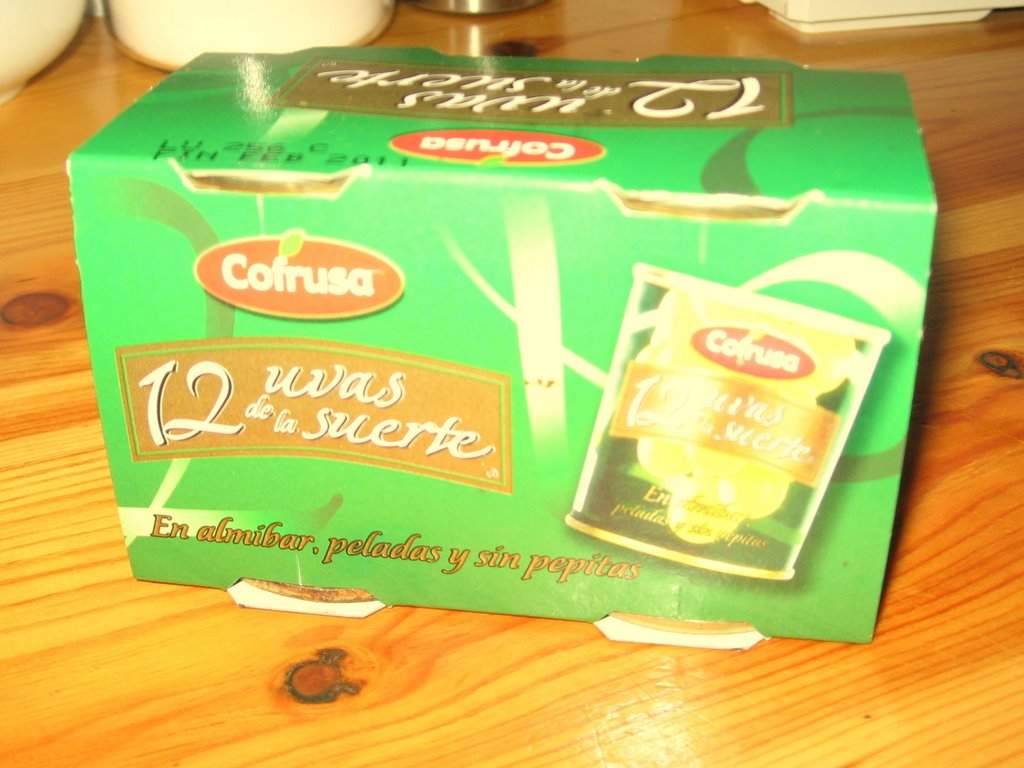
Not everyone counts down from ten. Spaniards start the New Year count at twelve, and accompany each number with a grape, swallowed rapidly. This sounds like some Deep Spain, pre-Christian ritual, but in fact, its the 20th century invention of a bunch of grape farmers who found themselves with too much product on their hands. The solution? Convince everyone that shoving twelve pieces of fruit into their mouths in 12 seconds will bring them a year's worth of good luck.

Of course, Spanish grapes tend to be on the large side, and they invariably have seeds, which means that one's good fortune in 2007 could easily be brought to an abrupt end by choking. But here again, some enterprising Spaniard has found a solution: seedless, peeled grapes in a handy little can. Twelve in each, of course, though two cans come to a pack, the better for romance.

Tuesday, December 19, 2006

Referrals, Holiday Edition


Until recently "Spanish terms of endearment" has been the search phrase that draws the most Googling-viewers to this blog. And most of them, despite what we had imagined in certain romantic moments, are college students. No doubt looking for a quick sweet nothing with which to spice up a final exam.

But in the last month or so, all that has changed. Now our referral list is filled with searches for the Catalan crapper we've described here and here. So as a public service for all of you looking for a little dumper of your own, we hearby bring you the Caganer Website. Like Santa's elves, their artisans spend the summer and fall crafting tiny little crappers that look like that year's celebrities. Last year, the big seller was the Leonor caganer, handsomely carved and painted to look like the Prince and Princess's new baby.

This year, the star caganer is José Montilla (see above). That name likely won't mean anything to those of you who are not Spanish. But tell me he doesn't look like Dick Cheney.

Friday, December 15, 2006

Country Pup in the Big City


We’ve noted that Levon loves living in Asturias. For a dog, what’s not to like?

He chases his tennis ball and rides the surf at the San Pedro beach, he walks along the cliffs to the Faro Vidio, and he wanders around the Molino and its grounds day and night, according to his whims. After his traumatic plane ride across the Atlantic almost a year ago, he probably thought he’d landed in heaven.

Last week, things changed. We had avoided taking Levon to Madrid with us because, with his fear of climbing stairs, we figured we’d never get him up the five flights to our piso. And if we did somehow manage that, we couldn’t imagine repeating it several times a day for walks, bladder relief, and the rest.

But Levon is a different creature since coming to Spain; he’s changed a lot more than I thought he (or any dog) could. As the months have passed, the notion of at least attempting a trip to Madrid with him has seemed less and less crazy.

So we finally tried it.

Last Saturday, after a five-hour drive down and another half an hour trying to find a parking spot, Levon and I approached Almendro 27. With some hope but realistic expectations, I opened the building’s large front door and plunged ahead. I’d decided that I would walk swiftly up the stairs and simply tolerate no lagging or resistance from Levon.

To make a long story short (and sweet), Levon went up and down those stairs dozens of times without a hitch. He was certainly anxious at times, and when we reached the top he always wanted to get inside the apartment door as quickly as possible. But a trip that I had accepted might be a drive down to Madrid and back to Asturias the same day, turned into a week and a half of pleasure (for us) and adventure (for him—and us).


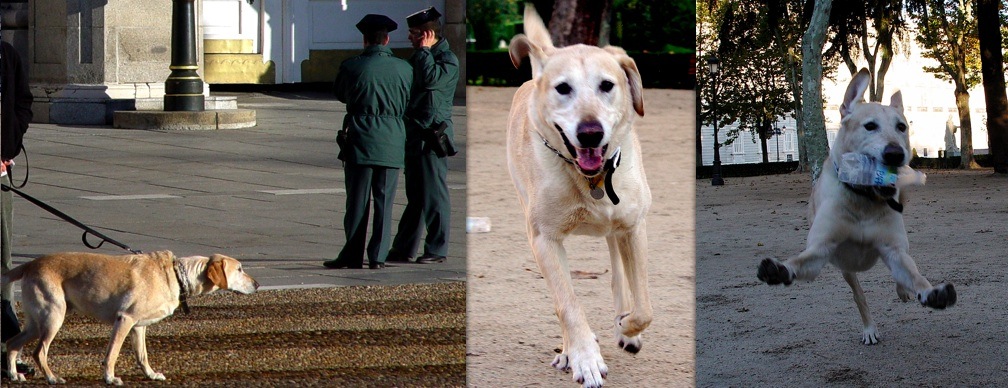
Sunday morning we took him along the Calle Belén to the Royal Palace and the Plaza del Oriente. At first skittish about all the loud noises and sudden movements of the city, Levon quickly realized that he could run and play here, too (if he could just sneak past those pesky Guardia Civil).

And when he was ready for a nap, he found that a bed under the living room window suited him fine.

I think we all expanded our horizons a bit. And Levon, at times the most stubborn dog in the world, discovered that even in Madrid, there’s a place for him.

Tuesday, December 05, 2006

What Every Girl Wants For Christmas


We first noticed them a couple of years ago. Calf-high, low-heeled (no heeled, really), lace-up horrors masquerading as women’s footwear. Suddenly, they were everywhere, filling scores of shop windows with their hideousness, marring the lower extremities of nearly every female under 40. Somehow, wrestling boots had become hip.

We shouldn’t have been so surprised. This is a country, after all, where men happily wear pirate pants, and where the mullet is the default haircut for people of all sexes. The staying power of these ill-conceived booties was, nonetheless, astounding: winter, spring, season after season, Spanish girls kept tying them on.

So it was with some relief that we came across this recent Christmas display. Red suede with black laces: we can only surmise that the wrestling boot has at last jumped the shark and is headed into Spanish fashion oblivion. (Just don’t tell John Irving.)