Monday, August 28, 2006

Under Construction – I


The tearing down, ripping up, digging, hammering, drilling, piling, and all the rest have begun.

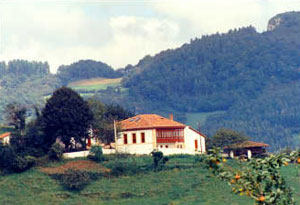
Starting last week, our albañil or contractor, José María, along with his merry partner, Calixto, and surly Bulgarian underlings, Florian and his still-unnamed partner, began the renovation of the Cabaña (the former stable by the Molino) that we’ve been planning, saving for, and dreading for over a year.

The place has been atop a pool of sitting water for a long time, and anything (or anyone, I suppose) maintaining residence there for a length of time begins to grow mold [see earlier ‘Shrooms’ blog post].

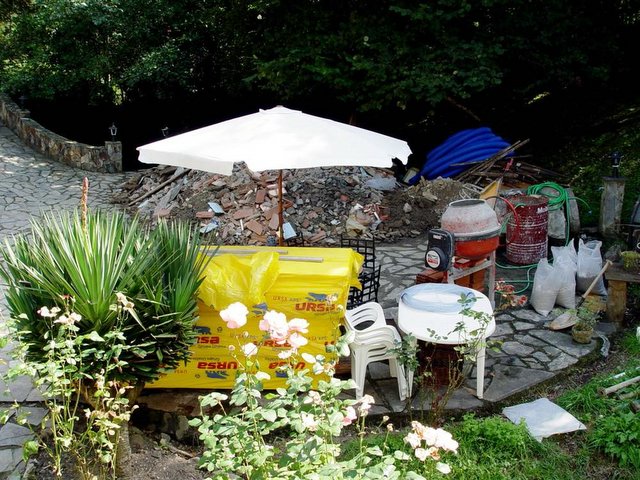
The details of exactly what our loyal crew is doing remain to come, but in this first installment you can see the dramatic effect that the work is already having; our once-spacious patio has quickly been transformed into the dumping ground for everything being expelled from the Cabaña.

We’ve been assured this project will be done in two months’ time. For now, we’ll remain optimistic. Posted by Picasa

Sunday, August 27, 2006

Back to the Barricades

With relief I realized that I hadn’t been thrown back in time.

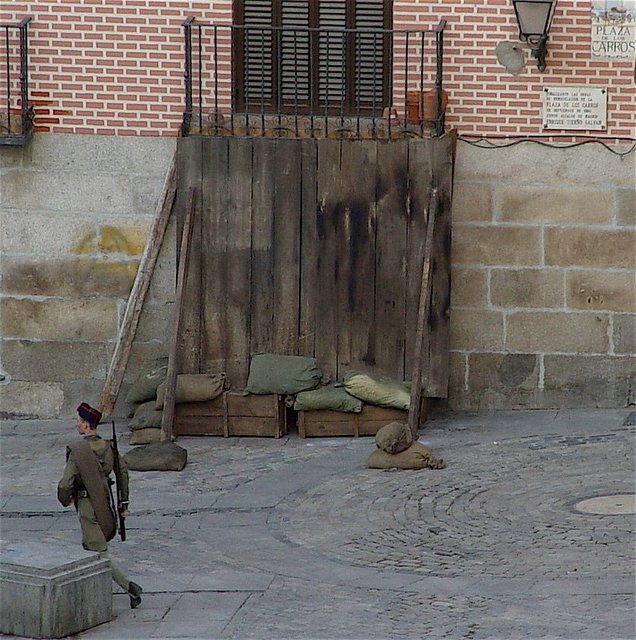
One morning early this week, as I looked out over the Plaza del Humilledero from our Madrid piso’ bedroom window, I was mildly startled: a hastily erected barricade covered part of an apartment building across the way — patrolled by what appeared to be one of Franco’s Nationalist soldiers.
 
Seeking enlightenment, I hastily dressed and descended to the street. Behind the news kiosk where I purchased a copy of El País, the Calle San Francisco, a busy thoroughfare one usually must cross with caution, seemed eerily desolate. Peering down the hill, I discovered why: the police had cordoned off the street and were attempting to manage a rather large gathering of onlookers.
 
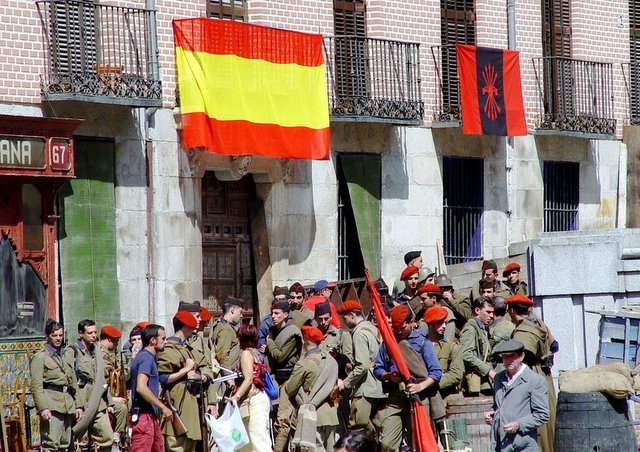
Not one to avoid a mysterious episode of such public interest, I tucked my newspaper under my arm and made my way towards the crowd. There, at the corner of the plaza, beneath Spain’s national colors as well as the Falange’s yoke and arrows, a squadron of red-bereted soldiers had assembled.
 
I noticed a tangle of cables running around my feet, then saw the cameras, light stands, and sound equipment. Opening my paper, I saw the headline: “Nationalist troops enter Madrid again for the production of ‘The Thirteen Roses.’”
It seems my neighborhood, La Latina, was being dressed up to look 70 years younger for Emilio Martínez-Lázaro’s film about 13 girls executed by Franco in August of 1939—apparently with no real evidence—for their political ideas and alleged role in the assassination of a military officer.
I stuck around for a few minutes but didn’t see any shooting—of film or innocent girls—so I headed back up the street, leaving unfinished another episode from the Spanish Civil War.

ALMENDRO Posted by Picasa

Saturday, August 26, 2006

Yes, Manolete, There is a God

 
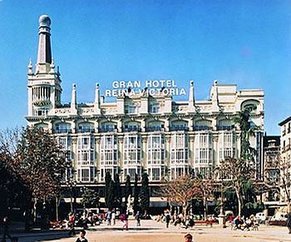
"It's going to be a 24-7, three-dimensional experience," said Trevor Horwell, chief hotels officer for Hard Rock International. "You're going to have moods happening within the rooms, vibes going on within the restaurant and another vibe in the bar."

Vibes within vibes. Just the thing for a hotel that used to house bullfighters like Manolete and their retinues before and after corridas at Las Ventas--a sixth-floor suite functioned as the dressing room where they would don their trajes de luces. Just what the Plaza de Santa Ana, one of the most delightful squares in Old Madrid, needed. The corporate lackies at Hard Rock International tried to pass off their transformation of the once-famous Reina Victoria Hotel as sophisticated. I guess that someone realized that perhaps mirrors etched with David Bowie lyrics and pillowcases decorated with Hendrix-style guitars fell a little short of hip.

But happy day, Hard Rock Hotel Madrid is not to be. The hotel's owner, the Tryp corporation, backed out of the partnership earlier this month. The reason, they said, was because the Hard Rock brand was about to be sold to another company. But I like this quote from Tryp's Dommunications Director. "No one really understood what being a Hard Rock Hotel meant." Least of all Manolete. Posted by Picasa

Monday, August 21, 2006

Curioser and Curioser


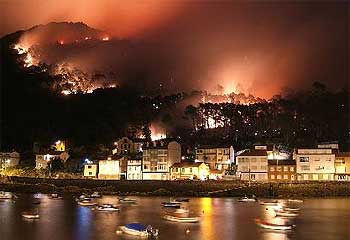
The fires that have consumed large swaths of Galicia were put out last week, but the controversy over who started them—and why—blazes on. At first it was the odd woman found in the woods, matchbook in hand, then the town drunk, then a few out-of-work firefighters who were arrested. Now, there are more than 30 people behind bars—ages 17-70—but no one seems any closer to an answer.

Which hasn’t kept anyone from voicing suspicions. In addition to the reasons we discuss here, a lot of academic-types are floating the idea that the fires represent a form of social protest, with modernization (whatever that means) as the likely culprit. The 20,000 people who showed up in Santiago yesterday to protest against impunity for “incendiary terrorists” (and broke out their old “Nunca Mais” t-shirts for the occasion) suspect something else is up: a vast conspiracy of greedy developers eager for the land.

And then there are those who argue that there isn’t anything new going on here at all, just regular Gallegans solving their land claims and petty jealousies and village outrages the way they always have. Very Fuenteovejuna-esque. As one anonymous Guardia Civil told El Pais last week. “Galicia is a culture of fire.”

Friday, August 18, 2006

What Could Have Been


Like nearly every expat looking for change, we briefly toyed with the idea of opening an inn. Back before we bought the molino, we came very close to buying the Casona del Tilo, a big old Asturian farmhouse not far from Villaviciosa that two Spaniards had turned into a bed and breakfast.

We spent one night at the Casona, as sort of a trial run. The next morning, on our way out, we visited El Malain, a self-serve berry farm nearby where I eventually made myself sick from eating too many raspberries. The whole time we were there picking fruit, I fantasized about inn-keeping life, fantasies that mostly revolved around collecting fresh eggs daily from the chicken coop out back and making jam for our guests' breakfasts from the blackberries we could get at El Malain.

Eventually we remembered that innkeeping also involved a lot of dirty sheets and few days off, and that, more to the point, the Casona's price tag was several hundred thousand euros to the north of what we could afford. But I still have those homesteading impulses, which is why we spent the morning earlier this week back at El Malain filling far more boxes with berries than we could eat. Or at least with more than we could eat before mold overtook them--another lesson in keeping one's fantasies in proportion to one's reality.

Wednesday, August 16, 2006

Downbeat


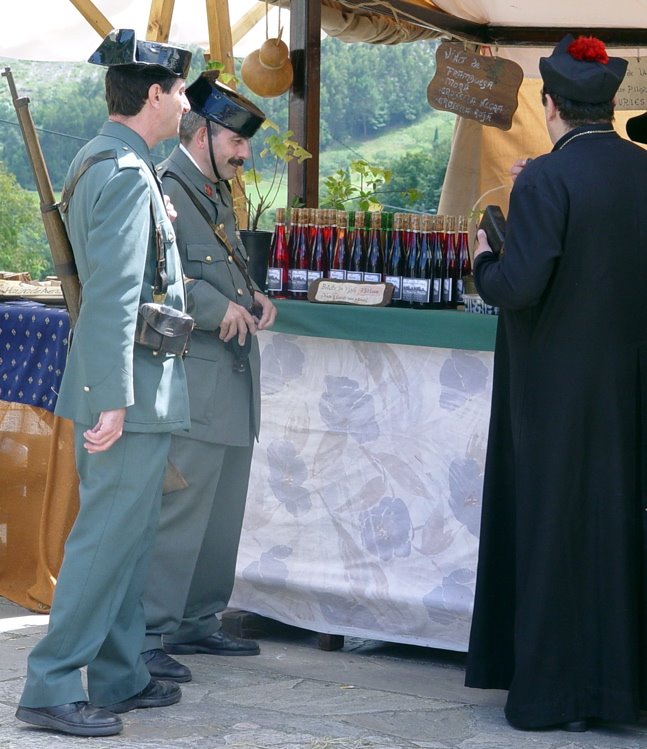
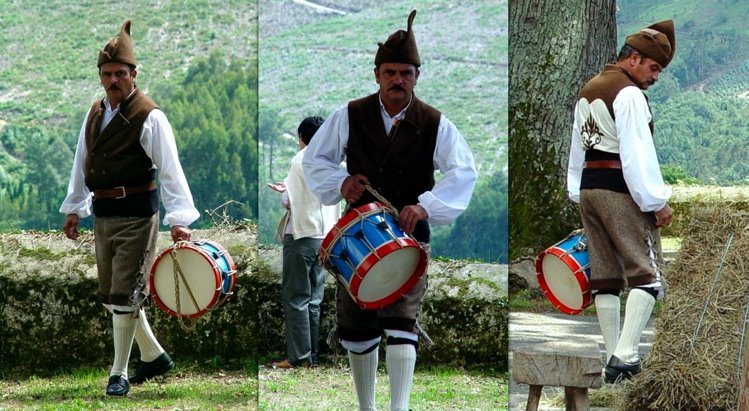
Saturday we drove to San Martín de Luiña for its mercado vaqueiro, where each year the townspeople evoke their agricultural past in clothing and cuisine. We encountered a sly priest, who never strayed far from the stand selling home-brewed spirits, a couple of hapless guardia civil, and some roving minstrels. All were jolly except for a solitary drummer, who--no matter where we found him--never lost his scowl.

Monday, August 14, 2006

Invasion of the Blobs


It is no secret that Spain witnesses a mass exodus (or 'Operacion Salida', as the traffic cops call it) every August as most of the population leaves one place for another. Up in Asturias, we've watched with amazement as lines form at our tiny grocery store, and campers fill the parking lots. But of course most Spaniards head to the Mediterranean coast, the better to bake themselves on a beach during the day, and spend their nights drinking in tacky bars by night. Ah, vacation.

There is not much that could tempt us to visit Benidorm or its ilk in August. Between the traffic, the heat, and the hordes of British and German tourists toasting to a bright lobster red on the sand, I, for one, would just as soon forgo the vacation all together. And now, in case we needed it, we have one more reason to avoid the lemming-like trek to the sea.

Sunday, August 13, 2006

New Shrooms


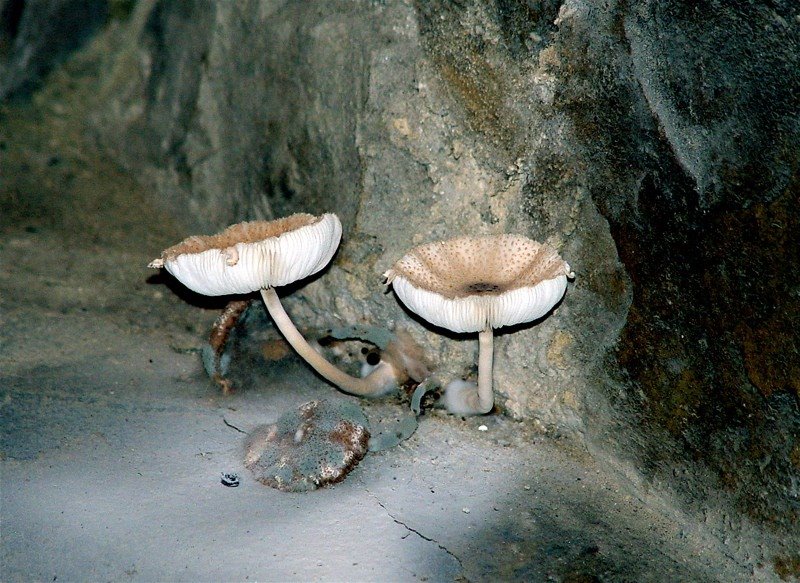
Asturias being an especially fertile place, things grow well here. Nonetheless, I was somewhat taken aback by the pair of mushrooms sprouting from the stone floor of the Cabaña (formerly the stable).

I suppose it's only fitting that this week we finally begin our renovation of the building, a thorough makeover that will include replacing the roof, rebuilding the rear wall, and laying down a new floor--beneath which will exist a drainage system to prevent moisture from settling.

The Cabaña's floors have been sweating since we purchased the property, making it largely uninhabitable as a guesthouse. We hope that in two months' time we'll be telling a different story.

Monday, August 07, 2006

Boared


Saturday morning I arose quite (in-the-dark) early so I could squeeze in a run with Levon on the San Pedro beach before the hordes of August vacationers descended (the arrival of this summer swarm of humanity has occasioned the appearance at San Pedro of several new "PERROS PROHIBIDOS"--"DOGS PROHIBITED"--signs, so these days I have to get in and out before anyone's the wiser).

As we drove up the steep incline from the Molino, and then sped along the road that winds through the forest and fields before reaching Oviñana, the nearby town, my scheme was thwarted--temporarily, at least.

Since taking over the Molino nearly two years ago, various locals had spoken of a jabalí, or wild boar, that stalked the woods surrounding our place in the nocturnal hours. We had never seen this creature, however, and so had thought little of the rumors. Today that changed.

Smugly anticipating the empty beach ahead, I was stopped short as the car's headlights caught not one, not two, not three, but four jabalí, walking leisurely in a pack along the road ahead.

The sight alone startled me and got Levon, who was sprawled sleepily across the back seat, up on all fours, hackles raised. But I was further astonished when the group turned and began--fearlessly, almost curiously--to approach the car.

As the jabalí surrounded us, I had visions of an ugly, sensational, and most unexpected demise. My instinct was to gun the engine and get past these brutes, but I didn't really want to run one over (both for fear of raising the ire of the others, and because I was technically outside the limits of the nearby hunting zone and would have no justification for my actions later, should I need it).

For a very long three minutes, I sat still, mostly listening as the beasts brushed along the front, sides, and back of the car, only occasionally glimpsing their raised dorsal bristles through the windows.

Finally, they reappeared as a group a few feet in front of the car and, as if following a practiced routine, turned as one and trotted off the road through a gap in the brush to the left.

After a brief pause, during which I thought with regret how I had nearly brought my camera to get a shot of the sun's first appearance at the beach, I put the car in gear, and we proceeded, still in darkness, to San Pedro.

Friday, August 04, 2006

Buskers


For years, it seemed, Madrid's street performers were confined to your run-of-the-mill accordionists and wistful travelling Germans strumming out slightly off-key Beatles songs. But now, every summer seems to bring a new addition. First it was the Thai massage people, who would congregate at the Plazas del Oriente and Mayor and corral weary tourists into sitting on a stool and getting their muscles rubbed. (You may not think of the massage as performance, but believe me, the sight of an overweight, sunburned, somewhat embarrassed American having her limbs pulled this way and that by a wiry Asian man is nothing if not a spectacle.)

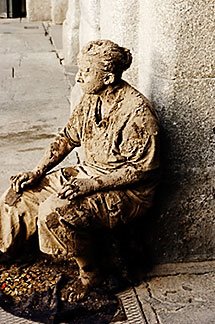
Then came the living statutes. On this front, Madrid continues to lag far, far behind Barcelona, where the rivalry among performers who stand around in outrageous costumes (my favorite: a talking head nestled in a big pan of paella) is fierce. Not only are there fewer in Madrid, but they tend not to do much.


This summer's addition to the scene appears to be guys playing water glasses. In one afternoon I spotted two of them, each dressed in a white shirt and tie (because, after all, water-glass-playing is a formal business), each rubbing his finger around the rims of water glasses until they released the dulcet strains of, why yes, Hey Jude.

Wednesday, August 02, 2006

More Adventures in Spanish Medicine

I went to the doctor's last week and was directed down the hall to the waiting room. When I walked in, there were about six or seven people already sitting in the small room, male and female, most of them older. As I sat down, I felt a little uncomfortable, as if they were all looking at me expectantly. I couldn't figure out why until the next patient walked in. "Buenos dias," he said, as he took a chair. "Buenos dias," they all replied in unison. Same chorus with the next patient, and the next. Apparently I am the only one who doesn't know waiting room etiquette.

After I had to get in a taxi to go for a blood test (these are almost always done in separate labs, far from your doctor's office). "You haven't eaten anything, right?" asked the technician who took my blood. When I told her that no, I hadn't, she handed me a voucher for breakfast at the corner bar. Because no one should suffer the hardship of going more than a few hours without food in Spain.

Thursday, July 27, 2006

Seeing: Cristina Garcia Rodero


For years, a book called Espana Oculta has sat on our coffee table in Oberlin, there even when we aren't. A collection of photographs by Cristina Garcia Rodero, it's always been one of my favorite art books, filled with gorgeous black and white pictures of widows in black and first communion girls in their wedding dresses, horsemen pulling off the heads of dangling chickens as they (the horsemen) gallop by, fierce demons jumping over newborns set in a line on their backs in the street. All the weird, fascinating rituals that make up Spanish popular religion, in other words. Through Garcia Rodero's lens they seem especially mysterious, even terrifying.


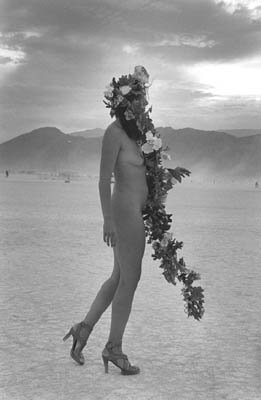
So it's interesting to see her latest work, which isn't about what goes on during festival days in small Spanish towns, but what goes on in the Nevada desert for a week each summer: Burning Man. The exhibition is part of this year's PhotoEspana extravaganza, and its subject--strangely dressed (or undressed), participating in a ritual of their own making--is just as fascinating. It's at the Juana de Aizpuru gallery until Monday.

Juana de Aizpuru Gallery, Barquillo 44

Monday, July 24, 2006

Taxi Driver - the sequel


The diversity of Spanish cab drivers may only be matched by their willingness to tutor you on whatever topic you bring with you into their vehicles.

Whereas the last taxista to earn a place on this blog had waxed long in the tradition of esoteric philosophical critics, the man shown above deserves notice for being an acute observer of contemporary popular culture.

At my mere mention of movies, this gregarious fellow, presuming that I was from the U.S. (a place he made clear he'd never visited), spent the entire half-hour ride not only affirming that Hollywood films offer an accurate portrayal of American society, but insisting that what such movies reveal is just how puritanical Americans really are.

Then proposing that Spain was more advanced in such matters, he proceeded to describe, in quivering detail, his favorite scenes from Spanish films in which Penélope Cruz disrobes.

I'm not taking issue with the man's views, and I certainly can't fault his passion, which seemed to prevent him from noticing (or caring) that he, alone, did all the talking--or that I snapped a picture of him at his pontifical best.

Sunday, July 23, 2006

Why Politicians Need Image Consultants


Photographs involving Heads of State that provoke the question 'Whatever Were They Thinking?': the Monica-Clinton Beret Clinch; the Bush Assault on a German Chancellor's Shoulders, and now, Zapatero Dons the Kefiya. Given the expression on his face, I tend to think that he was just trying to fit in with all the cool kids at the International Socialist Youth Conference. But still.

Regardless of whether Zapatero's momentary predilection for ethnic wear was accidental or intentional, I found myself agreeing with the editorial in this morning's El Mundo that chastized him for not knowing better. In part because that little sartorial decision has only fueled the shrillness coming from the other side (e.g. "We demand to know why a ruling party in Europe, for the first time since the 1930s, has patronized an anti-semitic demonstration," said Eduardo Zaplana, PP spokesman, referring to Thursday's peace march). But mostly because when you start wearing one side's logo, you pretty much rule yourself out as a mediator. Unless, of course, Zapatero shows up to work tomorrow in a yalmulke.

,

Friday, July 21, 2006

No, I didn't try it


Just last week one of our editors requested anecdotes from all her correspondents for a story on international ice cream-eating habits. At the time, we couldn't come up with anything quirky or endearing that Spaniards did with their helados, (although there was a segment on the nightly news last year about its health benefits: "Ice Cream: As Good for You as Ham and Coffee"). But today, for the first time, I traveled to Valencia, where along with the fantastic modernist market (live eels, ostrich eggs, one stall selling nothing but different varieties of beans); the Plaza Redonda, where a dozen ladies sat tatting, their wooden spools clacking; the soaring Gothic interior of the old silk exchange; and other unexpected delights, I found Gelateria Llinares.

Gelateria Llinares has regular flavors (chocolate, vanilla, strawberry) and exotic flavors (papaya; blueberry cheesecake--or as it's known here, 'Philadelphia'). And then there is something else. Gazpacho ice cream, for example. Lentil ice cream. Tortilla de patatas ice cream. And my personal favorite, Mussels in Vinaigrette Ice Cream. All of them piped and swirled into attractive swirls, and garnished beautifully with key ingredients (a handful of raw lentils sprinkled like confetti on one; a black shell propped jauntily on another.)

Monday, July 17, 2006

Eating in Barcelona: Bubo


Earlier this year I noticed that the candle shop that used to be on the corner next to our first apartment in Barcelona had changed into a bakery. It was just as well; I never saw too many customers in the candle store, or, for that matter, too many candles (that's Barcelona minimalism for you).

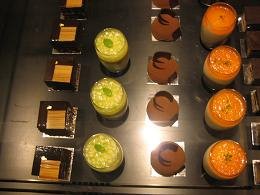
In truth, 'bakery' doesn't seem like the right word for Bubo: there is no smell of yeast, no warm air coming off the ovens. What it does have, however, are gorgeous cakes--some of them individually sized, some of them not--all of them decorated and displayed like some kind of postmodern jewel. Sacher torte, vanilla cream wrapped in white chocolate, tiny lemon sablee tarts. Also: swirls of chocolate and pistachio turned into lollipops, and homemade sugared marshmallows, that to my mind (if not my mother's) taste like really good, papaya-flavored Peeps.

In the course of doing research on Bubo for this piece, I learned that the name comes either from 1)a children's word for "yummy" or 2)the abbeviation of bueno and bonito. I almost volunteered the information that in English, at least, bubo also refers to the boil-like extrusions caused by the plague, but thought better of it.

Bubo, 10 Carrer Caputxes; tel 93 268 7224

Saturday, July 15, 2006

In the Kitchen


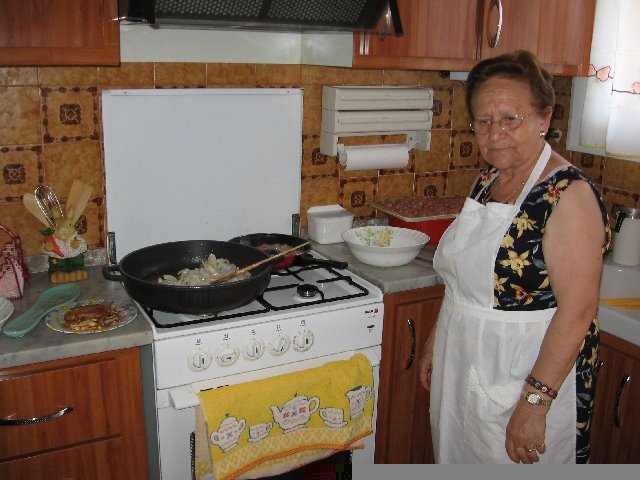
About this time a week ago, I was standing over a hot stove in a stifling kitchen, watching Carmen Barrios (above) prepare her trademark meatballs with squid. Carmen is one of the Cocineras de Sils (they used to be called The Grandmothers of Sils, but that was before a couple of 38-year-olds joined the group), a collective of about 100 women dedicated to preserving the traditional cooking of Catalonia. She is also the sort of woman who brings to mind the word "pistol."

When I met Carmen, she was cooking for The Cocineras' annual dinner. The Cocineras have published cookbooks, demonstrated how to prepare pollastre amb salsafins at the Hotel Ritz in Barcelona, received awards in Madrid, and appeared on television and radio with Arzak and Adria. But the dinner is what they most look forward to: the spiffed-up gym as dining hall, the adulatory speeches, the band with two female singers in matching dresses who complement their repertoire of pasodobles and foxtrots with synchronized dance moves. And of course, there's the food: 94 tortillas, 94 casseroles, and a whole lot of cake, all made by the Cocineras.

Carmen didn't waste any time. As soon as she saw me at the dinner, she marched up--recently coiffed hair bobbing, high heels clicking--and demanded in that machine-gun voice of hers, "Don't I look great?" Then she went off to ask the table that got her casserole if they didn't love her meatballs.

Tuesday, July 11, 2006

Back


Sorry about that. We went off to Guatemala with the best intentions of posting regularly from our backlog of ideas for wry observations on Spain. Somehow we never got around to it.

In the month that we've been gone, Catalans approved the Statute that will grant them more autonomy, Barcelona banned bullfighting, the Pope visited Valencia, (in the process giving Zapatero yet another chance to prove his Socialist creds by refusing to attend the Mass), and Spain startled everyone by actually winning games at the World Cup before reverting to its usual habit of inexplicable losses.

Closer to home, our normally deserted beach is packed with vacationers as half the country goes on its month-long holiday (the other half will arrive in August). A new, somewhat-better-than-Arbol grocery store opened 10 minutes away. And thanks to Geoff and his dad, our bedroom is looking a lot nicer.

Tuesday, June 06, 2006

Decentralized medicine

Geoff and I first got to know each other in a Red Cross hospital in Cordoba (a mutual friend had a sudden attack of appendicitis), so I've always had a soft spot for Spanish medicine. Especially the pharmacies, where the job is taken very seriously, and prescriptions are only occasionally necessary. Spanish pharmacists fulfill a role somewhat closer to doctors than they do in the US: often you can walk in, describe your symptoms, answer a few questions, and walk out with just the thing for what ails you. And in general, we've been delighted to learn that things like heavy-duty cough medicine with codeine (it's allergy season and the whole country is suffering from the highest pollen counts in the past 20 years) are ours just for the asking.

But I have to admit to being more shaken than pleased when we discovered that the way to secure the hepatitus vaccine we need for an upcoming trip was to go to the pharmacy and request it. For 25 euros, a pharmacist will hand over a loaded syringe, packed in ice so that you can get it safely (these are live viruses after all) home to your refrigerator. A Spanish pharmacist will not, however, no matter how much you beg, actually inject the vaccine for you. For that, you're left to your own devices ("Try the clinic," ours recommended. "Or you can do it yourself.") And while I appreciate the apparent trust in my medical capabilities, I couldn't help but wish on this one occasion for a little more oversight.

Friday, June 02, 2006

Death of a Diva


You can live in a country for years, you can start to think that you really get a culture, and then, blammo, something like this happens to remind you that, no, you are always and will always be a foreigner. Rocio Jurado, famed singer of that unpalatable sap known as cancion espanola died yesterday after a long battle with pancreatic cancer. If you happened to be in Madrid, you could have joined the 22,000 people who turned out to pay their respects as her body lay on display in the Centro cultural de la villa.

Cancion espanola singers tend to be of a type: buxom, leaning toward stocky and away from pretty (though you would think they all looked like Giselle Bundchen from the way they carry themselves). They marry bullfighters and have children who grow up to cause them heartache, and then, as if in middle-aged revenge, they adopt one or two more, usually from Latin American countries. They squeeze into flamenco dresses for their annual pilgrimage in honor a favored Virgin. They mount expensive comeback tours. They are regularly featured in the pages of Hola!. And when they die, their passing is greeted with the fervor that normally accompanies dead popes and dictators.

When Lola Flores, another cancion espanola singer--she also dabbled in flamenco and appeared in a number of films--died a little over a decade ago, her son was so overcome that he killed himself. And no one here, no one , thought to suggest that perhaps that response was a little extreme. So perhaps I shouldn't have been surprised yesterday that the morning news was completely--I mean, not one second devoted to anything else--given over to Rocio's death. Perhaps I shouldn't have been surprised that among those who paid their respects yesterday were the King himself and Pedro Almodovar, just back from Cannes. And I probably shouldn't have been surprised that her remains, already viewed by those tens of thousands in Madrid, are again on view this morning in Chipiona, her hometown. I shouldn't be surprised, but instead I keep wracking my brain for a corollary that will make sense of it all. Would Americans have this response to the passing of, say, Barry Manilow?