Thursday, July 27, 2006

Seeing: Cristina Garcia Rodero


For years, a book called Espana Oculta has sat on our coffee table in Oberlin, there even when we aren't. A collection of photographs by Cristina Garcia Rodero, it's always been one of my favorite art books, filled with gorgeous black and white pictures of widows in black and first communion girls in their wedding dresses, horsemen pulling off the heads of dangling chickens as they (the horsemen) gallop by, fierce demons jumping over newborns set in a line on their backs in the street. All the weird, fascinating rituals that make up Spanish popular religion, in other words. Through Garcia Rodero's lens they seem especially mysterious, even terrifying.


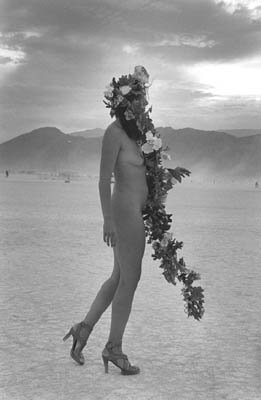
So it's interesting to see her latest work, which isn't about what goes on during festival days in small Spanish towns, but what goes on in the Nevada desert for a week each summer: Burning Man. The exhibition is part of this year's PhotoEspana extravaganza, and its subject--strangely dressed (or undressed), participating in a ritual of their own making--is just as fascinating. It's at the Juana de Aizpuru gallery until Monday.

Juana de Aizpuru Gallery, Barquillo 44

Monday, July 24, 2006

Taxi Driver - the sequel


The diversity of Spanish cab drivers may only be matched by their willingness to tutor you on whatever topic you bring with you into their vehicles.

Whereas the last taxista to earn a place on this blog had waxed long in the tradition of esoteric philosophical critics, the man shown above deserves notice for being an acute observer of contemporary popular culture.

At my mere mention of movies, this gregarious fellow, presuming that I was from the U.S. (a place he made clear he'd never visited), spent the entire half-hour ride not only affirming that Hollywood films offer an accurate portrayal of American society, but insisting that what such movies reveal is just how puritanical Americans really are.

Then proposing that Spain was more advanced in such matters, he proceeded to describe, in quivering detail, his favorite scenes from Spanish films in which Penélope Cruz disrobes.

I'm not taking issue with the man's views, and I certainly can't fault his passion, which seemed to prevent him from noticing (or caring) that he, alone, did all the talking--or that I snapped a picture of him at his pontifical best.

Sunday, July 23, 2006

Why Politicians Need Image Consultants


Photographs involving Heads of State that provoke the question 'Whatever Were They Thinking?': the Monica-Clinton Beret Clinch; the Bush Assault on a German Chancellor's Shoulders, and now, Zapatero Dons the Kefiya. Given the expression on his face, I tend to think that he was just trying to fit in with all the cool kids at the International Socialist Youth Conference. But still.

Regardless of whether Zapatero's momentary predilection for ethnic wear was accidental or intentional, I found myself agreeing with the editorial in this morning's El Mundo that chastized him for not knowing better. In part because that little sartorial decision has only fueled the shrillness coming from the other side (e.g. "We demand to know why a ruling party in Europe, for the first time since the 1930s, has patronized an anti-semitic demonstration," said Eduardo Zaplana, PP spokesman, referring to Thursday's peace march). But mostly because when you start wearing one side's logo, you pretty much rule yourself out as a mediator. Unless, of course, Zapatero shows up to work tomorrow in a yalmulke.

,

Friday, July 21, 2006

No, I didn't try it


Just last week one of our editors requested anecdotes from all her correspondents for a story on international ice cream-eating habits. At the time, we couldn't come up with anything quirky or endearing that Spaniards did with their helados, (although there was a segment on the nightly news last year about its health benefits: "Ice Cream: As Good for You as Ham and Coffee"). But today, for the first time, I traveled to Valencia, where along with the fantastic modernist market (live eels, ostrich eggs, one stall selling nothing but different varieties of beans); the Plaza Redonda, where a dozen ladies sat tatting, their wooden spools clacking; the soaring Gothic interior of the old silk exchange; and other unexpected delights, I found Gelateria Llinares.

Gelateria Llinares has regular flavors (chocolate, vanilla, strawberry) and exotic flavors (papaya; blueberry cheesecake--or as it's known here, 'Philadelphia'). And then there is something else. Gazpacho ice cream, for example. Lentil ice cream. Tortilla de patatas ice cream. And my personal favorite, Mussels in Vinaigrette Ice Cream. All of them piped and swirled into attractive swirls, and garnished beautifully with key ingredients (a handful of raw lentils sprinkled like confetti on one; a black shell propped jauntily on another.)

Monday, July 17, 2006

Eating in Barcelona: Bubo


Earlier this year I noticed that the candle shop that used to be on the corner next to our first apartment in Barcelona had changed into a bakery. It was just as well; I never saw too many customers in the candle store, or, for that matter, too many candles (that's Barcelona minimalism for you).

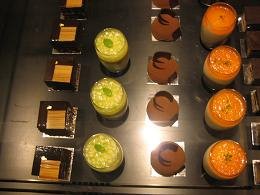
In truth, 'bakery' doesn't seem like the right word for Bubo: there is no smell of yeast, no warm air coming off the ovens. What it does have, however, are gorgeous cakes--some of them individually sized, some of them not--all of them decorated and displayed like some kind of postmodern jewel. Sacher torte, vanilla cream wrapped in white chocolate, tiny lemon sablee tarts. Also: swirls of chocolate and pistachio turned into lollipops, and homemade sugared marshmallows, that to my mind (if not my mother's) taste like really good, papaya-flavored Peeps.

In the course of doing research on Bubo for this piece, I learned that the name comes either from 1)a children's word for "yummy" or 2)the abbeviation of bueno and bonito. I almost volunteered the information that in English, at least, bubo also refers to the boil-like extrusions caused by the plague, but thought better of it.

Bubo, 10 Carrer Caputxes; tel 93 268 7224

Saturday, July 15, 2006

In the Kitchen


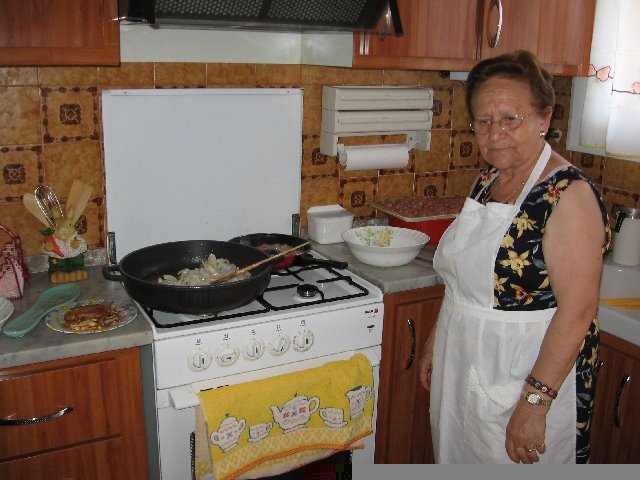
About this time a week ago, I was standing over a hot stove in a stifling kitchen, watching Carmen Barrios (above) prepare her trademark meatballs with squid. Carmen is one of the Cocineras de Sils (they used to be called The Grandmothers of Sils, but that was before a couple of 38-year-olds joined the group), a collective of about 100 women dedicated to preserving the traditional cooking of Catalonia. She is also the sort of woman who brings to mind the word "pistol."

When I met Carmen, she was cooking for The Cocineras' annual dinner. The Cocineras have published cookbooks, demonstrated how to prepare pollastre amb salsafins at the Hotel Ritz in Barcelona, received awards in Madrid, and appeared on television and radio with Arzak and Adria. But the dinner is what they most look forward to: the spiffed-up gym as dining hall, the adulatory speeches, the band with two female singers in matching dresses who complement their repertoire of pasodobles and foxtrots with synchronized dance moves. And of course, there's the food: 94 tortillas, 94 casseroles, and a whole lot of cake, all made by the Cocineras.

Carmen didn't waste any time. As soon as she saw me at the dinner, she marched up--recently coiffed hair bobbing, high heels clicking--and demanded in that machine-gun voice of hers, "Don't I look great?" Then she went off to ask the table that got her casserole if they didn't love her meatballs.

Tuesday, July 11, 2006

Back


Sorry about that. We went off to Guatemala with the best intentions of posting regularly from our backlog of ideas for wry observations on Spain. Somehow we never got around to it.

In the month that we've been gone, Catalans approved the Statute that will grant them more autonomy, Barcelona banned bullfighting, the Pope visited Valencia, (in the process giving Zapatero yet another chance to prove his Socialist creds by refusing to attend the Mass), and Spain startled everyone by actually winning games at the World Cup before reverting to its usual habit of inexplicable losses.

Closer to home, our normally deserted beach is packed with vacationers as half the country goes on its month-long holiday (the other half will arrive in August). A new, somewhat-better-than-Arbol grocery store opened 10 minutes away. And thanks to Geoff and his dad, our bedroom is looking a lot nicer.

Tuesday, June 06, 2006

Decentralized medicine

Geoff and I first got to know each other in a Red Cross hospital in Cordoba (a mutual friend had a sudden attack of appendicitis), so I've always had a soft spot for Spanish medicine. Especially the pharmacies, where the job is taken very seriously, and prescriptions are only occasionally necessary. Spanish pharmacists fulfill a role somewhat closer to doctors than they do in the US: often you can walk in, describe your symptoms, answer a few questions, and walk out with just the thing for what ails you. And in general, we've been delighted to learn that things like heavy-duty cough medicine with codeine (it's allergy season and the whole country is suffering from the highest pollen counts in the past 20 years) are ours just for the asking.

But I have to admit to being more shaken than pleased when we discovered that the way to secure the hepatitus vaccine we need for an upcoming trip was to go to the pharmacy and request it. For 25 euros, a pharmacist will hand over a loaded syringe, packed in ice so that you can get it safely (these are live viruses after all) home to your refrigerator. A Spanish pharmacist will not, however, no matter how much you beg, actually inject the vaccine for you. For that, you're left to your own devices ("Try the clinic," ours recommended. "Or you can do it yourself.") And while I appreciate the apparent trust in my medical capabilities, I couldn't help but wish on this one occasion for a little more oversight.

Friday, June 02, 2006

Death of a Diva


You can live in a country for years, you can start to think that you really get a culture, and then, blammo, something like this happens to remind you that, no, you are always and will always be a foreigner. Rocio Jurado, famed singer of that unpalatable sap known as cancion espanola died yesterday after a long battle with pancreatic cancer. If you happened to be in Madrid, you could have joined the 22,000 people who turned out to pay their respects as her body lay on display in the Centro cultural de la villa.

Cancion espanola singers tend to be of a type: buxom, leaning toward stocky and away from pretty (though you would think they all looked like Giselle Bundchen from the way they carry themselves). They marry bullfighters and have children who grow up to cause them heartache, and then, as if in middle-aged revenge, they adopt one or two more, usually from Latin American countries. They squeeze into flamenco dresses for their annual pilgrimage in honor a favored Virgin. They mount expensive comeback tours. They are regularly featured in the pages of Hola!. And when they die, their passing is greeted with the fervor that normally accompanies dead popes and dictators.

When Lola Flores, another cancion espanola singer--she also dabbled in flamenco and appeared in a number of films--died a little over a decade ago, her son was so overcome that he killed himself. And no one here, no one , thought to suggest that perhaps that response was a little extreme. So perhaps I shouldn't have been surprised yesterday that the morning news was completely--I mean, not one second devoted to anything else--given over to Rocio's death. Perhaps I shouldn't have been surprised that among those who paid their respects yesterday were the King himself and Pedro Almodovar, just back from Cannes. And I probably shouldn't have been surprised that her remains, already viewed by those tens of thousands in Madrid, are again on view this morning in Chipiona, her hometown. I shouldn't be surprised, but instead I keep wracking my brain for a corollary that will make sense of it all. Would Americans have this response to the passing of, say, Barry Manilow?

Wednesday, May 31, 2006

Marking Time


On Monday I visited the plaza de toros in Alicante, where a crew is shooting part of a film about "Manolete"--perhaps Spain's most iconic torero, who died in 1947, shortly after a bull gored him in the groin on a hot summer afternoon in Linares' plaza de toros.

In the film, Alicante's bullring stands in for Linares' plaza, as the latter has become surrounded by tall, modern buildings that would make it difficult to shoot scenes depicting 1940s' Spain.

Alicante's ring was a study in contrasts, its bleachers draped with advertising banners and political symbols evoking a different era (including national flags bearing the yoke-and-arrows of the Spanish Falange, a group that provided crucial support for Francisco Franco before, during, and after the civil war (1936-1939) that brought the Generalísimo to power), its earthen floor smothered by the film crew's tractors, cranes, and dollies.

When I left the plaza in the evening, I headed directly to the airport, and as I awaited the departure of my flight to Madrid, I looked down at my feet and realized that anyone familiar with the world of bullfighting would, at a glance, know where I had spent my day.

The sand in Spanish bullrings is almost uniquely fine in texture and yellow in color, and my pants and sandals were covered with it.

I bent to brush off my feet, then thought better of it, wondering if Manolete's Spain and mine shared much beyond the sand underfoot.

Monday, May 29, 2006

Historic Preservation


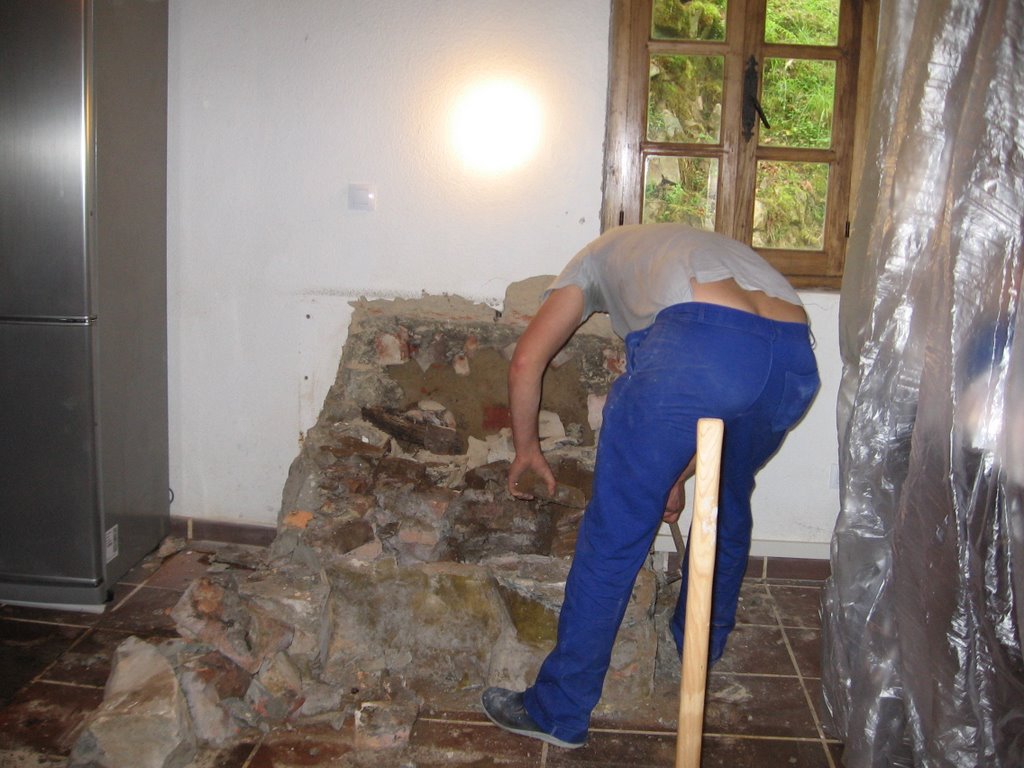
One of the great charms of the molino is, of course, that it was a mill. An actual, functioning mill, complete with a massive, hulking millstone. A massive, hulking millstone in which shards of petrified corn husk--the precious sustenance of some hard-working Asturian peasant, indisputable evidence of some simpler, more bucolic life--can still be found. A massive, hulking millstone right where our kitchen table should go.

We have contemplated getting rid of the millstone ever since we bought the place because 1) it is way too big for the room it is in and 2) it leaves no space for a kitchen table. Yet we have lived with the millstone for all this time because 1) our albaniles assured us that it could not be removed without knocking out an exterior wall and 2) everyone who heard heard that we (okay, one of us) was considering removing the millstone reacted as if we had just casually suggested that the pages of a Gutenberg Bible might make good rolling papers. "Oh, but you can't do that," they would exclaim, aghast, yet condescending at the same time.

Well, we did. And before anyone calls in the goons from Patrimonio nacional, let me emphasize that the millstone has not been destroyed, just moved to the patio where it awaits reassembly.


After last year's summary rejection, Jose Maria has changed his mind. Today he showed up with the same crew as before (Calisto as jovial as ever, Borja having grown his hair so that he now looks vaguely like Fernando Alonso) plus an ill-tempered Eastern European who has apparently taken Borja's formerly abysmal spot on the totem pole. The four of them lifted the grinding stone out with little problem, but things got dicey when it came time to move the 500-kilo basin that holds the stone. They cut it from its cement moorings, and got it on a dolly, only to find that they could not then move the dolly. They tried putting down boards and rolling it out on crosswise logs, but that got them only as far as the front door. Eventually they tied a rope between it and the bumper of Calisto's truck, and with much pushing and pulling, got it across the patio.

Right now, there is a hole where the mill used to be. I like to think of it as the yawning chasm of progress.

Tuesday, May 23, 2006

The Burro


Most days, year round, as we come and go from the Molino, we pass by this friendly fellow, whom we refer to simply as “the burro.” His age is unknown, as is his vocation. Is he retired from pulling carts, literally put out to pasture? Or is he defective or lame in some way, unable to perform normal burro tasks? The burro seldom moves, mostly stands, occasionally lies down. Surrounded by flies, munching grass, enduring whatever the skies pour down on him, he is a notably solitary creature. Personifying him as we do, we fear he is lonely, tired, uncomfortable. But we hope we are wrong and that, in the way of burros, he is content.

Monday, May 22, 2006

Spadrille Eseason


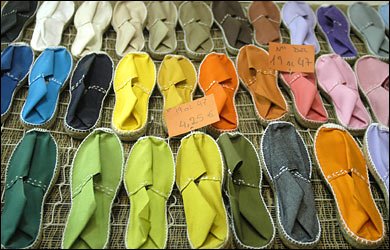
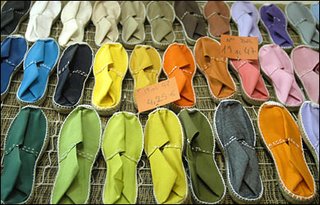
It's espadrille season again (or as a sign I passed today, clearing shooting—if perhaps not very effectively—for the English-speaking market says: "Time for Spadrilles from Spain." Not far from our apartment, the crowds are again gathering around what I think must be Madrid's most popular footwear store, Casa Hernanz. I wrote about the shop about a year ago, but what were in my opinion the best parts got cut out. So I thought I'd print the original here:

Around the first of May last year, long lines began forming outside a little shop just off Madrid’s Plaza Mayor. I had walked past it for months but never really noticed the place before: a non-descript awning reading “Casa Hernanz” and a pair of smudged display windows were the only signs of commerce. But now, suddenly, an ever-present trail of people led out from the door. Morning and night, every day but Sunday, lines snaked around the corner. What were they after? Was this a secret outlet for U2 tickets? Was someone handing out free hams?

Casa Hernanz, it turns out, makes espadrilles. A thousand stores in the city sell these homely, rope-soled shoes, but there is only one Casa Hernanz, where the long wooden counter dates to the nineteenth century and the shoes are made by hand. Come summer—a season which, according to local fashion norms, calls for rope-soled footwear—it is the place for madrileños to buy their authentic espadrilles.

The Hernanz family has been in business for five generations. Today, brothers Jesus and Antonio still make the basic kind of espadrille—two pieces of sturdy cotton sewn to a flat hemp sole—by hand, although they have improved on the original model by gluing a piece of rubber to the sole in order to make the shoe more durable. They also make truly traditional pairs—Jesus calls them “artisanal” –whose soles are unadorned and which are sewn with hemp instead of cotton.

Lightweight and inexpensive (at Casa Hernanz, a basic pair costs about $5.70, and the artisanal $19.50), espadrilles used to be footwear for peasants and laborers, but these days, they are more likely to be worn at home as a kind of warm-weather slipper. They’re not confined to indoors, however. “They’re very popular among young people who wear them to nightclubs,” says Jesus. “And you see them more and more on the street. They’re much better than those horrible plastic things.”

Even the humble espadrille, then, is subject to the whims of fashion. These days the Hernanzes also sell factory-made espadrilles in a variety of styles: some, called “valencianas,” tie around the ankle, others have wedge heels and pointed toes. “When I was young,” says Jesus, “there were only three models and maybe five colors available. But today they come in suede, silk, leather and you can get them to look like any other shoe.” The Hernanzes will even custom-make espadrilles in a fabric of the client’s choice.

But it is the basic espadrille for which those lines of people wait. Once inside the store, they line up at a counter squeezed between bolts of cloth. They state a size and a color, and Jesus or Antonio searches the floor to ceiling cases behind, where the sizes are handwritten directly on the shelves, for the proper pair. Only first-timers—foreigners, mostly—retreat to the small bench tucked near the entryway to try on the shoes. For everyone else, there is no need: this is an annual purchase, like suntan lotion or (heaven forbid) flip-flops.

Casa Hernanz, located at Calle Toledo, 18, is open Monday-Friday from 9am-1:30 pm and 4:30-7:30pm, Saturdays from 9am-1:30pm. Tel: 91 366 5450

Monday, May 15, 2006

And those Hubbel dolls will pay for your kid's college education

Last week, 350,000 Spaniards learned they may have lost their life savings when it came to light that two companies that were supposed to be investing their money in valuable postal stamps were actually operating big 'ol pyramid schemes.

Here's what we have to say about it.

Saturday, May 13, 2006

Castellers


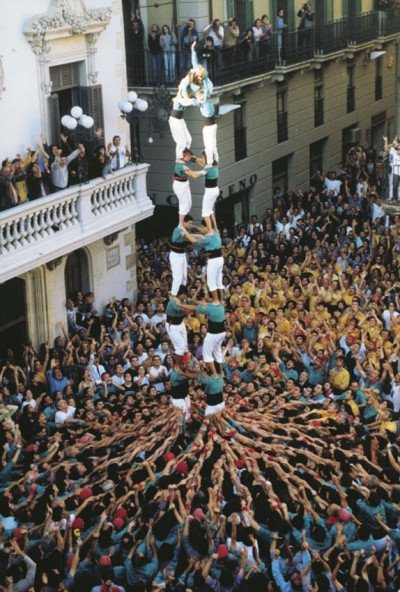
Spent one evening last week at castellers practice in Barcelona, and decided on the spot that of all the symbols of Catalan identity (the sardana, the striped flag, the Barça), those precarious towers of men are by far my favorite.

The first thing I realized upon entering the gym-like (polished cement floor, bleachers, smell of sweaty socks) space, is that they're not all men. Women, it turns out, make for perfect upper tiers. Children are on top, and they scramble up the adults like monkeys.

I learned a lot of things. That a bandana tied around the waist, for example, makes a good foothold. That the music that accompanies any tower-building display has signals in it that tell the guys on the bottom when the kid on top is ready to come down. That teams of castellers do not compete against other teams, but that the local papers rank them anyway. And that some people think castellers got their start in the Middle Ages, as a means of seeing what was going down on the other side of the castle walls. But that, says Toni, head of the Barcelona castellers, is the romantic version.

Tuesday, May 02, 2006

Viva el


Taxi drivers the world over are a curious group, and Spanish cabbies are no exception. I learned many years ago that most taxistas are more than happy to engage you on virtually any topic, and generally they are friendly, even if they disagree with you.

One of the first drivers I met here, in fact, became a devoted friend despite our differing political views when, after he told me that he played on a local baseball team (not a common sport in Spain, and one with little proper equipment), I had my soon-to-visit dad bring him a Louisville Slugger -- he nearly wept with joy.

Several years later I discovered that I could charm most taxistas if I simply mentioned how well one could eat in Spain. No driver has ever challenged this, and I recall leaving one literally gurgling, Pavlov-style, in his own saliva, as I mentioned, one by one, a few of the cheeses, hams, and wines to be enjoyed in this country.

Riding from the airport to my apartment in Madrid the other night, however, I encountered a taxi driver who genuinely confounded me. Bald, elderly, and seemingly mild-mannered, he was silent during most of the ride.

But when we hit a traffic jam entering the Plaza Santa Ana, things began to go awry. We were stuck for only fifteen minutes or so, consigned to observing the tides of chatting Spaniards that passed by on their evening walks, yet this incident somehow ignited my driver, who, without warning, exploded into a diatribe against "the masses," the media, and the mindlessness of contemporary Spaniards that went uninterrupted (it was uninterruptable, really) for the duration of our journey.

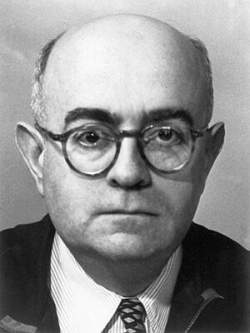
I was at first merely surprised by the outburst. Soon, however, I was flabbergasted, for the longer he held forth, the more complex and theoretically formidable became his rant. As he backed his claims by carefully quoting Marx, Hegel, Adorno (above), and an array of other political philosophers, I sunk lower and lower -- in my seat, and in amazement.

By the time we reached my apartment, it was all I could do to timidly offer him a handful of Euros and slink quietly from the cab. Hours later, I was still in shock -- NOT that a taxi driver would sound off, but that he could do it so eruditely as to plunge me into the kind of intellectual submission I haven't felt since graduate school.

Sunday, April 30, 2006

We interrupt this blog...

for a technical note. For some time now, we've been meaning to mention that, um, there are two of us here. But it all seemed far too complicated until a helpful reader mentioned that things were getting a wee bit confusing.
So from now on, we'll use different nicknames to sign our posts: Almendro (him) and Almendra (her). And since you asked, yes, we split our time between Madrid and Asturias

Saturday, April 29, 2006

Viva yo

Spaniards have a talent for groups. They are delightfully social creatures--able to talk to anyone about anything, and never happier than when surrounded by crowds of other Spaniards all jabbering away. They learn this skill at a young age--a British acquaintance of mine describes with mild amusement watching his children's daycare teachers chastise them for spending too much time on their own.

But they are also inveterate rule-breakers. They may enjoy spending time with other people, but Spaniards never think that the those same people's rules apply to them.

I was reminded of it twice on the same day last week. First, I went to the post office to pick up a certified letter. I stood there alone for the first 20 minutes or so--even though the post office was 'open,' it was also 3pm, right in the middle of lunch time--and when the guy finally showed up, he asked for my passport. I didn't have it with me, but offered my driver's license and credit cards as ID. He insisted that I needed my passport. I started to to recite the number, which I'd memorized. One more time, he told me he needed the passport. And yet all the while, he was filling out the form that showed receipt of the letter. "You always need your passport for mail from the municipal government," he said, handing me the letter. "Hasta luego."

A few hours later I was shopping at a department store. I brought a bunch of clothes into the dressing room, but the attendant stopped me, saying "That's too many." I asked how many I was allowed to take in. She started counting and said, again, "That's too many." I made a gesture like I would leave some with her, if she would just tell me how many I could take in. She said, one more time, in case I had missed it, "That's too many." And then she handed me the chit, and ushered me to the dressing room.

Thursday, April 27, 2006

A Tad Late, the Heat Arrives


Yesterday Nacho, our good-hearted but somewhat-scattered electrician, and his brains-of-the-operation mother, Encarnación, pulled up to the Molino around 9 a.m. and announced they had with them the two heaters we’d ordered (and that Nacho had promised to install) months ago -- during the winter. A great procrastinator myself, and in generally good spirits, I welcomed them in to execute a task they assured me would be finished within a few hours.

Two days (and couple of housecleanings)later, the Molino boasted its first-ever built-in heating system, complete with two two new outlets -- one tucked into the corner of the kitchen on the main floor, the other greeting you at the top of the stairs to the second floor -- and a thermostat on the living room wall. Now if we're cold, we simply reach up, turn a dial, and warm the entire house.

We can only imagine how much we'll enjoy this next winter.

Closet to Hell


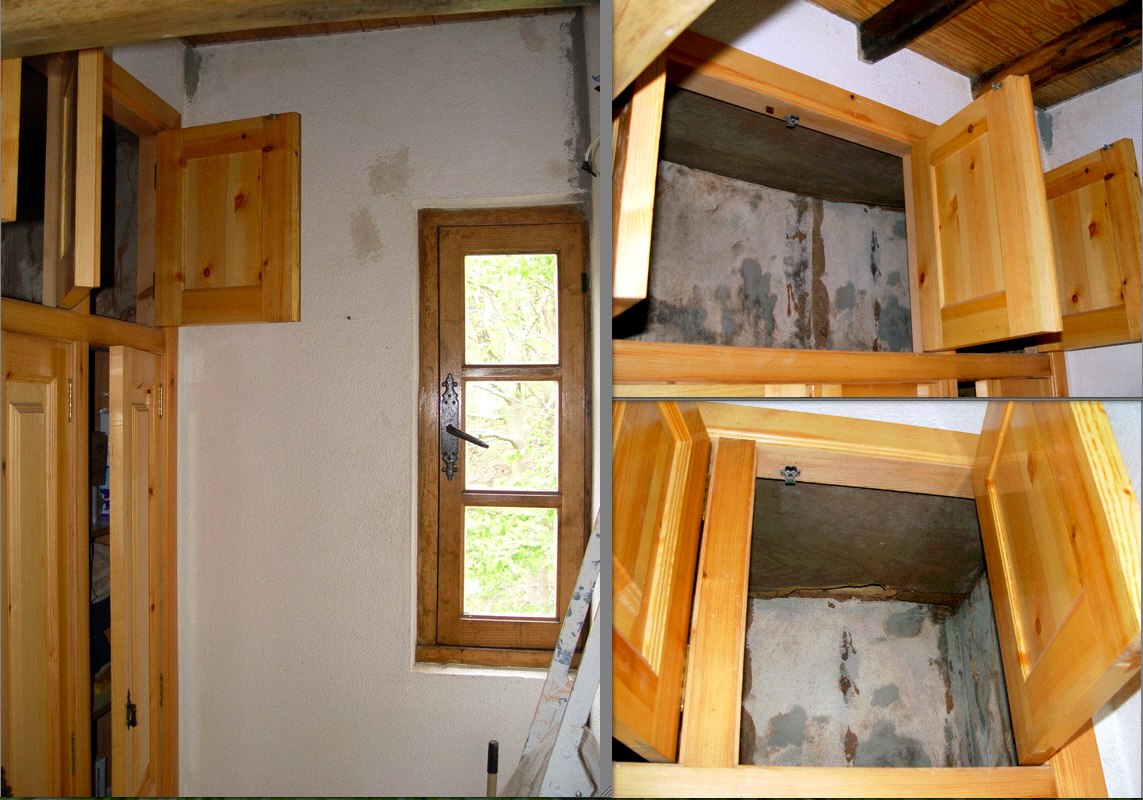
This week I began what I thought would be a simple and brief project: paint the closet in the Molino's master bedroom. It seemed a good way to do a test run with the new paint we bought (a color in the "Kenya" family at the store here) while spending relatively little time.

Monday afternoon, with enthusiasm and false hopes, I began scraped the walls, ripped out the old wall hooks, fixtures, etc., spackled and mortared the cracks and holes. At this point things seemed dandy, and it occurred to me that, since I was all set up, it would be logical to paint the inner closet too (in addition to the walk-in area I'd just prepared).

With boldness and a vain sense of heroism, I began by tackling the upper part of the inner closet -- a moldy area that we’ve never used and that has been the ugly repository for only items we neither want nor use. I began to scrape, and the trouble began. This closet sits in the corner of the house and apparently it has, over the years, absorbed a great deal of moisture. Unsurprisingly, everything I touched fell apart, rotten. This didn't make me happy, but I pressed on, figuring I could scrape away the decayed material and get to the bare wall, which would be easy to paint.

But the more I scraped, the further I penetrated a world of mold that appeared to have no end. Soon, the closet area as well as the adjoining bedroom were filled with a storm of pungent, grayish-brown mold dust whose eye swirled around my head. I kept scraping, and it kept getting worse. I feared I’d not stop until I hit the roof.

I finally donned my painting mask, something that I -- now quite lightheaded -- should have done much earlier, and bore down. A couple of miserable hours later, I felt as though I'd been dipped in putrid cocoa powder. (Indeed, in my feeble condition, my mind flashed to a television show I’d been watching, "House," in which a fabulously misanthropic and brilliant diagnostic physician, Gregory House, solves complexly mysterious cases while abusing his underlings. Each episode is, in effect, a new mystery, a physiological crime to be solved. The patients' maladies are bizarre and often harsh, in my mind’s eye I imagined myself as one of those unlucky patients -- the mold dust entering my airwaves, traveling to my lungs, into my blood stream, straight to my brain. I decided to stop watching the show until I'd finished this particular task.)

Soon I had to resign myself to the fact that before painting this part of the closet, I’d need to do a bit of carpentry. Exhausted, angered, and not feeling terribly well, I did my best to remove the piles of detritus from the upper closet, and called it a day.

This story, unfortunately, will be continued....