Wednesday, May 31, 2006

Marking Time


On Monday I visited the plaza de toros in Alicante, where a crew is shooting part of a film about "Manolete"--perhaps Spain's most iconic torero, who died in 1947, shortly after a bull gored him in the groin on a hot summer afternoon in Linares' plaza de toros.

In the film, Alicante's bullring stands in for Linares' plaza, as the latter has become surrounded by tall, modern buildings that would make it difficult to shoot scenes depicting 1940s' Spain.

Alicante's ring was a study in contrasts, its bleachers draped with advertising banners and political symbols evoking a different era (including national flags bearing the yoke-and-arrows of the Spanish Falange, a group that provided crucial support for Francisco Franco before, during, and after the civil war (1936-1939) that brought the Generalísimo to power), its earthen floor smothered by the film crew's tractors, cranes, and dollies.

When I left the plaza in the evening, I headed directly to the airport, and as I awaited the departure of my flight to Madrid, I looked down at my feet and realized that anyone familiar with the world of bullfighting would, at a glance, know where I had spent my day.

The sand in Spanish bullrings is almost uniquely fine in texture and yellow in color, and my pants and sandals were covered with it.

I bent to brush off my feet, then thought better of it, wondering if Manolete's Spain and mine shared much beyond the sand underfoot.

Monday, May 29, 2006

Historic Preservation


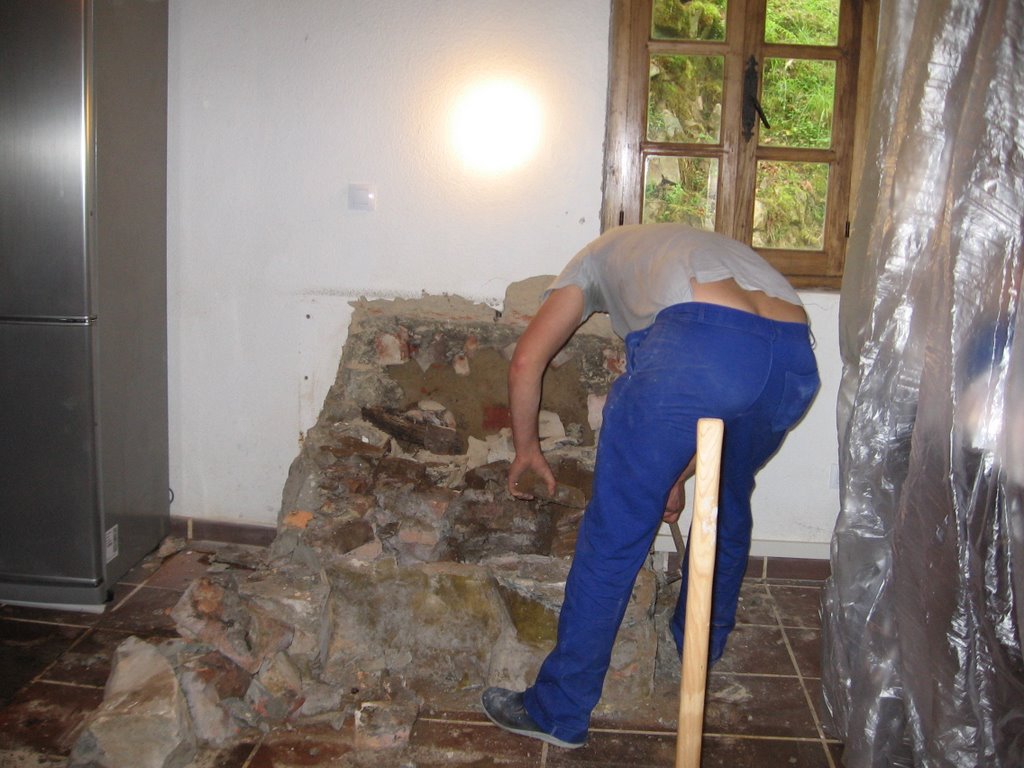
One of the great charms of the molino is, of course, that it was a mill. An actual, functioning mill, complete with a massive, hulking millstone. A massive, hulking millstone in which shards of petrified corn husk--the precious sustenance of some hard-working Asturian peasant, indisputable evidence of some simpler, more bucolic life--can still be found. A massive, hulking millstone right where our kitchen table should go.

We have contemplated getting rid of the millstone ever since we bought the place because 1) it is way too big for the room it is in and 2) it leaves no space for a kitchen table. Yet we have lived with the millstone for all this time because 1) our albaniles assured us that it could not be removed without knocking out an exterior wall and 2) everyone who heard heard that we (okay, one of us) was considering removing the millstone reacted as if we had just casually suggested that the pages of a Gutenberg Bible might make good rolling papers. "Oh, but you can't do that," they would exclaim, aghast, yet condescending at the same time.

Well, we did. And before anyone calls in the goons from Patrimonio nacional, let me emphasize that the millstone has not been destroyed, just moved to the patio where it awaits reassembly.


After last year's summary rejection, Jose Maria has changed his mind. Today he showed up with the same crew as before (Calisto as jovial as ever, Borja having grown his hair so that he now looks vaguely like Fernando Alonso) plus an ill-tempered Eastern European who has apparently taken Borja's formerly abysmal spot on the totem pole. The four of them lifted the grinding stone out with little problem, but things got dicey when it came time to move the 500-kilo basin that holds the stone. They cut it from its cement moorings, and got it on a dolly, only to find that they could not then move the dolly. They tried putting down boards and rolling it out on crosswise logs, but that got them only as far as the front door. Eventually they tied a rope between it and the bumper of Calisto's truck, and with much pushing and pulling, got it across the patio.

Right now, there is a hole where the mill used to be. I like to think of it as the yawning chasm of progress.

Tuesday, May 23, 2006

The Burro


Most days, year round, as we come and go from the Molino, we pass by this friendly fellow, whom we refer to simply as “the burro.” His age is unknown, as is his vocation. Is he retired from pulling carts, literally put out to pasture? Or is he defective or lame in some way, unable to perform normal burro tasks? The burro seldom moves, mostly stands, occasionally lies down. Surrounded by flies, munching grass, enduring whatever the skies pour down on him, he is a notably solitary creature. Personifying him as we do, we fear he is lonely, tired, uncomfortable. But we hope we are wrong and that, in the way of burros, he is content.

Monday, May 22, 2006

Spadrille Eseason


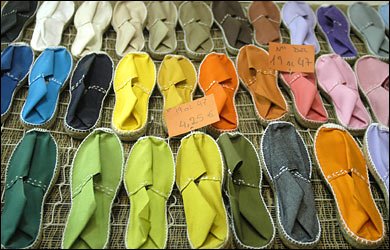
It's espadrille season again (or as a sign I passed today, clearing shooting—if perhaps not very effectively—for the English-speaking market says: "Time for Spadrilles from Spain." Not far from our apartment, the crowds are again gathering around what I think must be Madrid's most popular footwear store, Casa Hernanz. I wrote about the shop about a year ago, but what were in my opinion the best parts got cut out. So I thought I'd print the original here:

Around the first of May last year, long lines began forming outside a little shop just off Madrid’s Plaza Mayor. I had walked past it for months but never really noticed the place before: a non-descript awning reading “Casa Hernanz” and a pair of smudged display windows were the only signs of commerce. But now, suddenly, an ever-present trail of people led out from the door. Morning and night, every day but Sunday, lines snaked around the corner. What were they after? Was this a secret outlet for U2 tickets? Was someone handing out free hams?

Casa Hernanz, it turns out, makes espadrilles. A thousand stores in the city sell these homely, rope-soled shoes, but there is only one Casa Hernanz, where the long wooden counter dates to the nineteenth century and the shoes are made by hand. Come summer—a season which, according to local fashion norms, calls for rope-soled footwear—it is the place for madrileños to buy their authentic espadrilles.

The Hernanz family has been in business for five generations. Today, brothers Jesus and Antonio still make the basic kind of espadrille—two pieces of sturdy cotton sewn to a flat hemp sole—by hand, although they have improved on the original model by gluing a piece of rubber to the sole in order to make the shoe more durable. They also make truly traditional pairs—Jesus calls them “artisanal” –whose soles are unadorned and which are sewn with hemp instead of cotton.

Lightweight and inexpensive (at Casa Hernanz, a basic pair costs about $5.70, and the artisanal $19.50), espadrilles used to be footwear for peasants and laborers, but these days, they are more likely to be worn at home as a kind of warm-weather slipper. They’re not confined to indoors, however. “They’re very popular among young people who wear them to nightclubs,” says Jesus. “And you see them more and more on the street. They’re much better than those horrible plastic things.”

Even the humble espadrille, then, is subject to the whims of fashion. These days the Hernanzes also sell factory-made espadrilles in a variety of styles: some, called “valencianas,” tie around the ankle, others have wedge heels and pointed toes. “When I was young,” says Jesus, “there were only three models and maybe five colors available. But today they come in suede, silk, leather and you can get them to look like any other shoe.” The Hernanzes will even custom-make espadrilles in a fabric of the client’s choice.

But it is the basic espadrille for which those lines of people wait. Once inside the store, they line up at a counter squeezed between bolts of cloth. They state a size and a color, and Jesus or Antonio searches the floor to ceiling cases behind, where the sizes are handwritten directly on the shelves, for the proper pair. Only first-timers—foreigners, mostly—retreat to the small bench tucked near the entryway to try on the shoes. For everyone else, there is no need: this is an annual purchase, like suntan lotion or (heaven forbid) flip-flops.

Casa Hernanz, located at Calle Toledo, 18, is open Monday-Friday from 9am-1:30 pm and 4:30-7:30pm, Saturdays from 9am-1:30pm. Tel: 91 366 5450

Monday, May 15, 2006

And those Hubbel dolls will pay for your kid's college education

Last week, 350,000 Spaniards learned they may have lost their life savings when it came to light that two companies that were supposed to be investing their money in valuable postal stamps were actually operating big 'ol pyramid schemes.

Here's what we have to say about it.

Saturday, May 13, 2006

Castellers


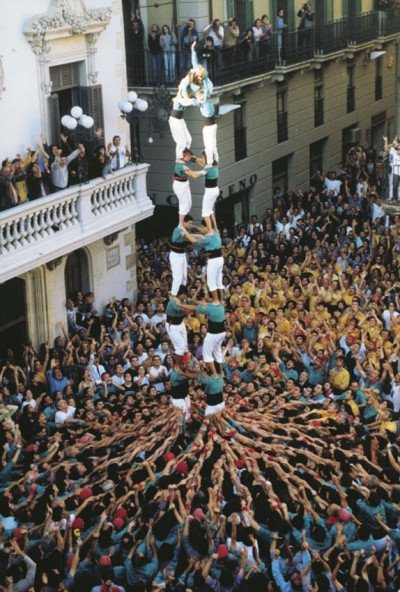
Spent one evening last week at castellers practice in Barcelona, and decided on the spot that of all the symbols of Catalan identity (the sardana, the striped flag, the Barça), those precarious towers of men are by far my favorite.

The first thing I realized upon entering the gym-like (polished cement floor, bleachers, smell of sweaty socks) space, is that they're not all men. Women, it turns out, make for perfect upper tiers. Children are on top, and they scramble up the adults like monkeys.

I learned a lot of things. That a bandana tied around the waist, for example, makes a good foothold. That the music that accompanies any tower-building display has signals in it that tell the guys on the bottom when the kid on top is ready to come down. That teams of castellers do not compete against other teams, but that the local papers rank them anyway. And that some people think castellers got their start in the Middle Ages, as a means of seeing what was going down on the other side of the castle walls. But that, says Toni, head of the Barcelona castellers, is the romantic version.

Tuesday, May 02, 2006

Viva el


Taxi drivers the world over are a curious group, and Spanish cabbies are no exception. I learned many years ago that most taxistas are more than happy to engage you on virtually any topic, and generally they are friendly, even if they disagree with you.

One of the first drivers I met here, in fact, became a devoted friend despite our differing political views when, after he told me that he played on a local baseball team (not a common sport in Spain, and one with little proper equipment), I had my soon-to-visit dad bring him a Louisville Slugger -- he nearly wept with joy.

Several years later I discovered that I could charm most taxistas if I simply mentioned how well one could eat in Spain. No driver has ever challenged this, and I recall leaving one literally gurgling, Pavlov-style, in his own saliva, as I mentioned, one by one, a few of the cheeses, hams, and wines to be enjoyed in this country.

Riding from the airport to my apartment in Madrid the other night, however, I encountered a taxi driver who genuinely confounded me. Bald, elderly, and seemingly mild-mannered, he was silent during most of the ride.

But when we hit a traffic jam entering the Plaza Santa Ana, things began to go awry. We were stuck for only fifteen minutes or so, consigned to observing the tides of chatting Spaniards that passed by on their evening walks, yet this incident somehow ignited my driver, who, without warning, exploded into a diatribe against "the masses," the media, and the mindlessness of contemporary Spaniards that went uninterrupted (it was uninterruptable, really) for the duration of our journey.

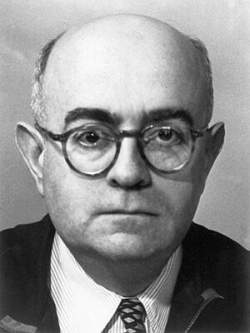
I was at first merely surprised by the outburst. Soon, however, I was flabbergasted, for the longer he held forth, the more complex and theoretically formidable became his rant. As he backed his claims by carefully quoting Marx, Hegel, Adorno (above), and an array of other political philosophers, I sunk lower and lower -- in my seat, and in amazement.

By the time we reached my apartment, it was all I could do to timidly offer him a handful of Euros and slink quietly from the cab. Hours later, I was still in shock -- NOT that a taxi driver would sound off, but that he could do it so eruditely as to plunge me into the kind of intellectual submission I haven't felt since graduate school.

Sunday, April 30, 2006

We interrupt this blog...

for a technical note. For some time now, we've been meaning to mention that, um, there are two of us here. But it all seemed far too complicated until a helpful reader mentioned that things were getting a wee bit confusing.
So from now on, we'll use different nicknames to sign our posts: Almendro (him) and Almendra (her). And since you asked, yes, we split our time between Madrid and Asturias

Saturday, April 29, 2006

Viva yo

Spaniards have a talent for groups. They are delightfully social creatures--able to talk to anyone about anything, and never happier than when surrounded by crowds of other Spaniards all jabbering away. They learn this skill at a young age--a British acquaintance of mine describes with mild amusement watching his children's daycare teachers chastise them for spending too much time on their own.

But they are also inveterate rule-breakers. They may enjoy spending time with other people, but Spaniards never think that the those same people's rules apply to them.

I was reminded of it twice on the same day last week. First, I went to the post office to pick up a certified letter. I stood there alone for the first 20 minutes or so--even though the post office was 'open,' it was also 3pm, right in the middle of lunch time--and when the guy finally showed up, he asked for my passport. I didn't have it with me, but offered my driver's license and credit cards as ID. He insisted that I needed my passport. I started to to recite the number, which I'd memorized. One more time, he told me he needed the passport. And yet all the while, he was filling out the form that showed receipt of the letter. "You always need your passport for mail from the municipal government," he said, handing me the letter. "Hasta luego."

A few hours later I was shopping at a department store. I brought a bunch of clothes into the dressing room, but the attendant stopped me, saying "That's too many." I asked how many I was allowed to take in. She started counting and said, again, "That's too many." I made a gesture like I would leave some with her, if she would just tell me how many I could take in. She said, one more time, in case I had missed it, "That's too many." And then she handed me the chit, and ushered me to the dressing room.

Thursday, April 27, 2006

A Tad Late, the Heat Arrives


Yesterday Nacho, our good-hearted but somewhat-scattered electrician, and his brains-of-the-operation mother, Encarnación, pulled up to the Molino around 9 a.m. and announced they had with them the two heaters we’d ordered (and that Nacho had promised to install) months ago -- during the winter. A great procrastinator myself, and in generally good spirits, I welcomed them in to execute a task they assured me would be finished within a few hours.

Two days (and couple of housecleanings)later, the Molino boasted its first-ever built-in heating system, complete with two two new outlets -- one tucked into the corner of the kitchen on the main floor, the other greeting you at the top of the stairs to the second floor -- and a thermostat on the living room wall. Now if we're cold, we simply reach up, turn a dial, and warm the entire house.

We can only imagine how much we'll enjoy this next winter.

Closet to Hell


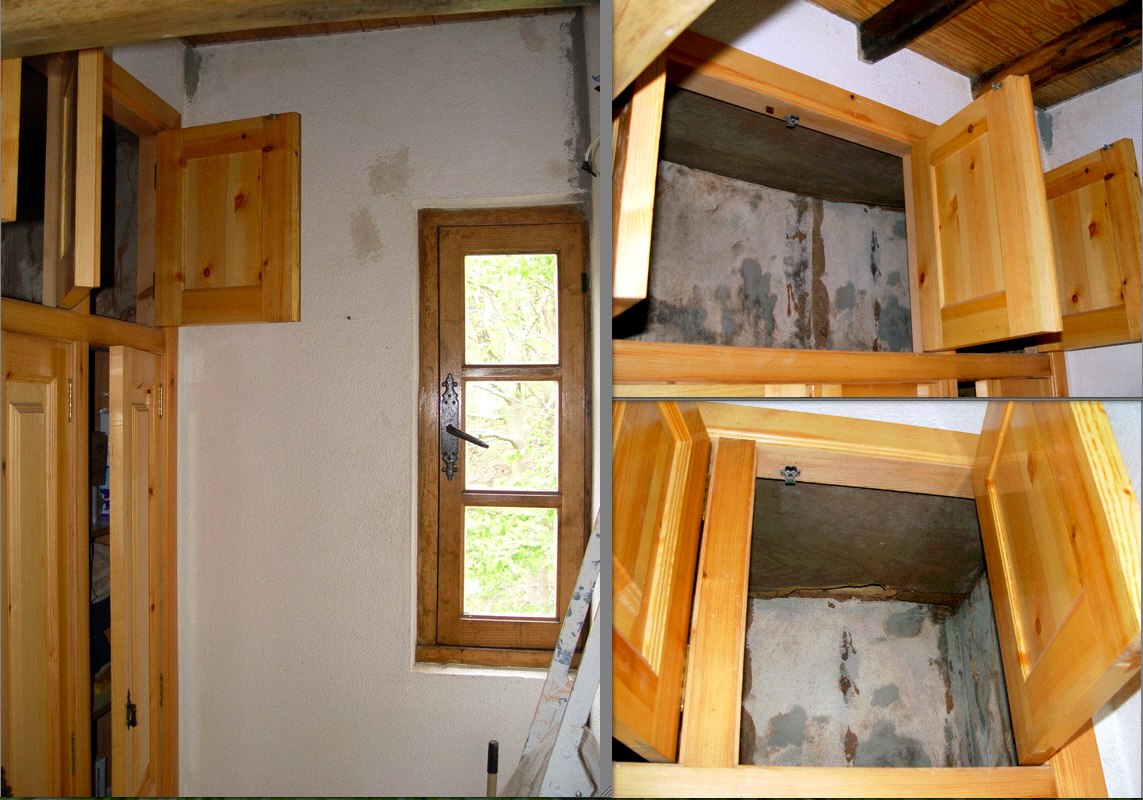
This week I began what I thought would be a simple and brief project: paint the closet in the Molino's master bedroom. It seemed a good way to do a test run with the new paint we bought (a color in the "Kenya" family at the store here) while spending relatively little time.

Monday afternoon, with enthusiasm and false hopes, I began scraped the walls, ripped out the old wall hooks, fixtures, etc., spackled and mortared the cracks and holes. At this point things seemed dandy, and it occurred to me that, since I was all set up, it would be logical to paint the inner closet too (in addition to the walk-in area I'd just prepared).

With boldness and a vain sense of heroism, I began by tackling the upper part of the inner closet -- a moldy area that we’ve never used and that has been the ugly repository for only items we neither want nor use. I began to scrape, and the trouble began. This closet sits in the corner of the house and apparently it has, over the years, absorbed a great deal of moisture. Unsurprisingly, everything I touched fell apart, rotten. This didn't make me happy, but I pressed on, figuring I could scrape away the decayed material and get to the bare wall, which would be easy to paint.

But the more I scraped, the further I penetrated a world of mold that appeared to have no end. Soon, the closet area as well as the adjoining bedroom were filled with a storm of pungent, grayish-brown mold dust whose eye swirled around my head. I kept scraping, and it kept getting worse. I feared I’d not stop until I hit the roof.

I finally donned my painting mask, something that I -- now quite lightheaded -- should have done much earlier, and bore down. A couple of miserable hours later, I felt as though I'd been dipped in putrid cocoa powder. (Indeed, in my feeble condition, my mind flashed to a television show I’d been watching, "House," in which a fabulously misanthropic and brilliant diagnostic physician, Gregory House, solves complexly mysterious cases while abusing his underlings. Each episode is, in effect, a new mystery, a physiological crime to be solved. The patients' maladies are bizarre and often harsh, in my mind’s eye I imagined myself as one of those unlucky patients -- the mold dust entering my airwaves, traveling to my lungs, into my blood stream, straight to my brain. I decided to stop watching the show until I'd finished this particular task.)

Soon I had to resign myself to the fact that before painting this part of the closet, I’d need to do a bit of carpentry. Exhausted, angered, and not feeling terribly well, I did my best to remove the piles of detritus from the upper closet, and called it a day.

This story, unfortunately, will be continued....

Sunday, April 23, 2006

Another Saturday, another protest


Actually there were six yesterday, and that's just in Madrid. The biggest was in the Plaza Mayor where thousands (5,000? 12,000? The process of counting demonstration participants is an art in Spain that, despite its clearly stated formulae, produces wildly divergent results) of Guardia Civil called on Zapatero to fulfill his campaign promise and de-militarize their organization.

A lot of ink has been spilled about this country's astonishly rapid social and political changes. Just the other day a friend and I were reminiscing about the fact that when we started coming to Spain in the 80's, the toilet paper had the consistency of crepe paper and was, for reasons I never discovered, usually mauve in color. And of course there are more serious changes as well, the things that long-time visitors say they never thought they'd see: gay marriage, domestic violence courts, trains that run on time, bare midriffs.

Yesterday's protest ranks right up there. Long before Franco came to power, the Guardia Civil, with their signature patent-leather hats, were a feared mechanism of state control; under Franco, they were nothing short of an instrument of state-sponsored terror. For however many thousands of them to be demanding that, effectively, they be stripped of certain kinds of power (admittedly in exchange for others: demilitarization means that they'll be able to form associations and join unions), well, that's an astonishing thing indeed.

Friday, April 21, 2006

NOW PLAYING IN OVIÑANA...


...Splendor in the Grass.

Tuesday, April 18, 2006

The Señoras de Almendro


Though in our Madrid apartment we are five stories off the ground, living far above the active life of the streets below (I often think of the apartment as a tree-house), we are but a few meters from our fifth-floor neighbors in the buildings across the street in any direction. Our windows — one in the bedroom, two in the living room, one in the dining area, and one in the kitchen — have afforded a number of interesting visual encounters with people familiar by sight but anonymous in every other way. From the two windows — one in my bedroom, one in the living room — on the west wall of our apartment, I am often looking directly at two elderly women, sisters I have always assumed, who regularly watch what is taking place in the Plaza San Andrés below. Something about their timing (always in the morning), their manner of dress (bathrobes, housecoats), their way of standing (bent forward, arms resting on the window bar), their gaze (left, right, straight down, up into the air), and their facial expressions (frowns of disapproval, mostly, with occasional smiles of recognition or eyes widened in surprise), has made these two neighbors more interesting to me than the others. They served as a barometer of sorts for what was happening in the neighborhood, and from watching them I could tell when there was misbehavior in the plaza, when a construction project was too loud or bothersome, when a wedding at the church (held most Saturday evenings) had let out, or when street musicians were particularly good or bad.

One day over a year ago, I took some pictures of these two women, who almost always appear together. I never thought about photographing them again until a few nights ago when, during the height of Semana Santa, one sister appeared alone, late in the day, all dressed up. At first I didn’t recognize her, and I realized that I had never seen her or her sister in anything but informal morning attire. Given the rarity of such an appearance, I quickly grabbed my camera and took another picture. Holy Week has a remarkable effect on Spaniards of all ages and affiliations; they’re suddenly well-scrubbed, dressed up, and somehow more reverent in their never-ending street parties. From now on I shall think of Semana Santa as the quiet holiday, for the movement and noise below is noticeably more restrained than the hustle and din of virtually all other fiestas (most weekends during the late spring, summer, and early fall).

I’ve always felt that the figure of a Señora on a balcony in Spain is somehow mythical, more than a woman merely standing at a window. They are a town’s observers, a neighborhood’s eyewitnesses. Last week, watching one of my own señoras, I think I began to see a little differently too.

Monday, April 17, 2006

Eating in Madrid: Cañas y Barro


There are a few basic rules for finding a decent paella that, if you are a foreigner, you learn only through harsh experience (I suspect that for many Spaniards, these rules are innate, like their ability to keep all the soccer leagues straight).

Rule #1: No matter what its bearer may call it, nothing that anyone ever brought to a potluck in Boston, or Ann Arbor, or, say, Oberlin, Ohio, is remotely close to real paella.

Rule #2: Never eat paella on a menu del dia--it's been made ahead. Same goes for those massive paellas on display at tourist restaurants along Echegaray and most every paseo maritimo on the Costa del Sol. You only want paellas that are made to order. And for that, you usually need to eat in an arroceria

Rule #3: Purists will tell you that paella should only have rabbit, snails, and those massive beans called garrofa in it. But in truth, most combinations are pretty tasty. Chicken and chorizo; shellfish and chicken; vegetables and squid--they're all good. The only exception to this rule are those vegetarian restaurants where they start getting funky on you with the verduras. Carrots do not belong in a paella. Ditto for broccoli, yellow squash, and tofu.

Rule #4: The best paellas, the ones that will stick with you longest in memory, are cooked over an open fire on a dia de campo with friends.

I'm frequently asked where to get a good paella in Madrid. And, since I assume the asker is willing to ignore rule #4 for the moment, my answer is usually Cañas y Barro. It's a small place, decorated in a romantic style whose excesses border on the ridiculous, but the rices, including the authentic (rabbit, snails, garrafo) paella, are expertly made and thoroughly delicious.

I found it the first time when I was working in the municipal archives at Conde Duque. That day, I was on my own for lunch, and since I am a bigger fan of paella than Geoff is, I decided to take advantage of my solitude for a little rice. It was a risk, since some restaurants require a minimum of 2 people per arroz. And I was the only person in there, which made me a little nervous. But the menu assured me they made rices for one, the waiter was solicitous, and the bright yellow dish of aioli he brought to start things off was reassuringly valenciano. And indeed, the shellfish paella that finally emerged from the kitchen was the best I'd ever tasted. Admittedly, I've never been to Valencia. But trust me, it was good.

For the longest time I thought that Cañas y Barro was my personal discovery, mostly because the place was always empty or near-empty when I was there. I've since been proven wrong by the CNN bureau chief. But he also turned me on to the restaurant's zucchini and bacon appetizer, so I can't hold it against him.

Cañas y Barro, Amaniel 23, Tel. 915 424798

Saturday, April 15, 2006

A Good Birth


Yesterday, Spain rather quietly marked the 75th anniversary of the declaration of the Second Republic. There’s been some controversy about whether and/or how to celebrate this day. Those favoring celebration tend to fall farther left on the political spectrum, are not admirers of Franco and his dictatorship, and are content that the right-leaning Popular Party lost the national elections in 2004. Those who resist or outright oppose any celebration are largely more conservative, have (at least in private) mixed feelings about Franco and his legacy, and are not supporters of current Prime Minister Zapatero, who speaks often of his grandfather, a Republican who was killed by Franco’s Nationalists during the civil war (1936-1939) that followed the collapse of the Republic. In any case, I have spent much of one of my careers—a college professor—studying and writing about things related to the Republic and the civil war, and so yesterday's events interested me. I was traveling from Madrid to Asturias and didn’t get much news, but I did read that the head of the United Left party was attending a Republican flag-raising in Grado, not far from here. But it seems that the Republic’s banner was raised in just one other Spanish town. And Zapatero’s governing Socialist party appears to be making conciliatory gestures towards the PP on legislation that makes this the “Year of Historical Memory.” Editorials have appeared all week, both praising the Republic for its achievements and even pointing to it as the precursor of today’s democratic state, and criticizing the Republic for its many errors while suggesting that those who remember it fondly are given to nostalgic fantasy. How to make peace with the past? That's a never-ending question. All things considered, the Republic's anniversary seemed a bit understated. I'm not particularly sad about this, but I will tell you that the first time I saw a photograph that for me has come to symbolize the birth of the Republic—delirious throngs of people flowing through the Puerta del Sol on April 14th, 1931, as a brazen few hoist the new government’s banner, all enshrouded in an inexplicable mist--I was moved.

Wednesday, April 12, 2006

Drink From the Cup


It's Wednesday of Semana Santa. In our Madrid neighborhood, people are getting ready for the four days of religious celebration that begin in earnest tomorrow and continue through the weekend. From my fifth floor window, I observe the San Andrés church, lit up by the sun, lying back against an azure sky, ready for the days of worship. I descend to the street and, upon leaving our building, notice that the preparations have begun. During this Holy Week, no one will go thirsty.


,

Connected

A dear friend from college and two of her three adorable children have been visiting, and in all the excitement, I forgot to mention the most important news. I was sitting at the Cafe de las Vistillas two weeks ago, having just dropped off said friend and children for a jetlag-induced nap. I was feeling pretty happy because 1)it was such a beautiful, warm day that even the normally surly waiters at the overpriced Cafe de las Vistillas were in a good mood and 2)although no one official would tell me where they were, I had just managed to track down some of the recently transported undocumented immigrants at a homeless shelter near the Royal Palace (not that it mattered in the end, since most of what we wrote was abandoned in favor of reporting from Mauritania).

So I was sitting there on this beautiful day, looking at the still snow-capped mountains in the distance and drinking my agua con gas, when my phone rang. It was Geoff, and he was giggling. "I just sent you an email," he said. It took me a few seconds before I realized he was calling from the molino. And then I began to giggle too. Because although it took buying a cheap PC and temporarily abandoning our lifelong devotion to Macs, we do indeed, finally, have internet at the mill.

Monday, April 10, 2006

There is No Foot Kissing


That, roughly translated, is the note attached in boldface capital letters to the Good Friday procession schedule issued by the Archdiocese of Madrid: NO HAY BESAPIES. Semana Santa has its serious side (see below), but there are also, at least to this outsider, some thoroughly comic moments. The image of anyone attempting to prevent hordes of se~noras from kissing the feet of a Jesus statue is just one of them.

My first introduction to Semana Santa came, properly, in Andalusia, home to all forms of religious excess. There, I experienced the peculiar shock that Americans feel when they first witness the cofrades in their modified KKK garb. I giggled as the crowds shouted piropos at passing statues of the Virgin: ay, que guapa estas!. And, I have to admit, I felt something strange and mysterious at night, when drums fill the air, the streets glow with candlelight, and a single voice pierced the dark with a saeta.

In Madrid, Semana Santa is somewhat different. A couple of years ago, my parents and I caught one procession in which the cofrades wore not the ordinary robes and pointed hoods, but some kind of 18th-century military garb. It was the strangest thing: there were the drums, the candles, the same ladies in their mantillas, and in the middle, a bunch of guys dressed up like Paul Revere. It lacked, shall we say, something of the spooky mystery you get in a place like Cordoba or Sevilla. But then, I doubt that those cities prohibit foot kissing either.

,

Sunday, April 09, 2006

Who's Kant?


It’s Semana Santa in Spain, and this year I am struck by the way that Spaniards seem to live closer to the ground, their spirits, minds, and bodies more fluidly part of an overall scheme. Traditionally, that scheme is Catholic. Friday was “Viernes de Dolores” [“Friday of pains”), today is “Domingo de Ramos” (“Sunday of branches," of Palm Sunday). People, mostly men, are carrying large, heavy Virgins through the streets of cities and towns across the country. Many children are still named José María or María Jesús. Rituals of devotion to the body of Christ. On a more mundane level, people here simply like their bodies and their bodily pleasures. Spaniards gather in bodies, they eat and drink to fill their bodies and sate their desires, they dance with a holy (or unholy?) passion, their beaches are filled with topless women (of all ages and appearances). I think that they are just not terribly self-conscious about their bodies. This makes me both more comfortable with my physical self and appearance (I care little about what I wear when I leave the house, especially up here in Asturias) and more aware that I am an outsider, not a Spaniard. The mind/body split? I’m not sure what it means here, or that it means much at all.

,