Wednesday, November 29, 2006

File under: Go Figure


The biggest thing on Spanish television these days isn't a sitcom or reality show, and it isn't even in Spanish. It's an ad for BMW cars. Featuring a resurrected, Zen-like Bruce Lee telling an off-screen listener to "Be water," (the clip was taken from an interview that Lee gave to Canadian television in 1971), it has taken the country by storm, prompting a Marca headline after the Barca suffered defeat at the hands of its eternal enemies ("Be Madrid,"), several parodies on a number of television shows, and even a counter ad from Mitsubishi (Who's that Chinese guy?" asks an elderly man).

And Google.es lists over a million hits for "Bruce Lee" and "BMW."

,

Sunday, November 26, 2006

Evolution


I've said it before, but man, does Madrid change fast. I've been away for a month, and in that time, a new subway entrance has gone up at Corte Ingles, there's a new bar on our street where none had existed before, and just around the corner, the Restaurante Capitan Alatriste has opened, complete with a wall-sized version of The Surrender at Breda, and other 17th-centuryish accoutrements.

What's more, the crowded, noisy, car-jammed stretch that was once Calle Arenal has turned into a crowded, noisy, pedestrian walkway. Admittedly, the change wasn't exactly sudden: there was many months there of jackhammers and dust. So many, in fact, that one began to suspect, as one often does in Madrid, that the obras would never finish. Needless to say, it comes as something of a surprise when they do.

Friday, November 24, 2006

Hints Are Dropping


Thanksgiving has now past, and you know what that means.

As we drove out this morning, fairly early, to walk along the beach, we encountered a jolly figure on our road that reminded us what’s just around the corner.

We’ve written before about the caganer, the Catalan crapper who shows up in nativity scenes this time of year. The caganer is a mischievous reminder that, despite the high serenity of the Virgin Birth, nature has its way.

There, just to our left, one of our neighbors was celebrating the start of Christmas season by staging his own nativity. Squatting, grunting, and grimacing, pants at his ankles, hairy bum in the air, he was—how shall we put this?—dropping his load. Though we were a bit startled, to say the least, our neighbor didn’t seem to mind, or even notice us, as we passed.

And so it was that as we headed out this morning, we realized that around here anyway, it is indeed beginning to look a lot like Christmas.

Saturday, November 18, 2006

At least they're consistent, part II


This week, Spain's Health Ministry asked Burger King to suspend a new advertising campaign for its "XXL" hamburgers. According to the ministry, the ads--for burgers that contain a hefty 971 calories--fail to comply with an agreement reached by Spain's food industry to avoid promoting supersized portions (they also offended a lot of Spanish vegetarians, who apparently see the ad above as a kind of hate crime). Burger King is fighting back ("Our customers' tastes come first,"), but with 18.5% of the country's children officially overweight, you have to wonder if this isn't a sign that burger ads may one day go the way of cigarette commercials.

Except in Madrid. The same regional government that banned models from Madrid runways for being too skinny apparently has a problem with efforts to prevent everybody else from being too fat. "The government shouldn't interfere with the tiny, intimate details of our lives," said the vice-president.

Thursday, November 16, 2006

TeymiGordy


Madrid’s Mercado de la Cebada is not a pretty place. I’ve seen photos that show it was once was one of those turn-of-the-century beauties decked out in wrought iron, but somewhere along the way, the graceful old building was torn down to make way for today’s brick and cement bunker. As Spanish markets go, it fulfills its function—good produce, good fish, good meat—but unless you count the nudie calendar hung on the wall across from the chicken and egg guy, it’s not the most aesthetically pleasing of places. And many of the original stalls stand empty, which, coupled with occasional noises from the mayor’s office about “revitalization,” sometimes leads me to suspect that the Cebada is not long for this world.

Which is why I was so pleased to walk in there a few weeks ago and see one of those previously abandoned stands suddenly occupied. TeymiGordy (more on the unfortunate name below) is lined with bright blue canisters, each one—there are over 300—containing a different variety of tea. All the basics are there, though even a simple chamomile comes in several versions—Egyptian, for example. But the most enticing are the blends, like green tea with strawberries and white orange blossoms, or the romantically named “Arab Sighs,” with rose petals, raspberry, hibiscus, cardamom, and cinnamon. There are also flavored sugars (lemon, caramel, three kinds of brown)and a middling collection of tea cookies. Two pots on sternos contain the day’s free samples.

TeymiGordy is run by Laura Miso, whose hair is dyed to match her tea canisters. The shop’s name came from the two things, she says, that comfort her: Tea (that would be the “Té”) and “my dog Gordy,” (that would be the Westie pictured on the sign). She got the idea to open a tea shop because, she says, “I don’t like coffee.” Those are heretical words in this espresso-fueled city, but she figured there had to be others like her. Here’s hoping she’s right.

TéymiGordy is located to the right of the stairs as you enter the Mercado de la Cebada. Tel: 91 344 2038.

, ,

Thursday, November 09, 2006

VERTIGO


It’s not that in Spain I think only about taxi drivers. It’s just that they’re so interesting.

I don’t know exactly how it works, but taxistas here reflect something essential, something organic, about Spanish society. Maybe this is true of cabbies everywhere in the world, but I have a hunch that Spain’s drivers reveal an unusual amount and kind of cultural information about the country.

So: late Saturday night I hailed a taxi to take me from my hotel in Valencia, the Astorias Palace, to the airport, for a flight back to Asturias. It was raining, and empty cabs were scarce. But even though I was not the only person waving an arm at the white vehicles as they splashed past, one particular taxi pulled up directly to where I was standing.

I got in, soggy and grateful, and told my driver—a short, bald, man in his sixties, dressed conservatively (though quite typically for someone of his generation)—where I needed to go. He shook his head affirmatively, and we sped off.

Interested in chatting, I began making trivial comments about the unusually rainy weather (Valencia hadn’t seen precipitation in quite a while). But my driver just nodded, wishing, it seemed, to drive in silence.

No problem: I retrieved my cell phone to make some overdue calls.

As soon as I began dialing, however, I realized that even if my driver didn’t want to make small talk with me, he wasn’t seeking quiet. He reached over, pulled a CD from a box in the passenger seat, inserted the disc into the car’s stereo, adjusted the volume, and sat back.

In the two or three seconds before any sound was actually emitted, some part of my mind considered the various types of Spanish music that I might expect to hear.

Imagine my surprise when—


“UNO! DOS! TRÉS! CATORCE!”

—U2’s upbeat “Vertigo,” from How to Dismantle An Atomic Bomb, filled the car.


The quality of the stereo was impressive, and the volume was high (my throbbing seat seemed to function as a subwoofer). But my driver never moved his head in rhythm, never mouthed any lyrics, never changed his body language or facial expression in at all. He just drove and listened.

And so did I.

By the time we arrived at the airport, we’d made our way through roughly half the album, and I’d enjoyed a most welcome, if unexpected, aural treat.

In some curious show of respect, we sat at the departures curb until the song we were listening to had ended. The driver then turned off the stereo, took my money, and gave me my change and a receipt.

I stepped out the door and was about to walk away, but I had a question I couldn’t resist. I put my head back into the cab and asked, “So you like U2?”

Without turning around, and with no apparent sense of irony, he said, “It’s my seventeen-year old son’s. He buys a lot of music, and when he’s tired of something, he throws it in the trash. I pull it out and put it in my box, here, and listen to it when I drive.”

More intrigued than ever, I sat back down in the seat. “So you must be familiar with a lot of contemporary music,” I queried.

“Not really,” he answered. “I just hear bits of this and that.”

“Hmmm,” I said. “Very interesting.”

Smiling, I gathered my things, stepped back out of the cab, and began to walk away.

As I did, I heard my driver call out.


“I like Boy better.”

Wednesday, November 01, 2006

All Souls Come Out


Yesterday, while in the U.S. kids took their once-a-year chance to masquerade and solicit candy, in Spain, schools, banks, and businesses shut down so that people could lay fresh floral arrangements at the graves of their loved ones.

In Oviñana, this meant the dumpster beside the town cemetery was suddenly filled-to-overflowing with the phony flowers--burial site adornments the rest of the year--that had to be tossed to make way for the real thing.

Tuesday, October 17, 2006

El Pelu

Although the astonishing number of mullets--male and female--might lead the casual observer to conclude otherwise, Spain is a country in which it is practically impossible to get a bad haircut if you don't want one.

I was reminded of this fact a couple of weeks ago when I was in desperate need of color and a trim, but found myself in Asturias. I had planned to drive to Luarca, where there is a salon I had been to a couple of times before, but when I got to the car that morning, the front right tire was flat. I managed to get it to the nearest taller, where the mechanic patched the tire for 15 euros, but by that time, most of the morning was gone, and I had family coming to visit, and a house to clean. So I took a chance and went to the peluqueria in Ovinana, located next to the tiny, malodorous grocery store that we never go to except to buy bread.

It wasn't promising. For one thing, no one was there when I walked in, though the television was blasting a Spanish game show. For another, when the stylist--and I use that word advisedly--came out, I recognized her immediately as the grocer's wife. I knew this because I had previously encountered her behind the cash register, ringing up loaves of bread.

No cape, just a piece of plastic wrapped around my neck. No Vaseline to keep the haircolor from staining my forehead. Magazines all several months out of date. And a tv kept permanently on "blast," in apparent competition for auditory dominance with the stylist/grocer's wife, who, it turns out, has a very loud voice.

But my hair came out looking great. And best of all, it cost exactly the same as the tire patch.

Monday, October 02, 2006

The Upside of Immigration


What with all the focus on Subsaharans, pateras, and the Canary Islands, it's easy to forget that I too am an immigrant. Luckily, I have the city government of Cudillero to remind me (and in English, no less):

"Associate I send information to you about a Course of Spanish for immigrants, organized by the City council of Cudillero, that I consider could be interesting for you. If you are interested you do not doubt in contacting with us or going in person the City council or calling to telephones 985590020. The schedules of the course will settle down according to the necessities of the students." Posted by Picasa

Wednesday, September 27, 2006

Eating in San Sebastián: Galparsoro


There must be a hundred sayings in Spanish that have the word bread in them. My favorite is "Eres mas bueno que el pan," which translates literally as "You are better than bread," and is usually said while cupping the face of an adorable child in your hands and squeezing. Or alternatively, "Eres mas inocente que el pan"--"You're more innocent than bread."

But the dirty secret for a country that puts such a premium on bread as to compare it to goodness itself is that most Spanish bread is not very good. Your standard barra is cottony and bland and even the rustic-looking gallego is disappointingly flavorless and unchewy. It's true that La Tahona, near us on c/Humilladero, has me convinced it's the best bakery in Madrid because of its delicious chapata, but even it turns out standards--barras and baguettes--that just don't do it for me. I can only conclude that Spaniards like bad bread.

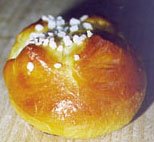
But Galparsoro, in San Sebastian, changed my mind this past week. They appear to supply barras to half the city; in the morning their deliverymen pull huge woven baskets stuffed with loaves on handcarts through the Parte Vieja. But it is their specialty breads that really stand out. Gorgeous chapatas and rusticas and vienesas. A dense, slightly sour mushroom-shaped thing called a Plus Minus. And what are certainly the best brioche I've eaten outside Paris. But the star, the shocking star, of their offerings is the humble suizo, a normally uninteresting sweet roll topped with sugar. At Galparsoro, the dough is chewy and yeasty and not too sweet; the sugar on top comes in big crunchy crystals. Early Tuesday morning I ate one warm from the oven as I walked along the seawall. It was, indeed, mas bueno que el pan.

Galparsoro: Nagusia 6, San Sebastian.

Saturday, September 23, 2006

Three gestures


In my travels in the past week three gestures, spied on the street, reminded me that however much Spain may change, there is still something so very Spanish about it:

In Soto de Luiña (Asturias): The garbage truck pulls into the one parking spot left on the town´s one street. It happens to be in front of the church. So, as he comes around the the passenger side to pull out his broom, the garbage man crosses himself.

In Madrid: I arrive home late on a warm September night. Propped against the wall of the San Andres church is a group of grungy looking jovenes drinking beer. One begins to sing flamenco with much fervor. The others join in clapping.

In Barcelona: I am walking down a street that is being torn up for re-paving. The noise and the dust are terrible, and the street--what remains of it--is treacherously uneven. Suddenly I feel a hand on my elbow: it´s an elderly woman, asserting her right to take the arm of any passerby, in order to safely traverse the street.

Tuesday, September 19, 2006

The Secret Life of Cabbies


I took the bus to the airport on my way out of Barcelona last week. Although I've frequently ridden the bus into the city, I don't I've ever done the reverse, because I was utterly surprised to find us, as we neared the airport, veering off into a back parking lot loaded with taxis. Literally hundreds of them, all black and yellow. At first I thought they were just lining up, from very far afield, to pick up passengers. But then I realized that none of the drivers was in his car, and that in fact they were all just hanging out, talking, smoking, and going for coffee at the special taxi drivers' bar handily located alongside the parking lot.

It was like one big, secret, taxi drivers' treehouse. The windows on the bus were closed, so I couldn't hear. But I can imagine the passionate, rapturous discourses on ham, and the declining morals of youth, and why the government is withholding information about the Madrid bombings that emanated up from the asphalt. Posted by Picasa

Saturday, September 16, 2006

Where not to stay in Barcelona


Travel writers rarely get to complain, at least not in print. Newspaper travel sections and glossy magazines exist to entice people to go places and spend money, not convince them to stay home and horde their cash. So you learn pretty quickly that editors want snazzy and upbeat, not depressing and whiny.

But that's the beauty of a blog.

I was in Barcelona this week, and since my favorite hotel (favorite when I'm paying, that is; otherwise it's no contest) was booked, I decided to try a new place, the Hotel Olivia Plaza.

That's it above. Looks nice, right? In some ways it was: good location smack in the Plaza de Catalunya. Stylish, not too expensive, and the chenille coverlets are a nice touch. But trust me when I say that these people have no idea what they're doing.

I suspect they decided to open a hip little hotel without ever stopping to think that someone might actually stay there. How else to explain the stained floor coverings (made of some unrecognizable material that felt like woven plastic) in a hotel that has only been open for six months? How else to make sense of the fancy, plate-sized showerhead...surrounded by a huge mold stain? The sophisticated track lights dim nicely, but won't actually turn off unless you take your key card out of the slot. Which means, of course, that you can't turn them on again without slapping around blindly in the dark in search first of your keycard and then the damn slot. See those hipster-retro globe lamps hanging by the bed there? Turn the air conditioning on, and the current will keep them knocking into each other all night. Add a maid who, without knocking, lets herself into the room at 8:00 am while you are dressing, and you have an all around bang-up experience.

Did I mention that there are no soap dishes? Nice little toiletry sets, but no place to put the soap. Which, being the exact size and shape of a golf ball, rolls.

, ,

Tuesday, September 12, 2006

True Grit

Last week I wrote admiringly of a couple that had held firm longer than the rest, remaining in their camping vehicle at Faro Vidio until the other tourists had turned tail and headed for home.

Today I salute somebody (somebodies?) who has bested them all.


These never-say-die campers have dispensed with vehicle, traveling, beautiful sights — hell, they’re gutting it out right there on the front lawn, with the sheep.

Need I say more? Posted by Picasa

Monday, September 11, 2006

Another Culinary Diatribe


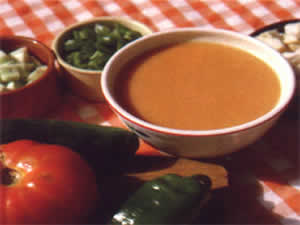
Temperatures in Madrid have dropped in the past few days, which means I've probably made my last gazpacho of the season.

In truth, it took me a long time to learn to love gazpacho. Not only because, well into my twenties, I refused to eat tomatoes (until the fateful day when I passed a market in Caligari, Sardinia--how well I remember it!--and the red globes looked too delicious to pass up). But mostly because, even after I had learned to love the tomato, I only tried gazpacho in the US, where it tends suffer from a serious texture problem.

Namely, it makes me gag. Admittedly, I am overly sensitive to foods--oatmeal and rice pudding come to mind--that try to be soupy yet still have tiny solids floating around in them. The problem with American-style 'gazpacho' is that somewhere along the line, someone got the idea that all you do to make it is put a bunch of vegetables in the blender and push the on button.

Gazpacho, it's true, is easy to make. But it is not that easy. Any Spaniard will tell you that in order to get the emulsified creaminess that defines good gazpacho, it is not enough to blend. You have to strain as well. If you're too lazy to strain, well, you're too lazy to make gazpacho.

My recipe:

1 kilo ripe tomatoes, cored, seeded, and cut into large chunks
1 Italian green pepper, cored, seeded, and cut into large chunks
1/2 a large cucumber, peeled and cut into large chunks
1 clove garlic
4 inches of day-old baguette, crusts removed
2 TBS of sherry vinegar
1/2 cup (or more--Spaniards tend to use more) extra virgin olive oil
Salt to taste

Throw everything except the last two ingredients in a blender and puree. With the motor on, gradually add the oil until the gazpacho attains the desired consistency (if you want it thinner, you can also add a little water). Add salt to taste.

With a wooden spoon, force the gazpacho through a fine-mesh strainer into a bowl, pressing on the solids to extract their full flavor. Discard solids. Refrigerate gazpacho until cold.

If you wish, you can garnish gazpacho once it's served, with chopped tomatoes, onions, cukes, and/or croutons. That is acceptable texture.

Friday, September 08, 2006

More Adventures in Spanish Medicine

Overheard at the pharmacy:

Rosa (elderly, hard of hearing, with a stack of prescriptions she needs filled): "Don't give me that one, it doesn't work."

Pharmacist (young, cheerful): "Now Rosa, you know it won't work if you don't believe in it. You have to believe in your medicine if you expect it to work."

Wednesday, September 06, 2006

Suspending the End

Most of the year, you can walk through Oviñana and right out to el Faro Vidio—the lighthouse at the point—without encountering a soul. That’s one of the great pleasures of living at the Molino. We’ve got the stunning natural vistas of the California coast, but we don’t have the crowds or the traffic.


But late July through early September—vacation time for Spaniards and many other Europeans—is different. The beach we frequent, San Pedro, as well as the Faro Vidio, are cluttered with campers, minivans, pitched tents, and all other manner of portable sleeping contrivance.

I can’t say I blame those who come to sample Asturias’ remarkable beauty (we moved here, after all), but neither will I deny that I’m a little happy when they fade away.

By this time in September, only a few remain—stalwart voyagers committed to one more memorable cliff view, one last night falling asleep to the sound of the ocean’s waves.


The couple we happened upon during our walk to the Faro Vidio Sunday morning typifies this species of sturdy traveler. Their maize minivan parked alone at the point, she glumly packed while he hitched up his suspenders, lit a smoke, and stole a final glimpse of the sea below.

Jutting out his bare, sunburned, jug-belly, this veritable Man-O’-War among tourists stood as if in defiance of the season’s passing, his attitude palpable: a man, a woman, a vehicle, a destination, and the time to get there—that’s all you need.

Soon, they were headed back to their daily grind somewhere on the continent. Posted by Picasa

Monday, September 04, 2006

The Smoking Wars, Redux


You may have thought that Spain's smoking ban went into effect on January 1. But everyone here knows that it didn't really start until the grace period for bars to create smoke-free zones was up. Which means it didn't really start until today.

At a train-station bar this morning, one young man came in for a healthy breakfast of Coke and a cigarette. As he lit up, the waitress told him he would have to take his Coke and his cigarette to the smoking zone (which lay outside the bar, and up a flight of stairs). "Sorry," she said to him, sheepishly. "It's the first day." "Hah!" came the retort from the other end of the bar where a second man was drinking his morning cognac and coffee and watching the exchange of sympathetic glances between the two. "Another comrade," he said, as the three commiserated.

Under Construction - II: The Palista

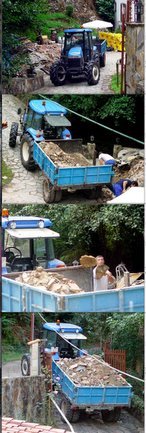
He rumbled in, backwards, the palista.

Four times he filled and hauled the
dumpster hitched to his tractor.

He took away the mountain of
construction rubble—the mangled
innards of the Cabaña—that for a
week had filled our patio.


He returned with loads of sand and
brick to fill up what had been torn away.

He managed his vehicle skillfully,
backing smoothly down the driveway,
navigating precisely up the snaky
curves leading away from the Molino.

Yet during one trip out he carelessly
scraped against the iron gate. His
tractor must have felt nothing more
than a ‘thump’ along its hip, but the
gate will no longer close.


When I asked José María, our
contractor, if I should avail myself
of the opportunity to rid the yard
of random detritus by tossing it
into the departing dumpster, he
told me not to worry: “He’ll be back.”
Posted by Picasa

Friday, September 01, 2006

A New Space


This is what happens when you leave the city for a few weeks. You go away and when you come back, Tirso de Molina, which was-- just a few days ago, and for as long as you can remember--home to drug addicts, and honking cabs, and top mantalistas, men who sleep on benches and the women who yell at them--that Tirso de Molina has suddenly become one big, clean outdoor cafe. I hear a flower market is next. My question: when did all this happen? Posted by Picasa