Monday, October 31, 2005

It's A Girl


Spain awoke to the news that it had (another) heir: early this morning Letizia gave birth to Leonor, who, according to her grandmother the queen, is healthy, chubby, and a "llorona," --a wailer. Leonor's birth will eventually occasion a reform of the constitution so that women have equal rights to the throne, but that is some time off in the future. For now, a few interesting facts about royal births:

All Spaniards have identification numbers that they use as a combination social security/driver's license number. The "DNI," as it is called, is necessary for everything from paying taxes to setting up a phone account to booking a plane ticket. For most, the number is 8 digits long, but the royal family has the market on the easily-remembered numbers 1-50. The king is 1, the queen is two, and so on through their children and grandchildren. Which makes Leonor #12.

And a little history: Victoria Eugenia, the English-born wife of Alfonso XIII, was the last Spanish queen to give birth in the comfort of her own palace. Apparently, her 12-hour labor was especially arduous, but every time she cried out, her mother-in-law, the Queen Mother, would scold her, "We Spaniards do not scream when we bring a king into the world."

Sunday, October 30, 2005

He Seemed Like Such a Nice Boy


On Thursday in Calella de Palafrugell, all the talk was of Tano, the local bar-owner/artist who was apparently in cahoots with the second-most wanted Nazi in the world. In June, Tano received a wire-transfer for some 170,000 euros from the son of Aribert Heim (also known as "Dr. Death") that, according to the artist, was payment for some paintings. At a sandwich shop just off the beach, Pilar and Lola talked at length about what a great guy Tano is: friendly and kind and a regular in their Tai Chi class. Pilar thought he was in a photo she had, but wasn't sure. And then she said that she had heard he and his wife had bought a huge house in Palafrugell. "So you never know," she sighed.

Saturday, October 29, 2005

Eating: El Cisne Azul


After being turned away from an Indian restaurant at 3:35 because the kitchen was "closed" (closed? at 3:35? in Madrid?), my friend Sam and I ended up eating bad-but-expensive sushi for lunch on Wednesday. And not enough of it either, because on the way home we ended up stopping for a dessert of sauteed mushrooms.

Sam had seen the place before, and although he knew it specialized in mushrooms, he had never eaten there. We went in, and it looked for all the world like your typical ca. 1976 Spanish bar, with bad lighting and blaring tv, formica floors covered in used napkins, and turquoise tiles (we later learned the bar is called The Blue Swan, at which point I understood the tiles to be an illustrative touch, though I still have no idea where the swan comes in) covering the walls. The only decoration, such as it was, were the laminated charts depicting wild mushrooms stuck randomly on the door, behind the bar, in the window.

The tapa display case held plates of trompettes de la mort, shitake, hen of the woods, and some irregularly-shaped mushrooms that the Spanish call cow's tongues. We argued about whether boletus in Spanish are porcini in Italian, then ordered them anyway. Sauteed with garlic until they were brown around the edges, a fried egg sitting on top, they were utterly delicious.

Meanwhile, in a corner of the bar, a group of ten men were finishing lunch. Cigars were out, talk was raucous, and there were two open bottles of Ballantines on the table as digestif. As one of the men got ready to leave, he pulled the waiter over and whispered instructions. Seconds later, the waiter came back with a large crate of boletus (which are indeed porcini, and cepes, for that matter), a thick layer of dirt still clinging to their fat stems. He pulled out a couple--they were huge--weighed them, and dropped them into a plastic bag for the man to take home.

The Cisne Azul, c/Gravina, 19; tel. 915213799

Wednesday, October 26, 2005

War Counsel

I spent a few hours yesterday with the folks at the Fundación Francisco Franco. Their offices were much as you'd expect: dark and a bit musty, walls hung with faded tapestries and flags; a paneled board room with a floor-to-ceiling portrait of the Caudillo dressed in full regalia. And the Foundation officers also what you'd expect: elderly, gracious, rather tenaciously nostalgic.

One of the most interesting things to come out of the meeting was the correspondence they showed me between Franco and Lyndon Johnson. It seems that the US president had asked the Generalísimo to send Spanish troops to support the American ones in Vietnam. And Franco's reply was, well, insightful:

"My military and political experience allows me to appreciate the great difficulty of the enterprise in which you are engaged: guerrilla warfare favors the indigenous insurgents, who with very few men can keep contingents of better-armed troops in check. ...War in the jungle is an affair without end.

"I don't know Ho Chi Minh personally, but from his history and his efforts to throw out the Japanese, the Chinese, and the French, we must credit him with being a patriot....Without a doubt, he could be the man that, at this time, Vietnam needs."

Someone should have shown that letter to Aznar.

Sunday, October 23, 2005

Winter

When I left Spain at the beginning of October, it was hot and everyone was still wearing sandals. Two weeks later it is still pretty damn warm, but clearly, the collective consciousness-- if not the actual season--has turned, and we are in winter. You can tell because even though I was almost sweating in a suede jacket this morning, everyone around me had on sweaters and scarves and was crossing the Plaza de Oriente like it was frozen tundra. And yesterday, the tables at San Gines were once again full of people drinking hot chocolate.


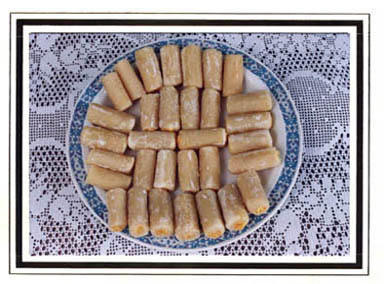
Another sign of winter: huesos del santo, little sugar-coated marzipan cookies that they make for All Saints Day. The holiday isn't until November 1, but in a bit of American-style commercialism, my bakery has begun selling them. The name translates as "saints' bones"; hence the shape. At La Tahona, they come scored like rotini, and with candied chestnuts, apple, or sweet potato where the marrow would be. My favorite, though, are filled with yema--sweetened egg yolk, which should be disgusting, but isn't.

Saturday, October 22, 2005

Feria de los Sentimientos


Walking through the Plaza Mayor this afternoon after two weeks' absence, I was reminded of how dearly the Spanish love a fair. And not just the big ones, that have them dressing up in costumes and drinking til all hours of the morning. Small ones--Feria of the Book, Feria of Used Tchotkes, Feria of Solidarity--all it takes is a few white tents and large speakers. Once, Geoff and I, crossing the Plaza Mayor early on a Saturday morning, were surprised by workers setting up what, for all intents and purposes, appeared to be a Feria of Disease. (In truth, they may have called it a health fair). Flocks of white tents filled the square, each one dedicated to a single, horrifying condition. There was a pancreatic cancer booth, a heart disease booth, even a leprosy booth. Not much action outside that one.

So it was with some curiosity that I entered the roped-off area of today's Feria of Feelings. I pictured graphic goings-on in the tents: wailing, hysterical laughter, screams of pain. But instead it was a children's fair, complete with inflatable Moonwalk (strangely called an "American court") and guys making balloon animals. There were some banners that listed various feelings, and among them "tolerance" and "phobias" were especially prominent, leading me to believe that this fair, like so many Spanish ones, had some subtle political statement to make. I just couldn't figure out what it was.

Friday, October 07, 2005

Eating in Salamanca: Zazu

I was in Salamanca yesterday, with time left over for lunch. My plan had been to take a cab directly to Chez Victor, which I had loved--especially a dessert whose only feature I remember is its luscious caramel sauce--when I ate there many years ago with my mom. But when I got there yesterday, it suddenly occurred to me that Chez Victor was probably expensive, and there was no menu outside to persuade me otherwise. So I opted instead for what looked to be a very charming, and far more economical, restaurant around the corner, called Zazu.

And it was charming, in its way, with deep blue walls and windows open on the Plaza de la Libertad. The restaurant called itself "Mediterranean", which translated mostly as Italian, with a few Spanish touches thrown in. I ordered the menu del dia (salad, pasta, dessert, wine, 12 euros) and asked for a glass of water, which in Spain always mean tap water. The waiter--long, dark hair, a little less than fastidious--said, "Of course," and then proceeded not to bring it. When I asked him again, some 20 minutes later, he said, "Sure, but we only have bottles." And then he brought the loud British lady next to me a glass of tap water for her medicine.

Salad was one of those weird concoctions with random vegetables (steamed carrots, raw celery) thrown in with the too-sweet dressing. But the gnocchi with chicken, bacon, arugula and sun-dried tomatoes came together well. Still, I found myself wishing I had stayed with my first impulse.

Zazu is at Plaza de la Libertad, 8, in Salamanca.

Wednesday, October 05, 2005

Things Done and Undone

Here is the list of things I hoped to accomplish on this last trip to Asturias:

  • Get the car inspected

  • Get the car registered

  • Get permission from all concerned to put electrical posts on their property

  • Get permission from the local government to put electrical posts along the road to the molino

  • Deposit the money so that Viesgo will connect us to the electrical system

  • Get the hot water heater fixed

  • Maybe do a little painting


Here is the list of things I actually accomplished on this last trip to Asturias:

  • Left the car (still unrepaired) at the shop so that when I return, the rear window will have been replaced

  • Got a map showing us who all the neighbors are along our prospective electrical route

  • Got permission from one of them

  • Made official request to local government for permission to put up electrical posts

  • Deposit the money so that Viesgo will connect us to the electrical system

  • Got hot water heater fixed, but now it shoots huge flames whenever lit; probably needs to be re-fixed


Part of the problem is that everyone has opinions that, when you hear them, seem perfectly rational, but that actually end up leading you down another horrifically torturous alley of bureaucracy and mystification. You know it's going to happen, of course, but it sucks you in nonetheless. "Why don't you connect from the factory?" asks Alfonso. "Why don't you have them lay the line underground?" says the unknown (and unasked) man at the bar. "Why don't you go to the industrial office in Oviedo and tell them to get all the permissions?" says Fernando, owner of Casa Fernando restaurant. Even I knew enough not to follow that trail, but six days later, it's a pretty short list of accomplishments with which to content myself.

Saturday, October 01, 2005

Mañana


Yesterday I brought the car (that's what it looks like, there on the left, only ours is charcoal gray and missing a rear window) back to Pedro, because he told me the new window would be in by then. When I got to the shop, he checked, assured me it was there, and sent me off to the cafe next door while they put it on.

It was one of those old-fashioned kinds of bars that used to be everywhere but are becoming harder to find as Spain turns more European: men coming in for beer at 9:30 in the morning, floor covered in napkins and empty sugar packets, a broken foozball table in the corner, hams hanging everywhere. And of course, both the tv and radio were blaring, as were two slot machines. I kind of liked it.

After spending an hour there reading Portrait of a Lady and drinking coffee, I went back to the shop. Pedro told me he had made a mistake: that the window that had come in was not mine. Would I like him to tape up the back with plastic?

On the good side, I picked some of our figs and apples yesterday. They are sidra apples, and hence, according to local wisdom, not good for eating. But I tried one, and thought it delicious. I would have made a pie, if only our oven worked.

Wednesday, September 28, 2005

El Orbayu


On this morning´s ride from the Asturias airport to Ovinana, the cab driver gave me a lesson on rain. Like Eskimos with snow, the asturianos have their own words for the different kinds of rain that fall. The most common is the the orbayu, that light, misting rain that sometimes seems like it will never end.

Our conversation reminded me how much I love Asturias, even though the orbayu was falling as I thought about it. And then we arrived.

I hadn´t been at the mill in almost two months, so there was the usual dampness, and mold, and dead insects to deal with. But unexpected was the blue tarp covering the rear of our car like a diaper. Afraid of what I would find underneath, I looked anyway: there was the back window, shattered into a million slivers, with one rock shaped hole in the middle.

Into every life...

Sunday, September 25, 2005

The Evil Empire

Spanish newspapers have an unusual way of promoting sales. Instead of lowering subscription rates (no one subscribes, anyway), they create little gifts to lure buyers while they're standing at the kiosk. Often these gifts are the first book or DVD in a series--"Great Historical Novels"; "Nature Documentaries"; "Breads of the World"— but they can also be "fasciculos" which are a few pages in a book that you then slowly put together yourself in a handsome binder also provided by the newspaper. And sometimes the gift is a collectible that it's hard to image anyone wanting: miniature clocks, fake antique toy cars, tea cups.

In any case, you get the first one for free. After that, the thinking goes, you'll be compelled to complete the series, paying 6.95 a week for your tiny timekeeper or your few pages on marine biology for the next 145 weeks. And of course you have to buy the paper. But apparently, it works: the papers spend far more money advertising their giveaways than they do advertising, say, the quality of their journalistic content.

Today, the freebie with El Mundo was the Lonely Planet guide to Rome, first in a series of some 30 city guides to come. As giveaways go, this was a good one, so I bought it, as did the woman in front of me at the kiosk. Which launched the kiosk guy with the badly-dyed hair (three people work there now: the dyed-hair guy who is always smoking; the tall, mildly crazy guy who occasionally mumbles things I can't understand; and Antonio, the reticent owner. Antonio's dad used to work there too; he was my favorite) into a tirade against us. He lambasted our weakness in the face of nefarious capitalist techniques, and denounced the evil empire of newspaper publishing that could so malevolently lure innocents into buying things they didn't want. He knew, of course, that neither I nor the other woman usually buys El Mundo. "You've surrendered," he cried.

Saturday, September 24, 2005

Top-Mantalismo


Tonight I was almost run over by a horde of fleeing top-mantas. Or should that be top-mantalistas? They are the guys--mostly Latin American or African—who stand on the street selling pirated CDs and DVDs. They display their wares on a blanket. Hence the "manta," although most often the cloth in question is really a sheet, or a portion of a sheet. No one calls it a top-sábana, however.

Where the "top" comes from is anyone's guess. It is true that the CDs lie on top of the blanket/sheet, but the Spanish only use the word "top" in reference to people like Kate Moss: she is, or at least before she lost her H&M contract, she was a "top model" practicing "top modelismo."

In any case, the equipment used in top-mantalismo is surprisingly uniform: everyone ties two pieces of rope diagonally to each corner of the cloth so that they cross in the center. That way, when the cops show up, the top mantalista can yank on the center knot and pull all his goods into a neat little bundle, the easier to run with. It's a common sight, actually, these groups of young guys tearing down the street like athletic Santa Clauses, homely little sacks tossed over their shoulders. Half the time, they look like they're having fun.

Wednesday, September 21, 2005

Neighbors

Our neighbor up the road in Asturias called us in Madrid to tell us she was worried about our car. Nothing's wrong with it mind you, and it's parked behind a locked gate, but still, she was worried. Nice to know someone is looking out for us, but still, a strange reason to call. Until she got to subject number two: her grandson, who is 25 years old, wants to be a journalist, and lives in Madrid. Would we call him?

"Your grandmother asked us to call" doesn't seem the right opening, and after that, I can't think of the first thing to say to a 25-year-old Spanish stranger. But his grandmother's property would be the first one to get a new cement post should we connect to the electrical system, so I suppose call is what we'll do.

Monday, September 19, 2005

Shopping: La Antoja


Found a new gourmet foodstuffs store yesterday afternoon, while I was walking through Lavapies. The tagline for La Antojá translates as "caprices of the palate," and that's pretty much what you get: all those things that the Spanish consider delicacies. Walnuts in honey; artisanal jams; smoked red peppers; and—of course—white asparagus.

(Speaking of which, I once got slammed on a foodie website for an article I wrote in which I referred to white asparagus as "repellently flaccid." To each his own.)

But back to those caprices of the palate: with the exception of Italian pastas and French foie gras, most everything at La Antojá comes from Spain, and most everything comes packaged in pretty little jars and tins. The red-haired owner Belinda was fretting about the unpredictable weather (she couldn't decide if it was time to take down the ice cream freezer), but was helpful nonetheless, steering me away from a bottle of Somontano ("too expensive," she said) and toward a very-attractively labeled Azul y Garanza, from Navarra.

La Antojá is located on c/Argumosa, 26, in Madrid.

Categories:

Saturday, September 17, 2005

Saturday Morning


Saturday is the big shopping day in Madrid. I had planned to get up early to beat all the Marias, but jetlag got the better of me. When I finally made it to the market, there was a long line of women waiting for their tomatoes and melons, plus a few men with lists, clearly sent by their wives.

We buy all our produce at Pedro's stand in the Mercado de la Cebada. Pedro loves his fruit, calls me guapa, and always throws in a little something extra--radishes, a ripe fig-- for free. But his mother works there too, and she is elderly, tectonically slow, and quite insistent about adding the total by hand, which she does creatively. Somehow I always get stuck with her. I'm convinced that all the other shoppers connive to sic her on the stupid American.

Shopping in Madrid is like that. You get the fresh produce, the beautiful displays, the personal service that are saddly missing from your average American supermarket. But you are also plagued by an unspoken code of rules diabolical in its complexity. No one ever had to figure out how to avoid Pedro's mother at a Giant Eagle.

To say nothing of the opprobrium. Today, I tried to buy fish, even though I don't really know how to cook anything except tuna steaks and salmon. Sole, I thought, would be nice. I chose my fish guy because his helpers are both Latin American, and I figured that they might be more sympathetic to a fellow foreigner who was a little sketchy on fish preparation. But no. I asked the smiling Ecuadorean man for sole, and he pointed toward a sign that said, "leguado de miga," which translates literally as "crumb sole," whatever that means . I said, "Two please, fileted." He snorted.

Crumb sole, apparently, are too small to filet. Also apparently, any Spaniard would know this. So I moved on to the besugo, which is bigger than lenguado de miga, and is either sea bass or sea bream, I can never remember which. Again I asked for it to be fileted. He looked at me with consternation, but he picked the fish up and weighed it. Then he passed it off to his boss. I had the distinct impression that by previous agreement, dealing with the unreasonable requests of American women who don't know the first thing about fish clearly fell to someone higher up the fishmonger ladder.

I took my besugo home where I cut it into strips, fried it in olive oil, and sprinkled it with lemon and Maldon salt. It was delicious.

A little history

How did we come to own a mill in Asturias that may drive us to bankruptcy and mental instability? It started like this: we bought an apartment in Madrid (you can rent it, if you want). After a few months, in which we felt inordinately happy with our choice, we realized--oops--that we would never be able to get our dog, a Labrador who suffers some neuroses uncharacteristic of the breed, including a fear of stairs and ventilation grates , up the four flights. Plus, we had always wanted a place in country. So we rented a car and started driving.

Our original plan was to start in western Asturias and cross the north to the Pyrenees. But we never made it out of Asturias. The very first place we saw was the mill, and the very first thing Geoff said upon seeing it was, "Holy shit." We kept looking--we aren't THAT impulsive—and ended up seeing at least a dozen places. The three that made it into the finals were a pseudo-Casa de Indianos in the Picos de Europa, that had wide-plank oak floors, a ton of land, and an unfortunate telephone pole that blocked the mountain view from the galleria; an inn with gardens and chickens just outside Villaviciosa; and the mill. After much agonizing debate, and one return visit, house number 2 won: at that point we were well into our let's-till-the-earth-and-run-a-bed-and-breakfast fantasy. But the bank saw things differently.

So the mill it was. The owner was a famous Spanish actress (that's her to the left) in the 1960s, but her son was the one doing the selling. He assured us that the place was totally self-sufficient (the stream that runs underneath provided water for the house and powered a turbine that produced electricty) and perfectly comfortable to live in. We thought, "Great. A few cosmetic changes, a little landscaping, some new furniture." Hah.

Wednesday, August 31, 2005

The View from Ohio

We awoke three times last night to the ringing of our Spanish cell phone. Of course, we are not currently in Spain, which is why the 4:00 and 5:00am calls provoked much disorientation and pounding of hearts. The first was about a potential stringer job; the second from the amateur archeologist who will not leave us alone until we make him famous. Neither, mercifully, was from Alejo, telling us in that booming yet incomprehensible voice of his that the Molino had burned down.

Ohio is a strange place to begin a blog on life in Spain, but there you have it. I could say that we needed the perspective, but so far, all the time away has done is confuse us more. We are trying, you see, to renovate an old mill in Asturias, to use as our retreat when we are not in Madrid (or Ohio, for that matter), a place to build a life in Spain around. But we've encountered rather a few glitches, mostly having to do with too much water in some places and not enough in others. More on the glitches, in excruciating detail in fact, later. First, we have to decide if we want to risk bankruptcy.

You can see the mill here.