Friday, February 10, 2006

The Smoking Wars


Every since Spain's smoking ban went into effect on January 1, every bar small enough to legally escape the crackdown—and they are many—has posted a handmade sign on its door advertising the fact. Which means that instead of actually preventing smoking in public, the law is simply shuffling the geography of where smoking takes place.

Meanwhile Esperanza Aguirre, the president of the comunidad--or region--of Madrid, is about to shuffle even more. Her government has drafted a plan to "enact" the anti-tobacco law that in fact disactivates it, allowing smoking in bars as long as the ventilation is good and in offices as long as there is a balcony . After all, she doesn't want smokers "to feel discrimated against." The Minister of Health has responded by calling Aguirre's plan illegal, and suggesting that the presidenta is perhaps willing to jeopardize the health of madrileños in order to win votes. Members of Aguirre's cabinet, in fact her very own councillor for health, has responded by calling for the Minister's resignation. Nothing new there--calling for resignations is what the PP seems to do best these days. The crispación continues.

,

Monday, February 06, 2006

The cake that ate our electricity

Sure, we were getting a little cocky. Two space heaters, two dehumidifiers, the occasional vacuum cleaner, and all the table lamps you could want. For six glorious days we were environmentally unsound, scarfing down all the electricity we could get our hands on. But it wasn't enough. I had to go and try to bake.

Baking: one of the things, right up there with blow-drying my hair, that would make me feel most at home. And it wasn't anything fancy, just a bizcocho, which is the Spanish version of something between a sponge cake and a pound cake. I had to improvise the recipe since the Spanish recipes I have all called for metric measures, and I only have American ones, conscientiously imported. I had to melt the butter instead of creaming it, since we don't yet have a mixer, but the batter tasted fine.

After the bizcocho had spent three minutes in the oven, however, the power blew--all of it, right as dark was falling. To be honest, I knew that back when we were running off of water power, the oven, which is gas but has an electric broiler, routinely overloaded the circuits. But I had hoped that now that we have some 17,000 watts at our disposal, I'd be able to bake a simple cake. I would be wrong.

So, we turned off the oven, lit all the candles in the house, and finished making dinner. After, as we huddled next to the fire for warmth, Geoff pointed out that since the electricity was already gone we might as well re-light the gas and finish baking the cake. So we did, and spent our Sunday night eating steaming bizcocho in the dark.

The recipe:

2 sticks of unsalted butter, melted
2 cups sugar
2 cups flour
1 tsp. baking powder
1 Tbsp. lemon juice
1 tsp. vanilla extract
125 g (sorry. that's the size they come in) plain yogurt.

Mix everything together. Pour into greased baking pan. Bake at 350 degrees for about 40 minutes. Serve warm.

Friday, February 03, 2006

Eating: Juana la Loca


One of the chief pleasures of urban life is that you can have a neighborhood restaurant, a place where out of the whole sprawling metropolis, you know the food will be good, you know the waiter will greet you by name, you know the bartender will remember how you like your coffee. Technically, I suppose you don’t need to live in a city to have a neighborhood restaurant, but somehow the whole enterprise seems less meaningful if 1) everyone knows you at the post office too and 2) you have no other restaurants to choose from. If one lives, say, in Oberlin, Ohio, the fact that the waiters at Black River Café all know you like your eggs scrambled is not comforting. It is suffocatingly boring.

But in Madrid, it’s a different story. There, my neighborhood restaurant is Juana la Loca. Tucked onto a corner of La Latina, its violet-blue walls are at once soothing and every so slightly chic. The waiters, despite their all-black uniforms, are friendly. There are at least 6 wines available by the glass. The owner, who looks like an older Pedro Almodovar, also owns what may be my favoritely-named restaurant ever, Maldeamores.

The food, needless to say, is great. It’s almost all tapas and pintxos, but innovative ones, like roasted artichokes with shaved parmesan and whole cloves of blanched garlic, or a tuna carpaccio that gets silkiness from a drizzle of almond oil and crunch from saffron-flavored puffed rice. Even the regular suspects come dressed up: humus comes with strips of crisp-fried pita and a sprinkle of pimentón; the onions in the tortilla de patatas are deliciously caramelized.

So truly do I love Juana la Loca that I hesitated to mention it here, afraid it might be overrun. But then I remembered what this blog’s traffic levels are. So, all tens of you, go forth and try Juana la Loca. Tell Gustavo I sent you.

Juana la Loca: Carrera San Francisco 4. Tel: 913640525

Thursday, February 02, 2006

Levon Across the Water

There's a lot to tell about our dog Levon's journey across the water, but I'll leave that for Geoff, who suffered the worst of it. I don't, however, think I'll ever forget the image of him inside his crate,coming toward us on the prongs of a forklift.

He seems to be adapting well, if tentatively, to Spanish life. The mornings with tennis ball on the deserted beach near our house, and the chunks of Asturian beef we guiltily slip him, only help.

Sunday, January 29, 2006

Let there be light

It's true. As of 5:15pm on Friday, January 27, we have electricity. Photos to follow.

Forgive me if I sound surprised. It's true that we were told, back in early November when we handed over a check for an absurd amount of money to cover the cost of cement poles and wire-hanging, that the process would take "10 days--two weeks max." It's true that as recently as 10 days ago, our own electrician told me that "things would have to get very complicated" for us not to have electricity by Friday. By now, I expect things to get "very complicated." When it comes to things involving installation of any sort in Spain, I am inured to hope.

Of course it didn't help that when I called on Wednesday to ask if they had finished hanging the wires, José told me that, well, they hadn't started until Tuesday, and they should be done Thursday. When I asked why they hadn't started on Monday, as he, and three other people at Viesgo had promised repeatedly, he changed the subject to how I hadn't gotten the right permissions. When I said that first, I had gotten the permissions they said we needed and that in any case the posts had been up since the first week of January, just waiting for the wires, he mumbled something about the weather. And then he changed the subject to how he still needed an order from his office to come do the final inspection and that another company would be in charge of putting in the meter, and who knew how long that would take. When I reported this to Nacho the electrician, he said, "Yes, I told you it was going to be very close to get it done by Friday." I said, "You told me things would have to get very complicated for them not to have it done by Friday." He shrugged.

Around 11, José himself showed up to do the inspection. Around noon, I called Laura at the customer service desk at Viesgo to ask when the guys would come out to do the hookup. Laura told me that she thought the team would be there that afternoon. By this point, I had already decided to head back to Madrid—forecasters were predicting a huge snowstorm overnight that would have the whole northern half of Spain blanketed, and I had to have the car in the capital to pick Geoff and Levon up on Monday. But I didn't want to miss the hook-up guys if they were indeed coming. I asked if she was sure. She said she "thought so." I decided to stay the night, kicking myself the whole time for ignoring instinct and experience.

But at 4:30, there he was: a handsome man in a blue Viesgo suit telling me I would have electricity within half an hour. I toyed with taking some of the space heaters I had bought out of their boxes, then decided to wait, still suspecting that something would go wrong. As the lights came on, Mr. Guapo said, "You never appreciate something so simple as flipping a switch until you don't have it, do you?" Well no, sir, you don't.

Thursday, January 26, 2006

How not to plan your next vacation


FITUR opened in Madrid on Wednesday out at the IFEMA convention center. You could tell it was coming because suddenly, a ring of yellow sand materialized in the middle of the Plaza Mayor, the newborn site —as it is every year—for a performance by the famous dancing horses of Jerez.

Out at the convention center, things are much less predictable. FITUR is the world's second largest travel trade fair, and in the quest to stand out amid the hundreds of other booths that are all grappling for the attention of hordes of travel agents and convention planners, each country or hotel chain or regional tourist board tries to outdo the other. Some wrap recent theater-school graduates in billows of turquoise tulle and have them ripple like a river you might want to row down. Some convince middle-aged Spanish men to dress like the Centurions who one roamed their city's streets. Some force poor natives from foreign countries to do folkloric things in an overheated convention center for hours on end.

Imperative to the task of drawing a tour planner from Lérida or Liverpool to your booth is a small legion of pretty azafatas--some dressed like hot businesswomen, others like hookers at Mardi Gras-- to hand out brochures. But hostesses aside, in the end, it all comes down to swag. Free food, drink, and tchotckes apparently keep the travel industry afloat. In the few hours I was there, I scored half a dozen pens, two pencils, one glass each of sherry, cava, and a very fine Rioja, a poster of Picasso, three lapel buttons, fresh conch, a fan, a bottle of olive oil, and a fez. And I wasn't even trying.

FITUR, which runs through Sunday, is open to the public during the weekend.

,

Wednesday, January 25, 2006

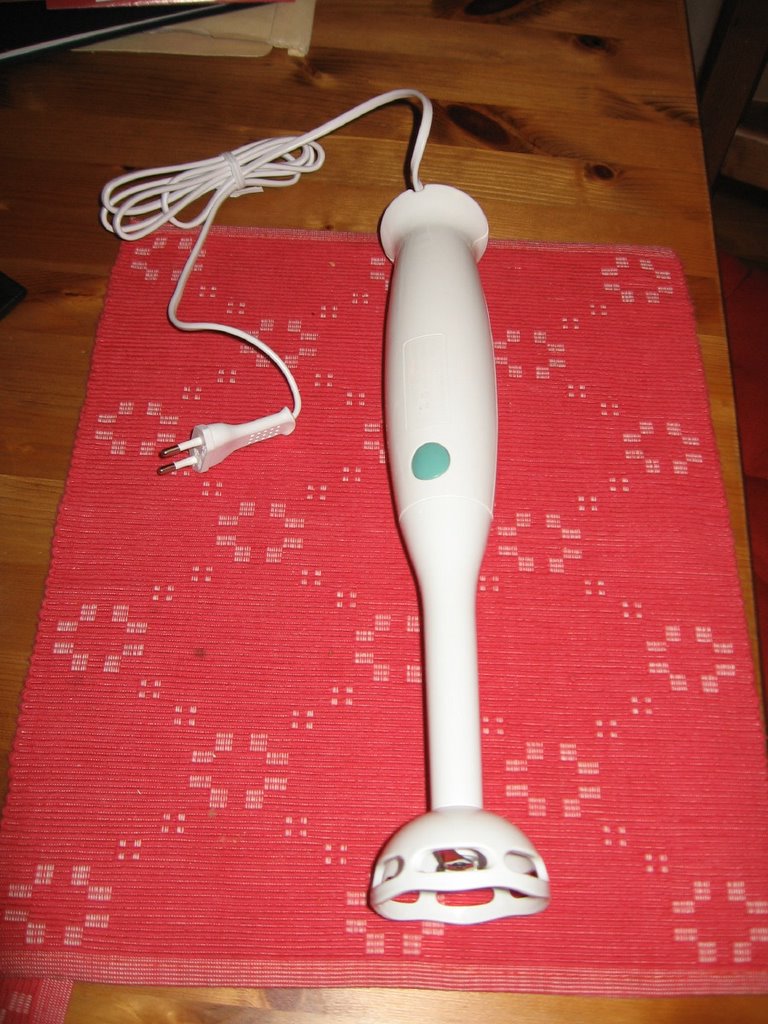
Ode to an Immersion Blender


I know that technology is supposed to be America's strong suit (after, oh yes, civil liberties and democratic transparency). But there are some things that Europeans just make better. Simple things, like dustpans with broomstick-long handles and oversink cabinets with built in dish drainers.

And immersion blenders. So neat and trim, so practical: no need to transfer anything, no chance of spraying asparagus soup all over your kitchen just as your guests arrive because you filled the blender too high. The very embodiment of European values, in fact: no gaudy doo-dads, just enough power to get things done without being ostentatious about it. I know that, technically, immersion blenders are available in the US, but honestly, how many people there do you know who have them?

It was a happy day yesterday when I took advantage of the nation-wide rebajas to first finally buy one, and then to make a deliciously smooth and creamy carrot soup with it. Couldn't have been easier. Here's the recipe:


Carrot and Dill Soup (serves 4)

2 Tbsp. butter
1 large onion, sliced thinly
6 carrots, peeled and sliced thinly
1 tsp dried dill
5 cups chicken broth
Chopped fresh dill for garnish

Sauté onion and carrots in the butter with the dried dill until the onions are translucent. Add the broth and bring to a boil. Lower heat, and simmer until carrots are soft, about 40 minutes. Use immersion blender (or if you must, a regular one) to puree until smooth. Serve topped with a good amount of chopped fresh dill.

,

Tuesday, January 24, 2006

Thank you, Benedict Anderson


By the time I got out of graduate school, I was a little tired of the ubiquity of the "imagined communities" rhetoric. Good idea, but damn if it didn't make its way into every dissertation and job talk of the 1990s. Still, I found myself thinking about it again as we near an apparent agreement on the Catalan statute.

Taxes, it should be said, have been a major sticking point--who gets how much of the revenue. But the major hold up throughout the process has been about the word "nation." All along, the Catalans have insisted that Statute define Catalonia as a nation, while the government has insisted that Statute define Catalonia as a place with a national identity. That may not seem like a difference worth holding up a pact that will utterly remake the nature of Spanish government, but trust me. And things got even more punctilious after that. Just days ago the government ceded a bit, and offered the concessionary "Some Catalan citizens feel that Catalonia is a nation"; when that was deemed too patronizing by the outraged Catalan parties, the government took off the "some."

Then, in the face of continued resistence, they revised it again. Now it says that "The Parliament of Catalonia...has defined Catalonia as a nation." Classic trick: say what somebody says it is, rather than what it is. But it seems to be working. The last hold out among the Catalan parties meets with Zapatero today, and I'll lay money that there's an agreement by the end of the day.

,

Sunday, January 22, 2006

The Electrician's Family

I showed up at the molino this weekend to find Nacho the Electrician hard at work, along with the better part of his family. Actually, with the exception of his mother (who has the body of your average señora but the dyed-red shag of an 80s rocker), the rest of them—sister, grandfather, unknown man who could have been a brother or a guy they met in the bar on the way over—seemed a bit sheepish. Which seemed unnecessary until I realized that rather than working they were there to look around our house. But Nacho's mother was working hard, and we now have 1) a cable that juts out from a hole in the wall, cuts up to the roof, and stretches across the patio; 2) one and a half floor's worth of new outlets (one and a half still to come); and 3) a pretty little stone house, complete with red tile roof, to house the counter, whenever that gets put in. Progress.

Thursday, January 19, 2006

Seeing: Madrid


The city of Madrid spends a lot of its culture budget promoting the Festival de Otoño in October, but for some reason, I always find the end of January a lot more interesting. This year, Spain´s most famous ballerina, Tamara Rojo, is dancing El Quijote with the Argentine Julio Bocca at the Teatro Albeniz, while Victor Ullate´s work El Sur--a ballet about domestic abuse with music by possibly the best-known flamenco performers in the world, Enrique and Estrella Morente--premieres at the Teatro Gran Via. Caja Madrid´s five-star flamenco festival begins next week. MadridFusion, which ends today, has all the avant-garde chefs of the world showing off their latest creations (Adrià issued a 23-point manifesto and demonstrated a battery-powered screwdriver that shoots out strands of carmelized sugar). And all the big US Christmas movies--Munich, Brokeback Mountain, Luther (what? You haven't heard of that one? Joseph Fiennes playing the tonsure-headed founder of Protestantism? I can't imagine why)are finally making their way over.

,

Wednesday, January 18, 2006

The Scent of Return

Not too long ago I mentioned how Córdoba's scent hit me as soon as I got off the train. It used to be that way with Madrid as well: I would get off the bus from the airport at Plaza Colón and lightly swoon as I inhaled the smell I hadn't realized I had forgotton, the smell of Madrid. It wasn't olive oil in this case, more like a mix of coffee and exhaust and fried calamari and that peculiar cleaning fluid that Spaniards use, but it instantly reminded me where I was, and I loved it.

When I got in to town earlier this week after a month away, it wasn't there. Or rather, it probably was but I didn't notice it. I think it must mean that Madrid is becoming home.

Wednesday, January 11, 2006

Essentialism

Two pieces of interesting news from the weekend:

A general in the Spanish army was placed under house arrest after he warned that if proponents of autonomy went too far with the Catalan Statute, the army would be forced to intervene. And a man in his 60s was killed when his car accidentally hit a gitana girl as she crossed the street, injuring her lightly. Her family, upon witnessing the accident, ran into the street and shot the driver eleven times.

There, in one news cycle, two constant themes of Spanish history and myth: the rebellious military, the violent Gypsies. The last time the army threatened revolt was in 1981, when a band of generals shot up the Congress of Deputies in an attempted coup. At the time, it was terribly frightening: Franco had been in the ground for fewer than 6 years and the prospect of a return to dictatorship or civil war seemed very real. But these days, "ridiculous" seems to be the general opinion of Lieutenant General Mena's threats regarding the Statute.

Not so the public outcry regarding the murder of Gaspar García in Sevilla. The Union Romani and other Gypsy organizations have been inundated with slur-filled emails and threatening phone calls. Some perceptions, it seems, are more resilient, like weeds.

Sunday, January 08, 2006

What the Three Kings Brought


Not electricity, exactly, but the poles on which our electrical wires are strung. It's a start.

Friday, January 06, 2006

The Kid, The Fat Guy, and the Objectification of Women


As consolation to all those who lost the El Gordo Christmas lottery, today brings the smaller but still sustantial El Niño. This one's winners are also announced by children in Catholic school uniforms, a fact that is probably not amusing to anyone but me.

But amused I am. Not least because the regular daily lottery is announced on TV every night by five willowly women in high heels and form-fitting clothes whose sole job it is to pick up a ping pong ball, slide it into place, and—with big, suggestive (now you'll have a chance at me) smiles— intone the number written on it. So I can just imagine the girls in the photo above thinking today is the start of a great career.

,

Wednesday, January 04, 2006

Eating in Cordoba: Meson Juan Pena

I traveled to Córdoba the day before I came back to the States, and realized that a lot of things have changed since I lived there a decade ago. They have these nifty bikes, free to use, parked outside the train station, for example (a woman in the tourist office told me that Córdoba has more bike lanes than any European city outside of Holland). El Churrasco has opened a small inn--lovely, if a bit rococo for my tastes. Muslim chic is all the rage, with tea rooms and Arab baths popping up around the Mezquita.

But Juan Peña is blissfully the same. Same bullfighting pictures along one wall, same farm implements along the other. Same braseros underneath the tables, with thick blanket-like cloths to pull over your legs and warm your feet. And the same fantastic food.

I had lived for months in Córdoba before I ever tried Juan Peña, even though it was right across the street from the bar where I had breakfast every day (every day, that is, until the waiter--whom I thought was my friend but who clearly disapproved of my unladylike habit of eating a whole, not half, toast—told me I was "getting a little fat"). In fact, it was my visiting friends David and Elizabeth who convinced me to try the place. They ate there one night and came back raving. "You have to get the fried eggplant and spinach with garbanzos," they told me.

So I did. And in the dozens of times that I've been to Juan Peña since, I've never not had those two things. The spinach is lightly cooked, and spiced with cumin and other vaguely Moroccan flavors. And the eggplant is just plain remarkable. Cut like french fries, it is crisp and salty on the outside, melting and not at all eggplanty on the inside.

That's what I ordered two weeks ago, plus a gambas al ajillo for good measure, in the spirit of all-time favorite tapas eating. "Is that a lot?" I asked the waiter after ordering, remembering his critical brethren across the street. "Yes," he admitted. Then I ordered it all anyway.

Meson Juan Peña
Doctor Fleming, 1.
Tel. 957 20 07 02

,

Sunday, January 01, 2006

Laws Sure To Be Broken

Spain's smoking ban goes into effect today, and already one guy has found a way around it. More, no doubt, to follow.

Saturday, December 31, 2005

A Modest Proposal


The big political debate in Spain right now (if we leave aside the smoking ban, and the LOE protest, and whether Zapatero is or is not, as his opponent Mariano Rajoy calls him, a "solemn idiot"), is over the Catalan Statute. If passed, the statute will grant significantly more autonomy to the already fairly autonomous region of Catalunya. There are many points of contestation—financing, the judiciary, whether Zapatero or Maragall comes first in official protocol—but the great sticking point seems to be over the word "nation." The Catalans consider themselves to be one; many other Spaniards aren't so sure.

Zapatero has successfully persuaded parliament to agree to discuss the proposal, but it's anyone's guess what will happen next. The Catalan parties are unanimous in their support for the "nation" clause, ZP has insisted that it cannot stand, and the PP is making loud pronouncements about how both the Catalans and the Socialists are trying to destroy Spain.

In the meantime, some opponents of the Statute have mounted a boycott of all Catalan products, which include mineral water, and the white sausage called butifarra, and a bunch of delicious cheeses, but more than anything else, means the sparkling wine called cava . Cava producers are already lamenting the drop in sales.

So choose tonight's champagne wisely. Have I mentioned that Freixenet, a fine, inexpensive cava, is readily available in the United States?

, , ,

Wednesday, December 28, 2005

Holy Innocents


Back here in the US, the holiday festivities are winding down as we slouch toward New Years. But back in Spain, things are barely getting started. New Years, after all, is merely the halfway point in a fortnight's worth of celebrations. And today—a Wednesday unremarkable in most parts of the world—is reason for its own brand of rowdiness.


For an outsider, the Spanish Christmas is full of mysteries. That's moss on the cardboard next to the Christmas trees, and it took me many years to figure out why anyone would want moss at Christmas. But of course: the landscapes in the elaborate nativity scenes—called beléns, or Bethlehems, in a charming piece of Spanish shorthand—that go up seemingly everywhere are lined with moss. The really upscale ones have waterwheels too. I know this because all the stands at the Christmas market that sell nativity scene figures have hand-painted signs tacked to the front proclaiming, "We have waterwheels that work."

And I only just learned why next to all those stalls selling miniature shepherds and Baby Jesuses are others—sometimes the same ones--that sell whoopee cushions, and fake bugs, and plastic piles of shit, and strange wooden instruments that look like butter churns but make loud farting noises when played. It's because December 28th—today—is the Feast of the Holy Innocents, which for the Spanish is a kind of April Fool's Day when everyone plays pranks on each other. Of course.


Have yet to figure out why everyone goes around in electric-colored fright wigs and cartoon masks, however.

,

Wednesday, December 21, 2005

And They Polish Their Windows With Balsamic Vinegar

One of the things that Spanish cities do well is clean their streets. Every night whole brigades of men and women dressed in neat green uniforms comb the streets with brooms and hoses. There are also these little washing mobiles that spray water out the sides as they inch down the street. It's quite effective, as one would hope in a country where littering (to say nothing of spitting, dropping burning cigarettes, or sitting on the street drinking) carries no negative value whatsoever.

When I lived in Cordoba many years ago I used to joke that they hosed the streets down with olive oil. No one but me found it funny, admittedly, but I thought it was a fine explanation for why the whole city reeks--in the best possible way--of extra virgin cold pressed. Which is why I found myself chuckling on Monday when I got off the train in Cordoba and was immediately hit with the same green scent.

Sunday, December 18, 2005

Eating: La Turuleta


Ever since it opened several months ago, I have avoided La Turuleta. I have done so despite that fact that it is right downstairs, because, well, it is right downstairs. On a street that is positively awash in bars and restaurants—so awash that the tides can be hard to part on certain warm summer nights—the last thing we needed was another one. In fact, there was a minor building-wide rebellion when it became clear that another bar was going in. The president of our comunidad went so far as to file a complaint with city hall, on the reasonable grounds that the space is not zoned for hostelry. Reasonable, but unpersuasive. The bar went in, no doubt illegally, and is now doing a thriving business in tapas.

So in protest, I resisted going there. Until the other day, when it came time for lunch and none of the other neighborhood menus del día seemed very appealing. So much for political commitment (though in my defense I will say that they did a remarkably fine job of soundproofing).

I'm glad I caved, and then caved again. In the two lunches I've had there in as many weeks, I've had a beautiful shellfish soup— bright yellow, slightly viscous, and stocked with squid, shrimp, and mussels; a tasty-if-a-bit-too-soupy rice with fresh artichokes; a classic potaje made with cod and chickpeas; and a very delicious, Asian-y chicken and vegetable stirfry. And a cream cheese brownie for dessert (twice).

LA TURULETA: Almendro, 25. Tel.: 91 364 26 66.