Friday, December 16, 2005

El Caganer


I've come a little late to the whole "War on Christmas" debate, but Bill O'Reilly has reminded me why I choose to live in Spain, even if they can't make a decent doughnut to save their lives. Or bagel, as the case may be.

Let's lay aside the obvious, distressing fact that O'Reilly et al are marshalling the great democratic forces of the boycott not to Christianly protest against, say, the atrocities in Darfur or the high cost of AIDS drugs in Africa, or even, and let's be clear here, consumerism itself. Let's leave aside the whole bullying insistence that "the majority celebrate Christmas so the feelings of a few secular humanists and other heathens don't count." Leave aside as well the attack on freedom of speech. Is it not absurd that the judgement of whether a society is secular or religious comes down to what their mega-stores paint on their windows in December?

Here in Spain, they say "feliz navidad" and "felices fiestas" with equal, well, felicity. In fact, the "fiestas"--that would be "holidays"--is perhaps more popular simply because it is more grammatically correct: what we have here is a series of holidays: not just Christmas, but New Year's and Epiphany as well.

Which is not to say that they do away the religious completely. One of the most popular holiday pastimes in Spain is to visit the nativity scenes that are mounted in most every public square and, yes, shop window. These can be very elaborate affairs, not just Jesus and his folks and the kings and a couple of barnyard animals, but whole armies of peasants drawing water from wells, and children playing, and soldiers advancing, all of them dressed in robes and headscarves.

In Catalunya, there is one figure, however, who does not share the vaguely biblical dress: El Caganer. Also known as: The Shitter. Tucked into a corner of the creche, the Caganer squats with his pants around his ankles, a freshly-laid pile of excrement beneath his bare butt. Theories on the meaning of the Caganer abound: he represents primitive nature in the face of the divine; he’s the embodiment of the value Catalans put on the down-to-earth; he is another example of the important place of shit in Catalan folk culture.

And although most caganers wear traditional Catalan dress, in the past few years, it has become popular to shape them so that they resemble the most significant people of the year—part homage, part mockery. So while last year’s big stars in the caganer line-up were Felipe and Letizia (they married in May 2004), this year it is their newborn, Leonor, who will be taking a crap in crèches throughout Catalonia. Leonor, and George W. Bush. Perhaps the best-known group of caganer artisans use their website to ask clients to nominate the year’s new figures, and this year, President Bush was their choice. I wonder what Bill O'Reilly would have to say about that.

, ,

Wednesday, December 14, 2005

Via Publica

It would be nice to think that during all that time in which we heard nothing from Viesgo they were steadily putting up posts and stringing electrical wire. Nice, but utterly unfounded. So when another week had gone by and we still hadn't heard anything, I gave José another call. "Oh yeah," he said, as if my voice was recalled to him from some place deep in his memory. "You need some more permissions."

It seems that the part of the route that we were told was public--and hence incorporated in the one permission we had from the ayuntamiento--is not. Or rather, it is, but there is not very much of it; the public path is only a few feet wide. As José said, "If we put the posts right down the via publica, there won't be a via publica any more." So we need permissions from the neighbors who own the land that runs alongside. All six of them.

But José said he and his partner were working on it. They already had four, and had sent letters to the other two, asking them to sign the form. One might be tempted to ask why Viesgo couldn't have done that from the beginning; why they couldn't have simply sent out forms instead of forcing us to figure out who owned what land and traipse from door to door, pen in hand. One might be tempted to ask, but one wouldn't.

Friday, December 09, 2005

Seeing: Modern Realism


On a walk the other night I stumbled across the Caja Madrid gallery in the Plaza San Martin, with Edward Hopper on the banner. Inside, an exhibition right up my alley: 1920s and 30s realism, with heavy emphasis on carnivals and dancehalls, and a charming farm scene, complete with donkey, by a pre-abstract Joan Miró. I was a bit confused, however, by the absence of the very painting on the banner, the melancholic Hotel Room. Had they taken down the star attraction of their show? Had I missed a room somewhere?

No, they had not and I had not. The exhibit is divided in two, with the really big gun paintings over at the Thyssen-Bornemisza. So Thursday being a holiday and all that, I decided to take in part two. Hotel Room was indeed there, and quite entrancing a painting it is. The longer I looked at it--the harsh light, the two suitcases, the carefulness with which the woman unfolds the paper--the more certain I became that something tragic was going to happen. But what I loved was that no matter how long I looked, I couldn't tell if the tragedy had occurred yet, or if it were still to come.


Away from the Hoppers, I had one of those experiences where I kept finding paintings I liked, and everytime I checked for the artist's name, it was the same one: Felice Casorati. He painted a lot of women, but it was the eggs on a battered black desk that I liked best.

Realismos Modernos is at the Fundacíon Caja Madrid (Plaza San Martin, 1) and the Museo Thyssen-Bornemisza (Paseo del Prado, 8) until January 8.

Wednesday, December 07, 2005

The Bridge


No sooner had we written about one obscure holiday, than another is upon us. Make that two: yesterday was Día de la Constitución and tomorrow, in a perfect marriage of Church and State, is Día de la Inmaculada (the Inmaculada in this case refers to Mary--Dec 8 is the day that Pope Pio IX declared that she too was conceived without sin).

The coupling of these two particular holidays might be a bit strange were it not for the puente. A puente (or "bridge") is what happens in Spain when a holiday falls a day away from the weekend--you just elide right over that irksome workday in the middle, and turn a simple day off into a four-day extravaganza. When it came time to schedule a day, 27 years ago, to sign the Spanish constitution, I have no doubt that country's politicos purposefully chose Dec. 6 because it fell two days before Dia de la Inmaculada. Not one: that would have gotten them, at best, one measly extra day off. But by putting the new holiday two days before the old one, they guaranteed themselves at least one puente. And in the best case scenario, two. Indeed, right now we are in the middle of the perfect storm of Spanish puentes: two official holidays that fall, respectively, on a Tuesday and a Thursday, necessarily wiping out Monday and Friday, and, why not, taking Wednesday with them for good measure. In short, a 10-day vacation.

Monday, December 05, 2005

Eating: Le Dragon


Lest anyone think that there are only Asian restaurants in Madrid, let me explain. For awhile now, I've been intrigued by the food blogging extravaganzas that go on over at sites like Is My Blog Burning, so when I read about the latest Dine and Dish I decided to give it a try. This month's theme: Asian Persuasion.

And then, this weekend, a friend reminded me of the mini-Chinatown that lurks, of all places, beneath the Plaza de España (northeast of the Don Quijote statue, down the stairs that lead to the underground parking lot). There's a lot to be written about this phenomenon, but for now, suffice it to say that I've wanted to visit for a while. And this confluence--my desire to try my hand at a food blogging event, my desire to visit Madrid's own Chinatown--took me to the Plaza de España today at lunchtime. Or underneath it, to be exact.

Well, I'm sorry to report that Chinatown might be something of an exaggeration. Chinavillage comes closer. China-convenience-store-on-the-side-of-an-otherwise-abandoned-highway is even more accurate. One travel agency, one grocery store, one place selling Buddhas and mah johng sets, and a single restaurant. A very authentic looking restaurant, but one with only 10 tables. All of which were very, very full.

But I still had my Dine and Dish assignment to fulfill. So I got on the metro, and headed to Le Dragon, which lies physically in the Salamanca neighborhood, and metaphysically at the other end of the Chinese restaurant spectrum from a joint in the Plaza de España parking lot. Very chic decor, like the inside of a laquer box, beautiful hostesses running around in bright red cheonsams, a style of Asian restaurant that the Spanish papers insist on calling "London-esque."

Which as far as I can tell, translates as "expensive." I, however, stuck to the 12-euro menu del dia, which included a plate of quite delicious sauteed vegetables, a credible version of curry shrimp with cilantro, and rice. I could have had dessert too--all around me the well-dressed Spaniards were consuming huge bowls of whipped cream with nuts the way Americans might reach for the fortune cookies; that is, as if whipped cream with nuts was the natural thing to have at the end of a Chinese meal. But I stuck to that other typically Chinese ending: espresso.

Le Dragon, Gil de Santibáñez, 6. Tel. 91 435 66 69/ 88

Saturday, December 03, 2005

Drinking: Via Lactea


I'm somewhat ashamed to admit that I had never been to Vía Láctea until last weekend. After all, it is one of the most famous bars in the city—the epicenter of the movida madrileña, that explosion of music and art and exuberant freedom that took hold of the city's youth following the death of Franco. If you've seen Pedro Almodovar's Bad Education, you've got some idea of what the movida was like. And Vía Láctea was at the heart of it, a cavernous bar with not much in the way of style except 80s rock posters and colored lights.

That, some decent music, and a good feel. Twenty-six years after it opened, Vía Láctea is still going strong. At 1am last Saturday night, the place was packed, with a steady stream coming through the door, and a line outside curling down the block. Most everyone was in their 20s or 30s, but I saw more than a few 40-somethings and, I swear, one small group wo were well into their 50s. Which makes a certain amount of sense, given the age of the place. As one 18-year-old I spoke with put it, "My parents used to come here." Now how many thriving bars can say that?

Vía Láctea: Velarde, 18. Teléfono: 91 446 75 81

Thursday, December 01, 2005

Tomorrow's Forecast: Rain

Months ago, Viesgo assured us that as soon as we deposited an obscene amount of money in their account, they would start work, and that we would have electricity a short 10 to 14 days later. They said the same thing 15 days ago, when we made the deposit. Of course we did not believe them. But still, that tiny flame of hope flickered.

Today I called José, the "capataz"--or guy in charge of this whole project. We had talked to him last week as well, and he had promised to start no later than Monday. But on Thursday, he and his team still hadn't begun. "It's the weather's fault," he said, in that charming-irritating way that Spaniards have of refusing all blame. This is very bad news. "The weather" to which José referred is rain. And let's be clear: Asturias is the Seattle of Spain, the London of Spain. It always rains. "Don't worry, we won't forget you," said José. I was not reassured.

Wednesday, November 30, 2005

The Box

When I was in high school, a couple of friends and I would play a game: we would go to the mall, identify a promising victim, and follow him or her throughout the mall. The fun in this (in case it is not clear) derived in part from the sheer unpredictability of the unknown person: would she be a stalwart, middle-America type, nothing but Sears and Cinnabon, or were we in the presence of a more unexpected character, someone who might, say, top off her visit to the lingerie department at Neiman Marcus with a cheese log at Hickory Farms? The other part of the fun came from the stealth: you were supposed to follow your target without being detected. If through poor technique or plain bad luck, however, your mark turned around and looked at you, you had to fall down dead on the spot.

I was thinking about this game today because when I stepped out onto the street this afternoon, I again crossed paths with an elderly, full-dress nun (Carmelite, I think), carrying the same mysterious card board box with holes punched in it as yesterday. When I saw her the day before, she seemed to be coming from the market, so I imagined that, in the best case scenario, the box contained chicks who would lead long happy lives supplying fresh eggs for the sisters, and in the worst, that it held the rabbit that would soon be dinner.

But today, there she was again, tottering her way down the street with her air-conditioned box. What could it contain? I had no choice but to follow her. We passed the newsstand. She did not, mercifully, go to the market. We turned left, past the paper store with the Christmases, past the new Gallegan restaurant, past the lighting supply store. She was moving very slowly, so it was hard to keep my distance. And when she stopped, it was so sudden that I almost ran into her. Where was she going? Of course: the vet's. She went in, and I decided it best not to follow since 1) the office was very small and 2) I might be forced to fall down dead. As a result, I never got to see what was in the box, what pet it is that nuns get to keep.

Tuesday, November 29, 2005

Shopping: Casa Postal


I first discovered Casa Postal several years ago when I was working in the Biblioteca nacional. In those days I used to walk home in the afternoon, a little physicial exertion after long hours of reading or avoiding reading. I would try to take a different route each day, just to keep things interesting.

Which is how, on a stretch of Libertad I had never traveled before, I found myself entranced by the display windows of this tiny shop, crammed with old posters, calendars, post cards, wrappers, cut-out dolls. Perhaps it is a bit strange that after having just spent the day with old, dusty papers I would want more, but historical research does that to you: it convinces you that a great and unusual find is yours for the handling.

So I went in. Two of the walls were papered with more of the same—calendars from the 40's, advertisements from the 20's, movie posters from the 50's. But most of the space was given over to large stacks of flat file cases, each one labeled with a theme or geographical name that identified its contents. And in the center, two long wooden tables, where mostly old men would sit, having asked to see all the postcards on, say, Seville, or fly-fishing.

I was there again this weekend and it hadn't changed. Same crowded space, same old men thumbing carefully through stacks of postcards, same sense that a great discovery was contained there, if you just knew to ask for it.

Casa Postal, c/Libertad 37; tel 91 53 27 037

Sunday, November 27, 2005

Overheard, Sunday morning

Well-dressed middle-aged señora to her Chihuahua as he lifts his leg and pees on the corner of the San Andres church: "¡Así me gusta!" ("That's the way I like it!")

Friday, November 25, 2005

Merry merry


There is no Santa Claus. They do not decorate Christmas trees, nor do they give presents on Christmas day. They do not hang stockings or blast popped-up versions of Christmas carols through their department stores. They do not eat candy canes.

At least not naturally: none of these traditions is remotely Spanish. But all of them have been making inroads into cultural life here, one more example, for good or ill, of the globalization of American culture. Happily, the infiltration of American-style holidays does not mean that Spanish traditions disappear. They just get added on: more ways to have a good party.

The process, however, is not always seamless. Hence my amusement this morning at the paper store, when I saw the sign above, which translates roughly as "We've got the Christmas of Christmas." An utterly confusing phrase--are they saying that their Christmas is the best of all possible Christmases?--until I realized that "Christmas" is the word for "Christmas cards." How "Christmas" came to mean "cards" and not trees or stockings or candy canes or any other holiday-related import remains a mystery.

Thursday, November 24, 2005

Six degrees

One thing of which I was reminded on this last trip to the molino was that everyone in Oviñana has a stake in it. We first encountered the phenomenon on our second night there, when, in a fit of naive confidence that we could somehow get the electrical system to work if only we understood it better, we called up the electrician that the previous owners recommended, and invited him over. Manolito was a very chatty guy, who, in between discourses on amps and watts, mentioned that he had help raise the millstone that functions (or used to function. An errant bottle of sidra broke the glass top, but that's another story) as a kitchen table. Later we found out from our albañil, José María, that the millstone was right where it had always been and Manolito had nothing to do with raising it or anything else. But the pattern was set.

Now, everytime I'm up there I seem to run in to someone who has some connection to the place. There was the town drunk who showed up with our furniture delivery, saying that he was "strong as a toro bravo" and that he helped lay out the stone patio. There are random guys in the café, who periodically remember that they helped re-do the walls or put on the roof. There is Alberto the Carpenter's wife (Alberto being the one who built all the cabinetry we'd like to tear out), who told me that before David and Mari Paz owned the place, a homeless man and his burro lived there. And before that, it belonged to her mother, who was born in the molino.

Then, last week, in the process of collecting permissions, we met Nelli, who turns out to be the mother of Eduardo, who runs the construction supply store where we got the tiles for our new bathrooms. Nelli says HER mother was born in the molino. Which either makes Nelli and Alberto's wife sisters, or makes for a very strange coincidence.

Sunday, November 20, 2005

Like Sheep


It is the thirtieth anniversary of the death of Francicso Franco, Spain's former dictator.

It is also the annual Día de la Transhumancia, when the country's agricultural sector asserts its rights by herding livestock (mostly sheep) through the center of Madrid--along the Calle Mayor, through the Puerta del Sol, to the Puerta de Alcalá, and then back again.

Last night, a Mass was held at the Valle de los Caidos, or Valley of the Fallen, the massive basilica/shrine built through enforced labor by the losers of the Spanish Civil War, during nearly two decades, to honor Franco. The dictator is buried inside the church, as is José Antonio Primo de Rivera, founder of the Spanish Falange, a right-wing political group that supported Franco's Nationalists during the civil war. Notable attendees of the gathering included Franco's daughter, Carmen, and Antonio Tejero Molina, the Guardia Civil officer who led the 1981 military "golpe" or coup that attempted to topple Spain's then-nascent democracy. Today's news replayed the chants of "Franco! Franco!", and the Fascist salutes.

This morning during my weekly Sunday run, as I crossed the mouth of the Calle Mayor, I had to jostle for position with teams of oxen, impatient to execute their marching orders.

Later this morning, we had breakfast at the Cafe del Oriente.

Outside, in the Plaza del Oriente, which spreads out in front of the Royal Palace, several hundred Spaniards--mostly well-off elderly citizens or angry young people--congregated to pay homage to Franco by singing patriotic songs, chanting nationalistic slogans, stabbing the air with fascist salutes, waving (and often actually wearing) Spanish flags, and selling Francoist and Falange literature and memorabilia.

After we finished breakfast, we made our way through the chants and flags and walked the short distance to the Puerta del Sol, so that we could observe the animals on their home stretch. Before us passed men carrying flags on thick wooden poles several times their height; oxes pulling carts; groups of men, women, boys, and girls dressed in traditional attire, stopping intermittently to perform folk dances; large, swaggering, forlorn sheepdogs; and finally, the guests of honor--hundreds of confused sheep, herded through the passageway narrowly permitted by the hovering crowd.

The sheep's appearance, though glorious, was brief, and soon the Puerta del Sol had emptied, leaving only an army of sanitation trucks and workers (all dressed in bright, flourescent green uniforms), hosing the cobblestone streets and dispensing with the formidable splattering of sheep dip.

Saturday, November 19, 2005

Love the One You're With

Late Saturday afternoon, back in Madrid after four days at the Molino.

I never tire of the contrast between urban Madrid and rural Asturias. Madrid: heat and noise rising; Asturias: dampness and quiet descending. Madrid: large gatherings of people, swift mobility, heels on sidewalks, a whirl of lights at night, hard edges; Asturias: pairs and solitary figures walking tree-shadowed roads, leisurely paces, the soft earth below muffling all movement, endless darkness at night--introducing a billion trillion brightly precise stars when the sky is clear, easy curves.

This trip was relatively uneventful, in the sense that no catastrophes befell us. We rounded up the final permissions forms from neighbouring landowners and transfered the money to Viesgo, the electric company, with its assurance that work would begin within the week (or perhaps the week after...), so we should actually have electricity at the Molino the next time we head north. We've lined up an electrician to make peace between the new powerlines and the ancient and idiosyncratic wiring inside the Molino. And we learned just this morning, as we were preparing to leave, how to clean the pipe filters so that our connection to Oviñana's water supply flows with enough force to get the showers and sinks upstairs working.

The mold and mildew was legion, as always, and my guess is that we'll never defeat it. But can we somehow embrace it?

Except for the concern about how the place will look when family and friends start visiting in the spring, we enjoyed ourselves more fully this visit because our expectations seemed better matched to what we experienced.

No matter how bad things have been, or how forcefully Lisa has insisted we have to sell the place, I fall in love with the Molino every time I go. Whatever's wrong with the place, it's not the Molino's fault, I tell myself. Just because previous owners have made bad decisions about it doesn't mean I should hate it. If I got a pound dog who'd been abused by his former masters, it wouldn't occur to me to blame the dog. So with the Molino. In fact, I feel very protective of this strange, mysterious beast--moreso each time I go.

For good or ill, I think I'm a friend for life.

Tuesday, November 15, 2005

Eating: Anarkoli

I have a long history with Indian restaurants in Madrid, mostly unsatisfying. On my very first trip to Spain, they were something of a refuge, one of the few kinds of places where a 19-year-old American girl might feel comfortable eating by herself (Chinese restaurants filled the same function; other foreigners, I figured would be less likely than Spaniards to wonder at the social worth of a person clearly so unpopular as to be unable to find someone to eat with her). But the food was never very good.

That changed when Geoff introduced me to Annapurna, a very upscale restaurant near Alonso Martínez. Annapurna is credited with being the first place to introduce upscale madrileños to upscale Indian cuisine. It's easy to see why they would like it: very heavy on the cream, nothing very spicy, lots of hushed, subservient waiters. But servings are small, prices high, and there were far too many people in business suits smoking cigars. Plus, both times I've been there, the hostess was rude.

For awhile we used to go out to Mombai Masala on Recoletos after yoga. Decor: Raj fantasy, food: decent, prices: high. Isn't the whole point of Indian that it's good and cheap?

So I'm happy to say that last week we found our perfect Indian restaurant: Anarkoli. Just opened, on a street that already has a string of Indian places. Warm, not terribly Indian-looking decor, nice waitresses, reasonable prices. And the food is excellent. The samosas are light, flaky, and dusted with chile-salt mix. Saag aloo still has its distinct components; the spinach bright green, with a few tomatoes thrown in for color, the sauce rich but not greasy. And the butter chicken--all white meat, nothing to leave you worrying about what parts you're eating-- was just plain delicious.

Anarkoli: c/Lavapies, 46
91467 6000

Sunday, November 13, 2005

We Gather Together


Spaniards like to gather. Usually there’s no more serious purpose to it than simply being with other people—eating, drinking, talking, and talking some more. This makes public demonstrations in Spain both more and less interesting than in the United States. An American political protest is usually something you notice. In Spain, you’d probably notice it, but it may take you a few minutes to be sure that you’re not confusing it with one of the other myriad gatherings you regularly encounter.

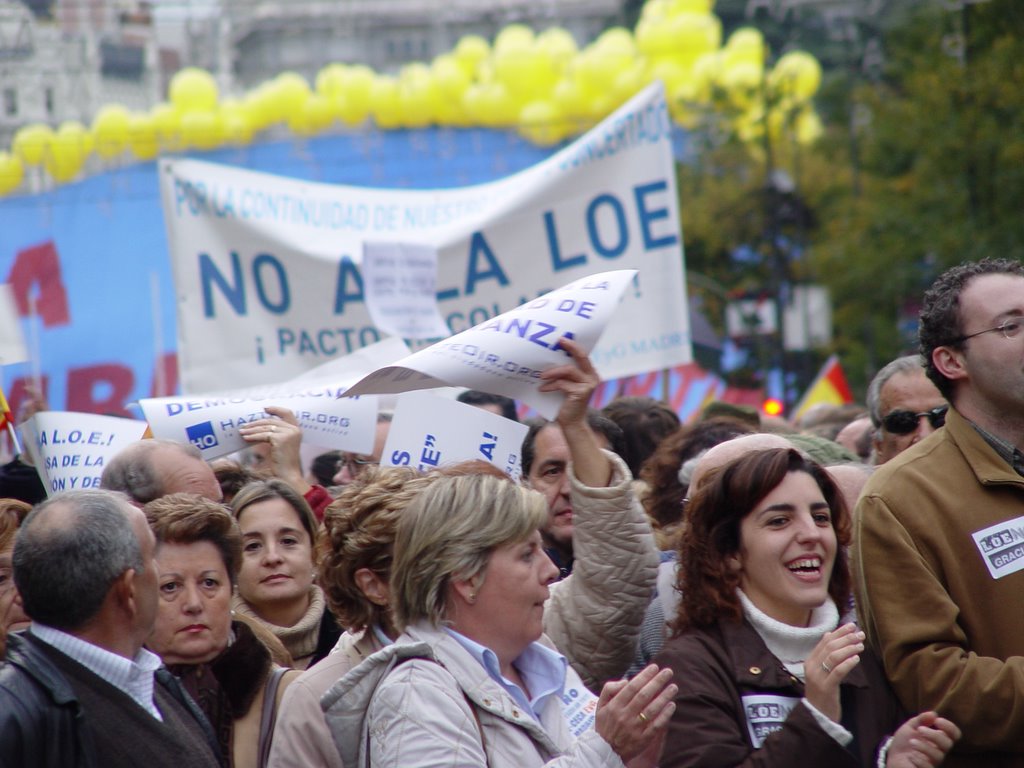
Yesterday, at the urging of the Catholic Church (THE Church here for centuries—and still hanging on) and the conservative Popular Party, between five hundred thousand and one and a half million people (depending on who did the counting) gathered at five o’clock in downtown Madrid, near Neptune’s Fountain, to march in protest, up the Paseo del Prado, to the Plaza de Independencia.

We knew this was more than a casual social gathering, if only because of the countless placards. What were all of these Spaniards protesting? The Ley Orgánica de Educación (LOE), the government’s new education law. Why were they protesting this law? We were actually covering this event for an assigned news story, so it should have been clear to us. But from the dozens of times we asked protestors why they were opposed to the LOE, we never got a coherent explanation.

The Spanish government has supported the Catholic Church forever, including paying tens of thousands of clerics to teach required religion classes in the public schools, and only after the government changed hands—from the Popular Party to the Socialists, has this cozy dependence come under public scrutiny.

So this law must be the Socialists’ way of getting religion out of the schools, right? One would think. But this legislation—a close version of which the PP itself put in place before it left office—ensures that every child who attends a public school will be guaranteed the choice to either take a religion class or not. And it stipulates that both the teachers and content of the religion classes will be determined by the Catholic Church. Best of all, the government will foot the bill.

So what’s to protest, you might ask. (If this law were on the table in the U.S., wouldn’t the religious right praising the heavens for its divine mission accomplished?) Well, it seems that in Spain, there is something about meddling with religion in public schools that just won’t do.

Or that yesterday’s event was really less protest than posture, less inspired crusade than plain old gathering. The language of politics certainly seemed to fill the air…in platitudes blared from a monstrous sound system along the route, and on signs carried by thousands upon thousands of marchers. But after attending the rallies after the terrorist attacks, this march seemed like a poorly run carnival, without enough food or stuffed animals to compensate for a lack of deeply shared public feeling.

After making its short way from the beginning to the end of its designated route, the crowd had nowhere to go, and for the better part of an hour, we were stuck together like a huge ball of rice. And although the popular music playing over the loudspeakers made things a little better, the song list seemed remarkably odd: Pink Floyd’s “Brick in the Wall” (“We don’t’ need no education…”)? R.E.M.’s “Losing My Religion”?

Trying to make the best of the situation, I kept shooting photos for the story we’d eventually have to file. But it wasn’t long before I felt like I a photographer hired for some rich child’s Saturday afternoon birthday party. The kids, talking in groups with friends and a lot of balloons, spent most of their time dancing and singing to the music, and only during the occasional moment when I, or another press photographer, would point the camera in their direction, did they begin suddenly to blow their party horns, raise their protest signs, and scream memorized chants about the horrors of the LOE. It had the drama of a puppet show (the children’s parents pulling the strings).

Participation in the democratic process is good, one of the things I’ve most admired in Spain in recent times (democracy has certainly been more genuinely operative here than it has in the U.S., for example). But this episode—an example of something the U.S. does in fact seem to have figured out (in this case, the separation of church and state)—left me a little depressed.

After a while, as the afternoon became night, the crowds melted away, heading towards the bars, cafes, and restaurants of the surrounding neighborhoods. And except for the notable fleet of water-spewing trucks and green-suited sanitation workers that materialized to clean up the mess, it seemed like any other Saturday night in Madrid. Everywhere you looked, people were eating, drinking, and talking. Everywhere you looked, Spaniards were gathering.

Thursday, November 10, 2005

Dia de la Almudena


The first clue should have been the cathedral bells that started clanging just before 10am. I went out to the street, thought to myself, "hmm, the museum isn't open yet," but figured that the guard had overslept. Went to the bakery, noticed that the shelves were full of a roscon-like pastry with little cream crosses drawn on it, and thought, "there must be a holiday coming up." But it wasn't until I got to the market and saw the big metal gates drawn across the entryway that I realized that the streets were suspiciously quiet for a Wednesday morning. Aha. The holiday was today. But what holiday was it?

Saint Isidro. Virgin of La Paloma. Constitution Day. Armed Forces Day. Assumption Day--although we're used to the regular eruption of esoteric holidays here, they still amuse us. I thought we knew them all. But no. Yesterday was Dia de la Almudena--the patron Virgin of Madrid. Of course.

So we went: Dia de la Almudena is celebrated with a huge Mass in the Plaza Mayor. Cardenal, bishops, priests, noviates, all lined up in neat rows, with nuns guarding the host back stage. The non-clerics get to dress up too: women in their tight castizo dresses, with that goofy carnation on top of their head; men in their far more elegant capes. They go to Mass, they take the Virgin out in a procession, everyone goes out for vermouth. Another successful holiday, with all the critical elements: costumes, a little religious devotion, plenty of alcohol.

Tuesday, November 08, 2005

Neighbors, Part II


Spent the weekend once again trying to track down the neighbors who own the land where our electrical posts will go. And, through gossip and actual encounters, I learned a lot in the process: that the head of the water mafia in town, whom everyone seems to hate, is not terribly well-educated: he spells "Nieves" with a "B"; that the monstrosity going up near Cesar's house was supposed to be a new home but has since been turned into an insurance office; that the father of Eduardo, the construction-company's owner, is a lawyer; that Emilio, who owns the tiny grocery in town, might be something of a political counterweight to Alfonso, owner of the tobacco shop.

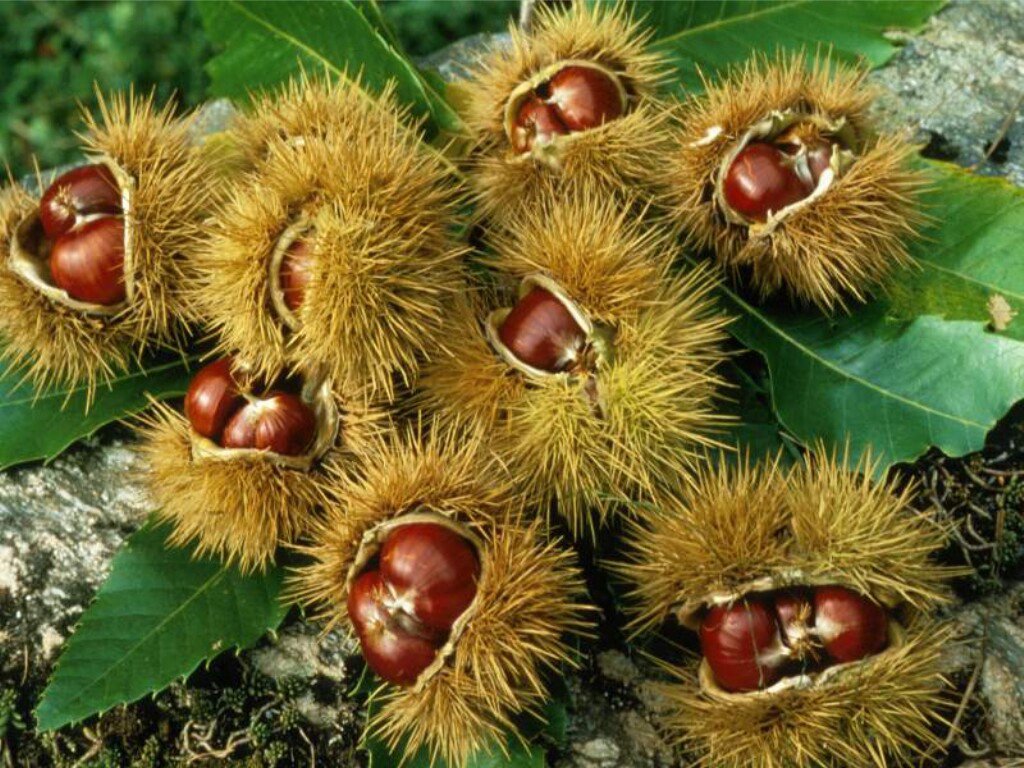
It's chestnut season in Asturias, and everywhere old men and women stand hunched on the side of the road, with sacks and baskets for collecting. And at the neighbors' houses too: wooden boxes filled with shiny chestnuts left to dry a bit in the sun. Back at the molino I collected a bowlful myself, pulling back the burrs that look like prickly golf balls to reveal the trio of nuts inside.

Friday, November 04, 2005

Staying: Asturias Airport


So I get to the airport at 4:45 for my 5:25 Iberia flight, thinking I'll just swipe my card through the automatic check in and be on my way (to Asturias). But no, the machine swallows the card, then spits it out, swallows, spits, swallows, spits, before telling me it can't read it. I try entering my passport number. "No Reservation Found". So I try another machine, to no avail. The lines at the counter are monstruous, too long for me to wait in and still make my flight. I go to an agent who is supposed to help passengers use the automatic check-in machines. I explain my plight; her response is to try the machine again. When she is satisfied that I am neither lying nor an idiot, she tells me to go stand in one of the monstrous lines. I explain that if I do that, I won't make my flight. She tells me she can't do anything else: her job is to help people with automatic check in.

I see that the lines for Business Class are much shorter, so, with about 20 minutes until my flight leaves, I choose one to stand in. When I get up to the counter, the man taps on his computer until he discovers that my ticket is coach. "This is a coach ticket," he says. I reply that I am aware of that fact, but that my flight leaves in 15 minutes, and the machine doesn't work and the lines..." He tells me he can't check me in: his job is to check in people in Business Class.

He then points me to two counters at the end of the terminal for "Last Minute" flights. There are two lines, each 3 deep with very antsy people, but there is only one agent, working very, very slowly. When I finally get up to him, he chides me for getting to the airport so late, but hands me my boarding pass. I speed off through security, pissing off a security guard and lots of other Spaniards by jumping the line. I get to the gate with about 4 minutes to spare. The agent there is talking at length to another passenger. I try to interrupt (politely, of course). She snaps at me and tells me to wait until she is done. When she finally turns to me, she has adopted the tone of voice that one would use with a very naughty, if tragically slow, child. "The plane," she says, "has already left."

She sends me to the Transit counter, where the line is, if anything, even longer than the original check-in lines. I stand there, along with a seething mass of Germans, Swedes, French, and the odd Spanish--who know better and keep trying, with more or less success, to jump the line, for about an hour. Finally, an agent takes my now-useless boarding pass and says, "let me get you a boarding pass for the next flight." I am joyous. For about 10 minutes, until it becomes clear that she is not, in fact, doing anything of the sort. After another 20 minutes or so of just standing there, another agent, newly arrived, waves me over. I hand her the same now really useless boarding pass. She types away for a bit, then tells me she can't give me a new boarding pass: her job is to give boarding passes to people who are connecting from other flights.

I go to the sales desk. The woman there, the only sympathetic person I've met in this whole ordeal, tells me she can only sell me another ticket for an additional 170 euros. But she does suggest I talk to a supervisor.

I go find the supervisor who is busily typing at a computer. I stand there for 15 minutes until she is done. I tell her the whole saga. She issues me a boarding pass for the next flight. It is, of course, delayed, meaning I get to Asturias far too late to pick up the car (which is still at the shop where I left it, shattered of window, back at the beginning of October). Which is how I came to spend the night at the Hotel Cristal, conveniently located in what is basically the Asturias Airport parking lot.

It's funny: the Spanish are so famously independent, so "viva yo," and all that. But give them meaningless bureaucracy and they'll enforce it for all they're worth. On the positive side, my Spanish really came together during my tirades.

Thursday, November 03, 2005

Staying: Barcelona


I found myself having unexpectedly to spend the night in Barcelona last week on what was apparently Catalan 99.5% Hotel Occupancy Day. After calling around to many, many places, including my favorite hotel in the city, I finally managed to secure the very last room in Barcelona at the Hotel Abba Sants. Not the sort of place I would normally go: big, ugly exterior; lots of businessmen. But it turned out to be relatively nice, modern but not too cold, with a very kind receptionist who patiently tried to come up with a phone charger for me, even though in my bleary state I kept erroneously insisting that the make of my mobile was Movistar ("Not the service, señora, the telephone").

It's located right near the Sants train station, which makes it a good place for getting in and out of town. And it's a short uphill walk away from the L'Illa Diagonal mall, which has a wonderful--I can't believe I'm saying this--food court, half inviting, gourmet-y restaurants, half food stands and cookware stalls. Fresh fish and produce, beautifully displayed, in a mall. Plus a FNAC, which, should anyone besides me be interested, sells phone chargers.